2.9.09

Chopsticks: Diner's Yield Sign

NOTE: This post had been read a lot, amazingly.  Thus, I must point out that it was clearly written from the perspective of a chopstick novice.  I've seen folks annihilate bowls of Phở with hyper-efficient scoops and slurps. In the intervening years since I wrote this, I've gotten a bit more adept with this utensil; I'm still slower than when using a fork, though.

If you didn't grow up using chopsticks at every meal, you may be just as slow at using them as I am. However, I'm realizing now that that's not such a bad thing. Anything that helps us slow down and appreciate life, in whatever way, must be a good thing (and no, that's not a Martha Stewart rip-off -- I'm simply stealing that phrase back for the rest of us!).

The clear truth is the more we hurry through life, the more we tend to miss. With chopsticks, and especially for the non-proficient operator, each and every bite is an individual process of combining ingredients (as the chef intended us to do) and then delicately but accurately delivering those items for tasting -- the best part!

How many times have you gotten that perfectly assembled mixture just millimeters from your mouth when - schlop! - the whole delicious thing plops back into your bowl or onto your plate? This is the crucial moment: If you sigh and let frustration dominant, then you've lost the battle with the noodle bowl, but if you concentrate and try again, you'll get it and all the careful picking with the chopsticks will have been a success!

Just imagine what this does for the ego of the eater; each bite that reaches the mouth is, in essence, a tiny "job well done" for the diner with its own built in reward. On the Western side, the fork is nothing short of forged, mechanical efficiency. There is nothing romantic about it and the task it helps the user to perform is completed with little grace or skill. Sure, the handhold is critical, as with the chopsticks, but even tiny toddlers can incorporate proper posture into this early expression of fine motor skills. For me, watching the same age kid handle chopsticks gracefully is a completely different, and thoroughly impressive accomplishment.



Even with the accompanying slurping and smacking, chopsticks and their efficient use help someone like me to slow down, taste and savor each bite for the world of flavors contained therein. If not for a little natural clumsiness, I might revert back to my primeval self and simply gorge without relish.

So, pass me the chopsticks, and I'll dive into the dish, even if it's only one grain of rice at a time! After all, I learned in third grade with a wonderful, patient teacher, Mrs. Fidler, and that was Cheerio by tiny Cheerio (yes, hooking through the center hole was considered cheating!).

NOTE: This post had been read a lot, amazingly.  Thus, I must point out that it was clearly written from the perspective of a chopstick novice.  I've seen folks annihilate bowls of Phở with hyper-efficient scoops and slurps. In the intervening years since I wrote this, I've gotten a bit more adept with this utensil; I'm still slower than when using a fork though.  It's always wise to slow down--just a little--and savor things.

1.9.09

Selected Podcasts

The following is a conglomeration of podcasts I've come across recently that occupy a unique auditory niche in the cyberlandscape. Check out a few and see if you relate to the content and creative delivery methods offered:

Radiolab - a fine set of science-based podcasts from WNYC that each explore a particular theory, notion, or subject such as memory, laughter, chaos, and so on.

Downtown Soulville - Mr. Fine Wine spins selected soul records (mostly 45's) for New Jersey's WFMU and he does it well - see related blog post from this summer for a direct link to WFMU.

NPR's Planet Money - some of the best explanations (in laymen's terms) of the current financial crisis -actually makes credit default swaps and mortgage backed securities comprehensible!

Daptone Jukebox - a nicely presented blog from the folks at Brooklyn's Daptone Records including excellent soul, funk and afrobeat podcasts with informative playlists, artist backstories, and more -sounds and looks slick!

31.8.09

Mr. Fine Wine spins on WFMU

Hailing from Jersey, Mr. Fine Wine puts out some of the most unique, far-reaching, deep-delving soul music playlists of anyone on the airwaves. Many of his broadcasts (on Friday nights as "Downtown Soulville") can be streamed rather easily via wfmu.org so click it and enjoy some classics mixed in with a whole bevy of rare finds.

Very fine!

21.7.09

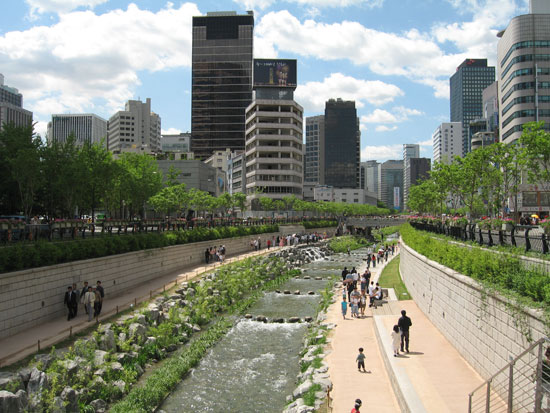
Cheonggyecheon - The Heart of Seoul's Green Rehabilitation

After learning about this ambitious project on the PBS documentary design series " e2 " I sought out some more information. The endeavor had its critics but there can be no argument: the city of Seoul is far better off for having agreed to this expensive but worthwhile renovation of an urban eyesore into a cosmopolitan, "green" jewel.

A decent overview of the Cheonggyecheon River Restoration project from Spacing Toronto will help to see all the phases from the demolition of the expressway to the finishing of the promenade that has become the heart of Seoul's social life.

Images from the Rights of Way blog show the remnants of the original elevated expressway that orginal covered the river. Ironically, the mayor who originally spearheaded the elevated highway was the very same who pushed for the rehabilitation and restoration of the Cheonggyecheon River. So, in the end, it's a good thing that some politicians, in their search for approval, end up backing projects that actually improve quality of life.

Check out this pdf. hosted by cepis.org for more images and information.

Playing For Change

By now, most people have heard of the Playing For Change project. If not, check out the video or follow the links below and discover this shrewd, philanthropic, unifying approach to appreciating the world's buskers and their product: music!

Playing For Change - Mark Johnson, Founder


Be a part of the project -- go to:

Playing For Change Foundation - Whitney Kroenke Burditt, Executive Director

16.7.09

Chiyu Chen's Hybrid Bike System

Designer Chiyu Chen has conceived of an ingenious transit system that encourages the use of sustainable transportation by crediting people for renting and riding bicycles. His Hybrid2 system consists of a fleet of rentable bicycles that are capable of generating and storing kinetic energy, which is then used to power the city’s hybrid electric buses. Simply rent a bike, charge it up with kinetic energy from pedal power, and then return it to a kiosk – the station feeds energy into the city’s smart grid, and you receive a credit towards your next bus pass!

The answer to the climate crisis is going to come in myriad forms. This transit model, centering around bikes and buses, may be part of the solution. Consider it.

Find more info on the Hybrid2 Bike Rental System at inhabitat.com

Only in New York...but why?

The recent opening of NYC's newest greenspace, the Highline Urban Park, which sits atop an abandoned, elevated rail line, is an exemplary rehabilitation of derelict industrial infrastructure and, in my opinion, represents the new standard for reuse in an urban setting. The fact that the space occupies square footage above the conventional, street-level plane is yet another reason this project is so remarkable.

The mission and its concept are reported thoroughly at the leading sustainable design site inhabitat.com, so that's the place to see the Highline Urban Park project from all the nicest angles.

For those who want it and want it now, check out the video below to give a glimpse of what cities with a more modest profile (and even small towns) should be striving for in the coming years and decades.


Just because NYC is a mecca for creativity and innovation (or maybe it's the art of hype that makes New Yorkers the real pros), it absolutely does not mean that other places, tiny and not so, shouldn't be looking to do them one better. With or without a well-known architectural firm attached to the project, this example of inventive and considerate renovation could happen anywhere, not only in New York!

Our entire nation is littered with sites (literally) such as the Highline that, amidst weeds and broken bottles, are all but crying out to be transformed into gorgeous, open green space where people can feel human again whilst the vegetation thrives.

What real, sustainable, environmentally conscious urban planning requires is an ambitious, motivated, vocal citizenry to demand thoughtful progress, not in terms of economics or profit, but simply in terms of quality of life.

14.7.09

The Smell of Dish Soap in the Morning

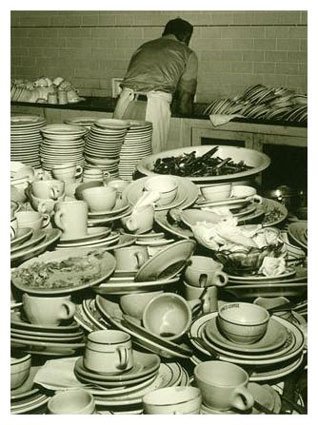
When I lived in Washington, D.C. for a time with my brother, sister-in-law and then 2 & 1/2 year-old niece, I learned that the commonly regarded task of dishwashing could be a pleasure unto itself. This quiet revelation on work in general gave me insight that I've since tried to apply to all manner of tasks. And why not relish these menial, day-to-day actions; however unromantic it may seem, cumulatively they amount to the whole of modern life.

In ancient times, the reality of a task-based life was amplified all the more, and as such, one can regard monasteries, convents, priories, temples and the like as the blueprints for today's rejuvenating Yuppie-centered spas and retreats. The fundamental difference lies in the work itself; the modern spa culture promotes rest and glorifies the absence of work, whereas communities of old cherished the daily work that kept them running while incidentally nourishing their members' spiritual, physical, and mental well-being. The monks had it right as they kneaded the bread, broke clods in the fields, tended the vegetables, and combed their hairshirts. When no temptation glistens provacatively beyond the light of a day's work, then the work of the day becomes life and within that work sits the key to contentment.

So, Anna would tell me, as I tried to lend a hand after supper time, "No. Just leave it in the sink and I'll get to them in the morning." To my naturally obsessive side, this seemed contradicatory. Why not rest well knowing the kitchen downstairs sits spotless and ready for another busy morning? She explained that the task of dishwashing possessed some quiet joy, the warm water and airy foam, the repetitive motion of scrubbing, the cool and flowing rinse, that she relished as a way to awaken to the day. And it made sense but only after I started to be mindful of the secret profundity of the activity.

Yes, it is strange to talk about the act of cleaning bits of food residue or burnt, charred flecks of what was, just the evening prior, a phenomenal homemade meal, as something almost sacred and valuable as a daily practice by itself.


Note: The title was either that or "Zen and The Art of Dishwashing" but after a quick google search, I found a blogpost on some site that was actually proud to call itself "Redneck ..." something-or-other and so I'd rather the none-too-subtle allusion be to the classic, mystifying film set in wartime Viet Nam.

13.7.09

Jazz: Faces of International Pride amidst Domestic Pain

A recent article in the Christian Science Monitor does an excellent job describing a very unique situation in United States' history related to domestic equal rights and our international image. Read for yourself and see if this dichotomy is, for you, as striking and thought-provoking as it was for me.

The following rhetorical questions are emblematic of the article's general tone which describes the State Department's employment of African-American jazz musicians for government sponsored tours across what was then the Soviet Union and various African and Middle Eastern regions:

What was it like for these black musicians to headline celebratory concerts for newly decolonized African nations on the one hand, but still not be able to stay in hotels south of the Mason-Dixon line back home? What was it like to travel under the auspices of a country known abroad for, as saxophonist Paul Jeffrey was told in Italy, white men being the boss of black men?
(By Carla Murphy Contributor to The Christian Science Monitor
from the July 10, 2009 edition
)


So, just as these musicians where escorted around the world to serve as an egalitarian, collective and creative face for the nation at large, the same talented and renowned citizens, because of their heritage and complexion, would have been discriminated against without a second thought in their own home country. Even with a fundamentally sound mission, the State Dept. tours were, at heart, hypocritical public relations campaigns designed to globally promote an American ideal that had hardly begun to gain momentum at home, regardless of the known fact that equality and inalienable rights had been and still are our constitutional guarantees.

Find out more about the traveling exhibition of photographs, called Jam Session: America's Jazz Ambassadors Embrace the World, that documents this fascinating international tour by some of the greatest jazz musicians of all time.

9.7.09

Ghanian Prints

Everyone always remarks upon spotting a brightly colored, finely woven garment: women of Indian descent in their flowing saris, Afghanistan's strictly sheathed mothers and daughters in their vibrant, pale blue, crocheted finery, and the eye-popping central African fabrics fashioned into dresses, skirts, and head scarves.

At Afropop Worldwide's page regarding President Obama's visit to Ghana, I learned that the colors found in that country's traditional fabrics each have special significance.

"Each color in the fabric has meaning, so we recommend some gold for royalty, green for a good harvest, pink and purple for a feminine touch, and blue for peace."

(by Danny Silva and Kwaku Boafo for www.afropop.org )

Below is a fine example of Ewe kente cloth:


Read up on the history of kente and even design your own over at the Smithsonian National Museum of African Art: africa.si.edu

8.7.09

Call it what it is!

It's to change the name around here yet again. This last title -- esse quam videri -- was a somewhat psychological attempt to get myself writing with better direction and some passion.

Now that things are orientated properly, I'd like to change the name this time to -- per volar su nata -- which is the Latin (or maybe Italian) for "to fly upwards" or "born to soar". Again, it's a way for me to keep momentum every time I visit the blog and to keep an eye on the main goal which is to improve the content herein with every post.

I hope you're enjoying this space and if you are, let me know by posting a comment. I'd love to hear what your thinking about what you see and read here, so thanks in advance.

30.6.09

To Shed Light...

In my opinion, a good idea deserves to be spread around.

A group of three designers, jointly know as the Civil Twilight Collective , has recently been recognized on NPR.org as the winner of Metropolis Magazine’s Next Generation Design Competition for an innovative adaptation to conventional streetlighting. The lunar-resonant streetlight intelligently adjusts brightness in correspondence with the phases of the moon and in doing so would stand to save significant amounts of energy, energy that currently dissipates into the night illuminating very little that the moon (in its brighter phases) is not already.

The inspiration for such a creative approach to outdoor, public lighting is little more than common sense, but by the same token, if it's such an obvious idea, then why had no one thought of it previously? The point may be that by adopting an ecologically "smart" system such as lunar-resonant streetlights , no corporation, no entities besides the manufacturer and
the designers stand to gain anything from its implementation.


This is where the currently snowballing shift from antiquated, greed-driven, profit-making ventures to sustainable, earth and human-friendly, social business models amasses some serious speed. With no material "wants" to calculate on behalf of its creators, lunar-resonant streetlights (like most socially beneficial inventions) simply cover the needs of their beneficiaries which is to brighten the night while conserving energy resources and also perceptibly reducing light pollution in urban centers.


Other intriguing projects by the Civil Twilight Collective:

Origami Kayak
Mycofarmhouse

29.6.09

A National Face

I absolutely love it when journalists, talking heads, public commentators and like decide to generalize on the so-called "core values" of a particular nation. These blanket statements almost always come across as sweeping stereotypes yielding only the tiniest indication of the nation or its citizens' identities. A beneficial practice for the youth of any country might be to make an acquaintance, better yet a friend, from a country other than one's own so as to instill, from an early age, a sense that even though a group may gather under a common, national umbrella, those in its shadow rarely possess more than just a few similar traits.


The best of these generalizations are quite detailed and as such have already narrowed their scope; the resulting idea is conveyed successfully. For example, in the Christian Science Monitor today (29.06.2009) the author James Miller states, "One of the core principles of traditional Chinese culture is that of harmony between humans and nature." If delivered by a news anchor or commentator, surely this statement would be reduced for shorter attention spans and might come out as something like, "The Chinese people believe in harmony between humans and nature." The latter comment is far less truthful than the former and this is the tendency of most media voices today; the goal is to get the point across while including the fewest details necessary.


This makes for a portrayal of the world, its people and its dynamics, that is two-dimensional at best and at worst, a gross misrepresentation of reality. As it is, the world is a full of tonalities of truth, varying from the purest of positive events and actions to the most heinous of malicious occurrences. To dissect our lives and our environment with such a cleaver, one that slices only black and white hunks of generalization, is the great disservice that corner-cutters on the boob tube provide us.


It's true; one could rightfully question: "What do you expect? It's free." However, the dangerous cost of this type of distilled dissemination of facts is our narrowed perspective which inevitably leads to misunderstanding and intolerance of others.

Most often, I balk at the notion that, "Americans are..." something or some way across the board. These stereotypes hardly apply to me or anyone I know. And this is not to say that I'm so unique that nobody can pin me to a category. I'm plenty normal, but the deeper fact is that no nation's face, even of the most ethnically homogeneous culture, can be sufficiently described by the use of just a few adjectives or the bandying about of blindly adopted stereotypes.

9.6.09

Green Sky Above

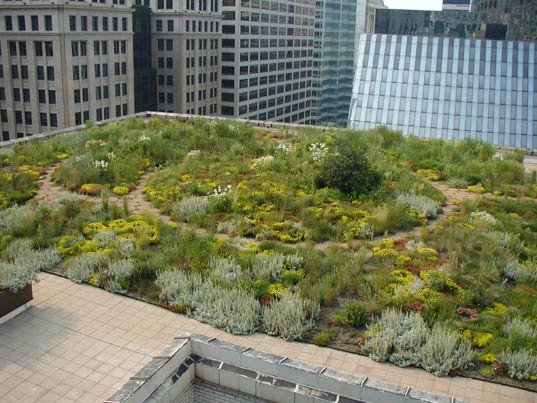
If green roofs are good enough for rural Norwegians and Dubai's business men, then why not us?


Green Roofs Australia reports that New York City is the fastest growing area for incorporating green roofs into new and existing structures, most of which are on commercial buildings. The potential for positive environmental impact with these relatively simple green roofing/walling systems is, at this stage, beyond measurement. For these eco-friendly, and human-friendly, steps to take hold, the effort must be a concerted one, though, or the true benefits might only extend to those within view of the new verdant rooftops.

At left is the William McDonough-designed visitor center at the Bernheim Arboretum & Research Forest outside Louisville, KY with its green roof of native species  -- a lucky pitstop this summer on a trip back down South!


If a public relations campaign can garner enough interest and support from both the corporate and government side, soon enough those antiquated folks with shingles, tar paper, cedar shake and tin above their heads will begin to feel significantly out-of-style. Perhaps keeping up with the Jones's will be the key to making skylines greener nationwide with the beneficial results trickling down to us all, after the sedum(s) on the roof get their drink, of course.

That's the idea and the effect is gorgeous, in many ways, depending on the sophistication of the design. The commercial applications seem long overdue.