If you're listening to the news, it's hard to disagree with the sentiment found in Chinua Achebe's title for his 1958 masterpiece "Things Fall Apart". While all is in flux half a world away, in our own backyard musician and composer Brian Smith has been busy bringing worlds together with the premiere of his latest musical suite titled "Daedalus".
On Saturday, March 19th at 7pm and again on Sunday, March 20th at 3pm, Canopy Studio at the Chase Warehouses in Athens, GA will host a remarkable union of original music and gorgeous aerial artistry, joined under the vision of composer Brian Smith with his troupe of talented musicians (including wife-flutist-trapeze artist, Natalie Smith, members of Georgia Guitar Quartet, Odd Trio, Maps and Transit) and aerialists performing on trapeze, silks, hoops, even bellydancing!
Brian was kind enough to discuss "Daedalus", his inspirations and his process, in a recent interview:
AT: What was the inspiration for this particular suite of compositions? I know that the Greek myth is the central theme, but is there any other driving force or catalyst that led you to create this work? Does it help push you that not many people are doing this kind of avant-garde, chamber music performance in the indie-rock dominated landscape of Athens, GA? You're part of an impressive network of very talented musicians, and it's got to be exhilirating to join forces in this way.
BSmith: The inspiration for this work came about at the last Canopy show actually. Julie [Phillips] was performing a silks piece to a duet that I wrote for Natalie [Smith] and myself and the silks looked like wings and there was a big drop in the piece. It made me think of Icarus and I thought it would be neat to write a piece for Julie to perform based on Icarus. When rereading the Icarus story, however, I noticed that I felt more of a connection to Daedalus rather than Icarus. I really felt the tragedy of a father losing his child now that I’m a father as well. Also, Daedalus appears in so many other well known Greek myths and in most cases is the catalyst, so I thought it would be interesting to follow his story.
Here in Athens, there are so many great musicians doing so many great things, I feel like a drop in the bucket. I think everyone here pushes the envelope and blurs the lines of style and concept. It’s very inspiring to be immersed within such a place. As a composer, I feel like I just have to do what I do and hope someone likes it.
It’s absolutely exhilirating. I feel so lucky to be able to work with so many amazing musicians and aerialists and dancers and it’s even better to know that they are all good friends. It’s nice to have a reason to get all these folks together in one place. I like to think that I’m just creating a platform for all of these great artists to shine and have a good time making music.
AT: In previous discussions, you've mentioned mathematics and number theory -- like the Fibonacci Sequence that describes nature's spirals as in a sunflower -- as those relate to music. How do you use number theory to inspire your pieces, and are there particular rhythmic patterns that the audience can listen out for during the upcoming performances of "Daedalus" ?
BSmith: Absolutely. Over the past few years I’ve been developing my writing style using what I call “numerical symbology”. I got the idea from Carl Jung’s and Joseph Campbell’s idea of the collective unconscious, wherein universal archetypes are similarly expressed throughout human culture worldwide. Joseph Campbell discusses the idea of archetypes within world mythology characters and symbols. I think people have the same universal symbolic perception and experience about numbers, their shape, sound and meaning. I have tried to craft the pieces using some basic number symbols as well as more deeply hidden symbols for those who care to study the score more closely. I also think that there are certain musical mathematical symbols expressed in pitch, harmony and rhythm. Whether someone considers themselves “musical” or not does not matter in terms of their perception of these symbols. It is the people’s like or dislike of the music itself that illustrates the symbol’s success. With this work, I tried to pull many cords within people’s psyche. We’ll see if it come across.
AT: The Cretan labyrinth is part of the story of Daedelus. Is there any purposeful misdirection in the work, at all? Do you want the listener to feel a sense of confusion at any point on the way to a deeper resolution, that epiphany moment when the puzzle is solved?
BSmith: I found the labyrinth story of Daedalus to be the big connector of the entire story. In this work, the piece “Labyrinth” is the big connector of the work as a whole. The piece is subtitled “Puzzle Piece” and the piece itself is a big puzzle. If someone studies the score, the piece can be solved. I created 3 “tries”, basically 3 different scores, that help in solving the puzzle.
For the listener, there are big chunks missing in the piece and recognizable melodies arise that help determine the solution. The epiphany moments will perhaps come after the concert is over. All the pieces of the work draw from the “Labyrinth” and all the pieces lead to the “Labyrinth” in some way. It’s a cornerstone.
AT: Based on some of the main character's actions, I'm not sure he's such a friendly mythic hero. Are there certain melodic devices or key signatures that you prefer to use to depict that feeling of fleeting malice or impropriety? Not a nice Uncle, really!
BSmith: Actually, I felt like Daedalus was a sort of tragic hero, a very human figure. He’s also one of those characters that really undergoes a change over the course of his life and suffers greatly for the folly of his younger days. I think he really tries to do the right thing for the most part, but due to his past transgression with Perdix, he always seems to end up in tragic situations. But, he also helps a lot of people on the way, stands up against the wicked rule of King Minos, is respected at his craft and is well taken care of by the generosity of others. Overall, he’s quite a balanced figure symbolically. I use octaves to represent Daedalus as well as the key of b-flat. All the characters have their own musical gestures, pitches, intervals and keys. (i.e. - Icarus is chromatic falling gestures, the notes f and f#, 9ths and the key of F) As a dad, I think Daedalus does what he has to do in the given situation. Well aware of the risks, but without many options. Fatalistic, I guess.
AT: I realize that composition and arranging are arduous processes; are there modern tools that make the job a little less painstaking, or is it still a lot of sharpening the quill, mending holes in the parchment, cleaning up spilled ink and managing frustration, fending off mental illness? I know you know the image I'm drawing from: Amadeus, the scene with the cue ball on the billiards table, repetitvely banking off the cushions and back into Mozart's hand as he fervently scratches away at a masterpiece.
BSmith: Ha! Well, for me personally, I fret and stew and tweek and change pieces a lot before they get printed and I’m usually still making changes at rehearsals. I spend a lot of time in my head going over and over things. Probably get a little too obsessive at times. By the time I get to the computer, things move pretty fast. I like the speed of entering the music on the computer and I like not having to use a pencil or pen to make everything look pretty. I have poor penmanship and it hurts my hand to have to be that meticulous. I think all musicians stew over their work and are probably never completely satisfied. I think you just try to make each piece you write the best that it can be and when it’s time to let it go you have to let it go, warts and all.
Thanks to the composer for the insights that will make the experience of "Daedalus, a work by Brian Smith" all the richer. For more details about the two shows on March 19th and 20th at Canopy Studio, follow links below:
The MusicSmiths
Canopy Studio
Georgia Guitar Quartet
Showing posts with label work. Show all posts
16.3.11
15.2.11
Kyle Dawkins (of Maps and Transit) Speaks!
According to the Maps and Transit site, "Kyle Dawkins has released two solo recordings under his own name, Conasauga (2002) and Walls became the world.(2004) and is a member of acclaimed chamber ensemble The Georgia Guitar Quartet. He lives and works in Athens, Georgia."
Collaborator and wife Julie Phillips is "a trapeze and aerial silks instructor at Canopy Studio and is a member of their acclaimed repertory company. She is also a bassist, percussionist, and writer."
The following is an email interview with Kyle Dawkins conducted in late 2010 after the release of the Maps and Transit project Songs for Divining in September, 2010.
AT: The instrumentation on the album is so unique and was dubbed "folktronica" at some point. How much of the sound is guided by the instruments themselves, or is it the sound in your mind's ear (so to speak) that dictates those choices? Can you recall any "happy accidents" as far as combining instruments to achieve a brand new quality of sound? Which instruments might be on your "dream list" regardless of cost -- is there a sound you're chasing that you could harness with a little help from Bill Gates?
KD: Many of the "happy accidents" happened as a result of the unpredictability of the stringed instruments that I was using. I've got some old mandolins and other stuff that have these really idiosyncratic, messed-up tones as a result of warped necks, frets, etc. I thought it gave the songs a sort of creaky, homemade feel. I love the sound of really antiquated or broken-down acoustic instruments. You can get sounds out them that you couldn't get otherwise if it was a new instrument off the shelf somewhere. Lately, I've been really into mellotrons. I love the often out-of-tune, fluctuating tape loops and it's spooky sort of canned sound. I used a bunch of "virtual" mellotrons from different sound applications on my computer but it's really hard to approximate the sound of a real one which I've yet to even try out. So yeah, I'd like a mellotron from Santa or Bill Gates.
AT: I'm sure this varies greatly, but how long does it take you to create a song in this way, with all the layers and pieces? Also, do you give express consideration, as you work out a new track, to how it might be performed live?
KD: I'll usually write the songs and then Julie and I will listen to it and figure out ways to juggle the parts using a combination of samplers. Usually the parts that would be interesting to see played live are the ones we rehearse and the more textural sounds we farm in using the samplers. The sampler parts are usually the ones that are more computer-based and aren't necessarily playable on guitars or mandolins or whatever. Usually a song will take me a day or two to write and a couple more days of Julie and I rehearsing and listening. Some songs seem to take forever though for whatever reason. Lately, we've been in the process of planning more collaborative song writing processes where we build the songs up as a duo instead of a composition that was written on a computer and figured out later as a band performance.
AT: Besides Applachia, which other regions of the world seem to contribute to these compositions. Is the Celtic tradition something you look to or particularly enjoy outside of writing and performing?
KD: I sometimes draw a lot from Asian and mid-Eastern folk instruments and melodies, some Sufi, and Indonesian music too. The Celtic influence is there mostly as a point of reference for certain melodies.
AT: You both are into fine art and design (and you've collaborated with painter Chris Wyrick in the past), so if you were to assign a color scheme to this album, what would it be? To put it another way, what is the "look" of your sound?
KD: I wanted some parts of the album to have a murky, underwater, brambles-and-vines-everywhere kind of texture combined with the feeling of hearing music from the inside of a dusty music box. Those aren't colors exactly but they're places. I don't usually get a sense of color when I'm writing music as much as a sense of texture or place.
AT: As I listen to your album, I see so many images in my mind, and I know that response is individual to the listener. Have you ever been approached by filmakers who want to use your music as a soundtrack to a "talkie" ?
KD: I haven't done any soundtracks but it's something I've always wanted to do. Filmmaker anyone? Email me at kyledawkins75@gmail.com
The Canopy Studio performance will feature aerial artistry on trapeze and silks with accompanying compositions by Brian Smith (Georgia Guitar Quartet) with Dawkins on guitar, among many other talented musicians. It's bound to be an enchanting, memorable event that shouldn't be missed. If you can be in Athens, GA, score some tickets!
Collaborator and wife Julie Phillips is "a trapeze and aerial silks instructor at Canopy Studio and is a member of their acclaimed repertory company. She is also a bassist, percussionist, and writer."
The following is an email interview with Kyle Dawkins conducted in late 2010 after the release of the Maps and Transit project Songs for Divining in September, 2010.
AT: The instrumentation on the album is so unique and was dubbed "folktronica" at some point. How much of the sound is guided by the instruments themselves, or is it the sound in your mind's ear (so to speak) that dictates those choices? Can you recall any "happy accidents" as far as combining instruments to achieve a brand new quality of sound? Which instruments might be on your "dream list" regardless of cost -- is there a sound you're chasing that you could harness with a little help from Bill Gates?
KD: Many of the "happy accidents" happened as a result of the unpredictability of the stringed instruments that I was using. I've got some old mandolins and other stuff that have these really idiosyncratic, messed-up tones as a result of warped necks, frets, etc. I thought it gave the songs a sort of creaky, homemade feel. I love the sound of really antiquated or broken-down acoustic instruments. You can get sounds out them that you couldn't get otherwise if it was a new instrument off the shelf somewhere. Lately, I've been really into mellotrons. I love the often out-of-tune, fluctuating tape loops and it's spooky sort of canned sound. I used a bunch of "virtual" mellotrons from different sound applications on my computer but it's really hard to approximate the sound of a real one which I've yet to even try out. So yeah, I'd like a mellotron from Santa or Bill Gates.
AT: I'm sure this varies greatly, but how long does it take you to create a song in this way, with all the layers and pieces? Also, do you give express consideration, as you work out a new track, to how it might be performed live?
KD: I'll usually write the songs and then Julie and I will listen to it and figure out ways to juggle the parts using a combination of samplers. Usually the parts that would be interesting to see played live are the ones we rehearse and the more textural sounds we farm in using the samplers. The sampler parts are usually the ones that are more computer-based and aren't necessarily playable on guitars or mandolins or whatever. Usually a song will take me a day or two to write and a couple more days of Julie and I rehearsing and listening. Some songs seem to take forever though for whatever reason. Lately, we've been in the process of planning more collaborative song writing processes where we build the songs up as a duo instead of a composition that was written on a computer and figured out later as a band performance.
AT: Besides Applachia, which other regions of the world seem to contribute to these compositions. Is the Celtic tradition something you look to or particularly enjoy outside of writing and performing?
KD: I sometimes draw a lot from Asian and mid-Eastern folk instruments and melodies, some Sufi, and Indonesian music too. The Celtic influence is there mostly as a point of reference for certain melodies.
AT: You both are into fine art and design (and you've collaborated with painter Chris Wyrick in the past), so if you were to assign a color scheme to this album, what would it be? To put it another way, what is the "look" of your sound?
KD: I wanted some parts of the album to have a murky, underwater, brambles-and-vines-everywhere kind of texture combined with the feeling of hearing music from the inside of a dusty music box. Those aren't colors exactly but they're places. I don't usually get a sense of color when I'm writing music as much as a sense of texture or place.
AT: As I listen to your album, I see so many images in my mind, and I know that response is individual to the listener. Have you ever been approached by filmakers who want to use your music as a soundtrack to a "talkie" ?
KD: I haven't done any soundtracks but it's something I've always wanted to do. Filmmaker anyone? Email me at kyledawkins75@gmail.com
Image by Bob Brussack courtesy of Athensview.com
AT: Along those same lines, it would be amazing to see some of your aerial artistry set to this music (and I have live at Canopy Studios!). Have you considered making a music video incorporating your other artistic endeavours?
KD: We've been in conversation about doing something like this with different people around town so yeah, hopefully something will be in the cards soon.
Songs for Divining ~ listen and download
Maps and Transit on Myspace ~ listen and enjoy
* Take note of an upcoming event featuring Julie Phillips' aerial work and Kyle Dawkins' guitar:
KD: We've been in conversation about doing something like this with different people around town so yeah, hopefully something will be in the cards soon.
Songs for Divining ~ listen and download
Maps and Transit on Myspace ~ listen and enjoy
* Take note of an upcoming event featuring Julie Phillips' aerial work and Kyle Dawkins' guitar:
Two shows plus an open house prior:Saturday, March 19th @ 7:00 &Sunday, March 20th @ 2:00Sunday, March 6th @ 4 - 6 pm Canopy Studio open house
8.2.10
Dan Nettles (of Kenosha Kid) Speaks
image courtesy of nowtrecords.org
Treat yourself to a truly revelatory cinematic experience and catch the Robert Osborne Film Festival's screening of Steamboat Bill Jr. with Kenosha Kid providing the live soundtrack.
Saturday, 4:00 PM The Classic Center, Athens, GA
Buster Keaton's Steamboat Bill Jr. (Silent Film - 1928) with a special live music accompaniment by Kenosha Kid
As it turns out, Dan Nettles does an equally fine job expressing himself and his vision with words as he does with his guitar in his ensemble Kenosha Kid. Check out the Q & A below, and enjoy the Steamboat Bill video to get an audio-visual sense of the group's style:
a.f.c.tank : Another Georgian, the iconic James Brown, was famous for his band leading techniques, with all the kicks, and stomps cueing the band to "hit it" or "quit it". So, when you direct other musicians in an ensemble, do you use your guitar neck like the conductor's baton or is the unity between instruments achieved mainly through the rehearsal process?
Dan Nettles : it all comes from playing together and learning to read one another. of course, that can be quite difficult in the dark during a movie for instance, but over time we get a pretty good idea of where each of us is headed musically speaking. after all, in bands that have a great "band sound", the music is all about a unique vocabulary that only that band speaks. i also have the incredible fortune to play with musicians who have impeccable instincts. there ARE two important body cues that get used a lot... one we all use is the "end of solo face" (meeting the eyes of bandmates, bugging them slightly, sticking out tongue, things like that), and the other is called "the foot" (when i wave a foot in the air, on the next big downbeat we move on).
a.f.c.t. : Is there an influence who you consciously have to keep yourself from emulating or do you find that kind of "quoting" a way of paying homage to forebearers?
Nettles : over the past ten years or so, i just try to keep the creative juices flowing. if something sounds good to me, i run with it as far as i can. i rarely worry if it "sounds too much like.." or "i need to make it sound different from..." simply because EVERYTHING has been played before, and probably better than i can do it. the few exceptions might be that during the writing process i may tweak the compositionin a particular direction, but usually i try to hold off from any over-editing until the thought is complete.
as far as homage to forebearers, what have they ever done for me?? haha, i joke... BUT in a way all the music we play is a nod to the great music gods out there, who are surely listening. if only they could also pay the band...
a.f.c.t. : Describe your sense of time during the act of composing / rehearsing / performing? Is there a kind of time warp when you find that zone?
Nettles : composing: time stretching can occur, usually in correlation to how much fun i am having. it definitely re-wires my brain, and after 4 or 5 hours writing it is difficult to re-enter the real world and converse with people sometimes. my vices of coffee and cigarettes also ensure that ever couple hours i step back and reflect.
rehearsing: any rehearsal is too long!
a.f.c.t. : Do you feel like jazz is becoming more or less accesible to the audience or is it veering more toward the esoteric side with time / key signatures that are just too tough for the average listener to grasp? Is it easier to set off composing a new work when you have a specific public in mind?
Nettles : ever since bebop, jazz seems to have remained a fringe art form. content like rhythmic or harmonic density seem to be a factor... most listeners just don't like (or never got a chance to like because they never get to hear it) complicated music. just look at all the crappy, content-free, smooth jazz record sales! on the other hand, the music should be fun, and full of life, and not complicated for its own sake. again and again, if you go to a fusion show, or a prog-rock show, or a "guitar god" show, the audience is made up of guys with their arms crossed "assessing the technique/gear" and their bored-to-hell girlfriends. it can become adolescent, boring and athletic... none of the reasons i got into making music! another thought: jazz very often becomes the victim of its own traditions, dogma, or history. jazz "went to school" after it left the clubs, and that set up the performers and audiences with a whole list of expectations that miles or coltrane would probably find quite amusing.
hmmm... usually my starting point is more involved with "who is playing" over "who is listening". i absolutely must write music that the band likes to play! if they didn't, who in their right mind would put up with all the BS that comes along with it? plus, an audience ALWAYS can tell when the band is enjoying what they are doing. they may never know what's going on, but they always respond to us when we are really giving all we can to the music.
a.f.c.t. : Is there a favorite lick that you tend to use frequently or it is always fresh and different every time? That has to be a challenge when you're playing out all the time, having to reinvent your vocabulary again and again.
Nettles : new vocabulary comes in and out, and also there're the moments of true improvising when i get to work completely in the moment. i also rely a lot on my bandmates to "feed me" with unexpected material to work off of. some nights might be a great show where i just basically played my parts right and let the band go crazy, or vice versa. it's all agive and take, and i don't mind using words... sentences... stories...that i've used before to say something meaningful. and hell, it's always a new day, and we are all different people than we were yesterday.
a.f.c.t. : Most nights you've got some pretty tight curls going on up there under your headband. Who gave you your notoriously kinky locks?
Nettles : haha! laziness. for a period of time i just stopped thinking about getting a haircut. it got too long to see, and i just tied it up, and it's been that way for a while now... who knows, maybe i will get ashampoo sponsorship?
Thanks go to Dan for his gracious participation and for keeping jazz alive in Athens, GA! Kenosha Kid's official site gives the feeling that Dan Nettles and his crew are up to plenty besides inventing soundtracks to classic silent films, so head over and have a look and a listen!
14.7.09
The Smell of Dish Soap in the Morning
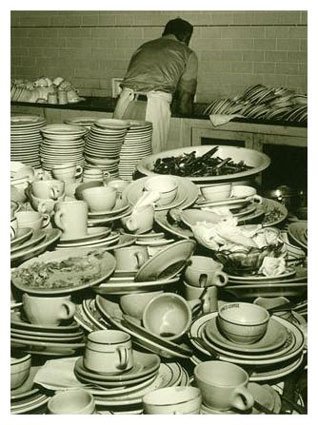
When I lived in Washington, D.C. for a time with my brother, sister-in-law and then 2 & 1/2 year-old niece, I learned that the commonly regarded task of dishwashing could be a pleasure unto itself. This quiet revelation on work in general gave me insight that I've since tried to apply to all manner of tasks. And why not relish these menial, day-to-day actions; however unromantic it may seem, cumulatively they amount to the whole of modern life.
So, Anna would tell me, as I tried to lend a hand after supper time, "No. Just leave it in the sink and I'll get to them in the morning." To my naturally obsessive side, this seemed contradicatory. Why not rest well knowing the kitchen downstairs sits spotless and ready for another busy morning? She explained that the task of dishwashing possessed some quiet joy, the warm water and airy foam, the repetitive motion of scrubbing, the cool and flowing rinse, that she relished as a way to awaken to the day. And it made sense but only after I started to be mindful of the secret profundity of the activity.
In ancient times, the reality of a task-based life was amplified all the more, and as such, one can regard monasteries, convents, priories, temples and the like as the blueprints for today's rejuvenating Yuppie-centered spas and retreats. The fundamental difference lies in the work itself; the modern spa culture promotes rest and glorifies the absence of work, whereas communities of old cherished the daily work that kept them running while incidentally nourishing their members' spiritual, physical, and mental well-being. The monks had it right as they kneaded the bread, broke clods in the fields, tended the vegetables, and combed their hairshirts. When no temptation glistens provacatively beyond the light of a day's work, then the work of the day becomes life and within that work sits the key to contentment.
So, Anna would tell me, as I tried to lend a hand after supper time, "No. Just leave it in the sink and I'll get to them in the morning." To my naturally obsessive side, this seemed contradicatory. Why not rest well knowing the kitchen downstairs sits spotless and ready for another busy morning? She explained that the task of dishwashing possessed some quiet joy, the warm water and airy foam, the repetitive motion of scrubbing, the cool and flowing rinse, that she relished as a way to awaken to the day. And it made sense but only after I started to be mindful of the secret profundity of the activity.Yes, it is strange to talk about the act of cleaning bits of food residue or burnt, charred flecks of what was, just the evening prior, a phenomenal homemade meal, as something almost sacred and valuable as a daily practice by itself.
Note: The title was either that or "Zen and The Art of Dishwashing" but after a quick google search, I found a blogpost on some site that was actually proud to call itself "Redneck ..." something-or-other and so I'd rather the none-too-subtle allusion be to the classic, mystifying film set in wartime Viet Nam.
Subscribe to:
Posts (Atom)