While the reasoning behind choosing the blog name 'vade mecum' was decent, it turns out that I only fixated on one part of the phrase's meaning. In truth, 'vade mecum' refers to an indispensable "handbook" (something of value and wisdom) that one takes along on every jaunt. Although I'd love to say that this is indeed that, I can't lie; while entertaining, nothing here is truly indispensable, so I'm moving on to the next title.
This time around I've honed in on 'mutatis mutandis'. No, it's not about any kind of District 9 style alien colonization. Mainly, the new title reminds me that thus far I've taken various tacks in this cloudspace and that I should continue to branch out. I'll be including more music clips, interviews, and remembrances, but I'm also not throwing out the bathwater yet, so to speak.
Thanks for checking in and looking about!
29.3.10


27.3.10
Thanks to Stuart Udall
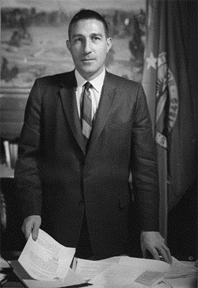 photo credit: historycentral.com
Thanks to Ken Burns and PBS, I'd heard of Stuart Udall before he died recently at the age of 90. In career terms, Udall was the forward-looking conservationist who served as Secretary of the Interior under Presidents Kennedy and Johnson. Under his tenure, our nation expanded a mandate of stewardship for our natural surroundings that began with John Muir and Theodore Roosevelt. This excerpt from the New York Times article by Keith Schneider and Cornelia Dean illustrates his legacy:
Few corners of the nation escaped Mr. Udall’s touch. As interior secretary in the Kennedy and Johnson administrations, he presided over the acquisition of 3.85 million acres of new holdings, including 4 national parks — Canyonlands in Utah, Redwood in California, North Cascades in Washington State and Guadalupe Mountains in Texas — 6 national monuments, 9 national recreation areas, 20 historic sites, 50 wildlife refuges and 8 national eashores. He also had an interest in preserving historic sites, and helped saved Carnegie Hall from destruction.Having visited certain of these treasured lands, I feel a direct debt of gratitude to Udall and his compatriots who recognized that his generation (as does ours today) held the power to preserve this continent's natural history for forthcoming Americans even in the face of strident opposition.
His descriptions of the Guadalupe Mountains hit home for me and helped to conjure up memories of days and nights spent at the foot of that great, monolithic ship's prow in Texas: the feel of the cool air, the sound of crunching footsteps as they echoed up canyon walls, and the magic of the life-giving streams trickling down the valley. Stuart Udall saw the grand value of these now heralded places before most others, and we should consider ourselves lucky that he did.
"Plans to protect air and water, wilderness and wildlife are in fact plans to protect man." - Stuart Udall
19.2.10
Throw Down Your Heart | Bela Fleck
 Bela Fleck's enthralling documentary film retraces the
 evolution of the banjo from its roots in Africa. When I saw the film, I knew I had to write about it if only to alert all my many banjo playing friends out there (the number keeps growing!).
As it turns out, Marc Gabriel Amigone at the Afrobeat Blog has already done a fine review, so I'll just let you get it from there. Self-dubbed 'Afro Marc' has an excellent thing going, and his spot seems to be the place to get your finger on the pulse of Afrobeat music's history and its recent resurgence.
Here's a little taste of what makes Throw Down Your Heart so special (Fleck meets Anania Ngoliga in Tanzania, finding the first in a string of musical soulmates):
16.2.10
Fluxus via Beck
Sometimes it's surprising how a random search, a click, a series of intriguing words can lead to an unexpected place. This is what led me to discover the Fluxus Movement, oddly enough, by way of recording artist Beck.
I've always been a Beck fan (saw him live once in Vegas) and decided to find out if that rumor -- the one where Beck is purportedly the older brother of the all-in-the-family, teeny-"mmm-bopper" group Hanson -- is actually true. As it turns out, he's not a Hanson brother although his surname is Hansen (tiny difference there, eh, like the difference between Swedes and Norwegians). Beck is, however, the progeny of a quietly heralded but influential artistic family.
 Chicago Gat by Al Hansen, 1966
Beck's grandfather, Al Hansen, while not credited as a co-founder, was one of the early artists to join George Maciunas, who is credited as the founder, in establishing and disseminating the essential vibe of the largely "d.i.y." Fluxus movement. Beyond that, Beck has said that his grandfather Al was a talented jive-talker and who better to spout-off, in slick but sometimes archaic, street-wise lingo, the virtues of this new, experimental movement. Until recently, Allen Bukoff, a founding member himself, was the most active mouthpiece for Fluxus; check the "Dear Fluxus" link below to find out if that's still the case.
To define Fluxus is a bit tricky; not even the founders could really tell you what it was (is). Good ol' Wikipedia describes the beginnings of the movement in terms of "event scores and Fluxus boxes" the latter of which were diorama-type assemblages of found materials (nothing too complex allowed -- no gold leaf, Gustav!). They may also have simply pointed to the top of a building just as a grand piano was sent careening to an explosive death by gravity. However it looked or sounded or felt, most agree that Fluxus was riding a wave that composer John Cage set in motion with his avant-garde works on mysterious, invented instruments. So, you see, looking into Fluxus becomes a kind of Pandora's Box -- watch out below!
I've always been a Beck fan (saw him live once in Vegas) and decided to find out if that rumor -- the one where Beck is purportedly the older brother of the all-in-the-family, teeny-"mmm-bopper" group Hanson -- is actually true. As it turns out, he's not a Hanson brother although his surname is Hansen (tiny difference there, eh, like the difference between Swedes and Norwegians). Beck is, however, the progeny of a quietly heralded but influential artistic family.
Chicago Gat by Al Hansen, 1966Hershey bar wrappers, painted wood, 11 3/4 x 11 3/4
photo credit: banffcentre.ca
Beck's grandfather, Al Hansen, while not credited as a co-founder, was one of the early artists to join George Maciunas, who is credited as the founder, in establishing and disseminating the essential vibe of the largely "d.i.y." Fluxus movement. Beyond that, Beck has said that his grandfather Al was a talented jive-talker and who better to spout-off, in slick but sometimes archaic, street-wise lingo, the virtues of this new, experimental movement. Until recently, Allen Bukoff, a founding member himself, was the most active mouthpiece for Fluxus; check the "Dear Fluxus" link below to find out if that's still the case.
To define Fluxus is a bit tricky; not even the founders could really tell you what it was (is). Good ol' Wikipedia describes the beginnings of the movement in terms of "event scores and Fluxus boxes" the latter of which were diorama-type assemblages of found materials (nothing too complex allowed -- no gold leaf, Gustav!). They may also have simply pointed to the top of a building just as a grand piano was sent careening to an explosive death by gravity. However it looked or sounded or felt, most agree that Fluxus was riding a wave that composer John Cage set in motion with his avant-garde works on mysterious, invented instruments. So, you see, looking into Fluxus becomes a kind of Pandora's Box -- watch out below!
 photo credit: museum.mit.edu
You can easily find out more about the Fluxus Movement if you only try:
Audio interview ca. 1977 with Allen Bukoff & George Maciunas -- fascinating, bizarre ramblings from the founders themselves.
The Manifesto is here and now and has been since Maciunas birthed it in 1963.
Fluxus' home in the 21st century.
Dear Fluxus open letter to "the founders" -- Bukoff is off and done and gone according to these only slightly cynical, severely scathing sentiments! Please, let us not grow old and bitter.
15.2.10
Ward Shelley Walks the Timeline
Sometimes art can convey a message in such a way that it's hard not to react. The following is art that needs to be engaged with, examined, studied, pondered, and digested; it's not going to simply hang on a wall and look pretty.
Ward Shelley is an artist who presents material in a very specifically framed manner; the pieces I've been drawn to are his unique timelines with their extravagant detailing and vast yet pidgeon-holed content. I'll let an excerpt from the artist's own "mission statement" do the explaining:
Ward Shelley is an artist who presents material in a very specifically framed manner; the pieces I've been drawn to are his unique timelines with their extravagant detailing and vast yet pidgeon-holed content. I'll let an excerpt from the artist's own "mission statement" do the explaining:
My paintings/drawings are attempts to use real information to depict our understandings of how things evolve and relate to one another, and how this develops over time. More to the point, they are about how we form these understandings in our minds and if they can have, in our culture, some kind of shape. Usually I choose topics from art or cultural history, such as the arc of an artist's career and its influences, or the effect of particular ideas in an aesthetic or political movement. They are "wide-screen", with all information available to the interacting eye at every moment.


Ward Shelley, Who Invented the Avant Garde, ver. 3. Oil and toner on mylar, 159 x 72 cm.
The format of the work seems to be inspired by botanical diagrams, scientific manuals, biological illustrations, and the long tradition of charts and mapping. From the outset, Shelley appears to be an engineer at heart, one who refused to choose the cubicle.
The connectivity of all the distinct bubbles and bits of information is the fascinating part. By showing us a macro view of a topic, Shelley let's the viewer filter out distractions and zoom in on the facts that propel the eye (and the mind) forward in time and in two-dimensional space while never quite letting us escape the weight of the "whole".
The very best examples I could find (with the finest resolution) are at the artist's webiste. The piece above, among others, is discussed in full in a press release issued by the Pierogi Gallery.
I came across post about Ward Shelley's timelines at kottke.org and that piqued my curiosity. There's plenty else to be interested about on that blog, as well, so give it a look.
Find out more at the Lawrimore Project with its close-ups of timeline details.
Read an interview by Chen Tamir found at TreviFlashArtMuseum.org
Visit Ward Shelley's official site at WardShelley.com
8.2.10
Dan Nettles (of Kenosha Kid) Speaks

image courtesy of nowtrecords.org
Treat yourself to a truly revelatory cinematic experience and catch the Robert Osborne Film Festival's screening of Steamboat Bill Jr. with Kenosha Kid providing the live soundtrack.
Saturday, 4:00 PM The Classic Center, Athens, GA
Buster Keaton's Steamboat Bill Jr. (Silent Film - 1928) with a special live music accompaniment by Kenosha Kid
As it turns out, Dan Nettles does an equally fine job expressing himself and his vision with words as he does with his guitar in his ensemble Kenosha Kid. Check out the Q & A below, and enjoy the Steamboat Bill video to get an audio-visual sense of the group's style:

a.f.c.tank : Another Georgian, the iconic James Brown, was famous for his band leading techniques, with all the kicks, and stomps cueing the band to "hit it" or "quit it". So, when you direct other musicians in an ensemble, do you use your guitar neck like the conductor's baton or is the unity between instruments achieved mainly through the rehearsal process?
Dan Nettles : it all comes from playing together and learning to read one another. of course, that can be quite difficult in the dark during a movie for instance, but over time we get a pretty good idea of where each of us is headed musically speaking. after all, in bands that have a great "band sound", the music is all about a unique vocabulary that only that band speaks. i also have the incredible fortune to play with musicians who have impeccable instincts. there ARE two important body cues that get used a lot... one we all use is the "end of solo face" (meeting the eyes of bandmates, bugging them slightly, sticking out tongue, things like that), and the other is called "the foot" (when i wave a foot in the air, on the next big downbeat we move on).
a.f.c.t. : Is there an influence who you consciously have to keep yourself from emulating or do you find that kind of "quoting" a way of paying homage to forebearers?
Nettles : over the past ten years or so, i just try to keep the creative juices flowing. if something sounds good to me, i run with it as far as i can. i rarely worry if it "sounds too much like.." or "i need to make it sound different from..." simply because EVERYTHING has been played before, and probably better than i can do it. the few exceptions might be that during the writing process i may tweak the compositionin a particular direction, but usually i try to hold off from any over-editing until the thought is complete.
as far as homage to forebearers, what have they ever done for me?? haha, i joke... BUT in a way all the music we play is a nod to the great music gods out there, who are surely listening. if only they could also pay the band...
a.f.c.t. : Describe your sense of time during the act of composing / rehearsing / performing? Is there a kind of time warp when you find that zone?
Nettles : composing: time stretching can occur, usually in correlation to how much fun i am having. it definitely re-wires my brain, and after 4 or 5 hours writing it is difficult to re-enter the real world and converse with people sometimes. my vices of coffee and cigarettes also ensure that ever couple hours i step back and reflect.
rehearsing: any rehearsal is too long!
a.f.c.t. : Do you feel like jazz is becoming more or less accesible to the audience or is it veering more toward the esoteric side with time / key signatures that are just too tough for the average listener to grasp? Is it easier to set off composing a new work when you have a specific public in mind?
Nettles : ever since bebop, jazz seems to have remained a fringe art form. content like rhythmic or harmonic density seem to be a factor... most listeners just don't like (or never got a chance to like because they never get to hear it) complicated music. just look at all the crappy, content-free, smooth jazz record sales! on the other hand, the music should be fun, and full of life, and not complicated for its own sake. again and again, if you go to a fusion show, or a prog-rock show, or a "guitar god" show, the audience is made up of guys with their arms crossed "assessing the technique/gear" and their bored-to-hell girlfriends. it can become adolescent, boring and athletic... none of the reasons i got into making music! another thought: jazz very often becomes the victim of its own traditions, dogma, or history. jazz "went to school" after it left the clubs, and that set up the performers and audiences with a whole list of expectations that miles or coltrane would probably find quite amusing.
hmmm... usually my starting point is more involved with "who is playing" over "who is listening". i absolutely must write music that the band likes to play! if they didn't, who in their right mind would put up with all the BS that comes along with it? plus, an audience ALWAYS can tell when the band is enjoying what they are doing. they may never know what's going on, but they always respond to us when we are really giving all we can to the music.
a.f.c.t. : Is there a favorite lick that you tend to use frequently or it is always fresh and different every time? That has to be a challenge when you're playing out all the time, having to reinvent your vocabulary again and again.
Nettles : new vocabulary comes in and out, and also there're the moments of true improvising when i get to work completely in the moment. i also rely a lot on my bandmates to "feed me" with unexpected material to work off of. some nights might be a great show where i just basically played my parts right and let the band go crazy, or vice versa. it's all agive and take, and i don't mind using words... sentences... stories...that i've used before to say something meaningful. and hell, it's always a new day, and we are all different people than we were yesterday.
a.f.c.t. : Most nights you've got some pretty tight curls going on up there under your headband. Who gave you your notoriously kinky locks?
Nettles : haha! laziness. for a period of time i just stopped thinking about getting a haircut. it got too long to see, and i just tied it up, and it's been that way for a while now... who knows, maybe i will get ashampoo sponsorship?
Thanks go to Dan for his gracious participation and for keeping jazz alive in Athens, GA! Kenosha Kid's official site gives the feeling that Dan Nettles and his crew are up to plenty besides inventing soundtracks to classic silent films, so head over and have a look and a listen!
2.2.10
Take a Stab at Oscar ®
Despite having had very little success in the past, I'm still going to have a guess as to the winners in a handful of Academy Award categories -- only the biggies!

Give it a try yourself as a comment (that's where I'll record my picks). Check back after all is said and done and see how you've made out. Number your choices and see if you can best me --> Challenge!
...........................................................................................................
Complete Nominees List: The 82nd Annual Academy Awards
by The Associated Press
February 2, 2010
1. Best Picture: Avatar, The Blind Side, District 9, An Education, The Hurt Locker, Inglourious Basterds, Precious: Based on the Novel 'Push' by Sapphire, A Serious Man, Up, Up in the Air.2. Actor: Jeff Bridges, Crazy Heart; George Clooney, Up in the Air; Colin Firth, A Single Man; Morgan Freeman, Invictus; Jeremy Renner, The Hurt Locker.
3. Actress: Sandra Bullock, The Blind Side; Helen Mirren, The Last Station; Carey Mulligan, An Education; Gabourey Sidibe, Precious: Based on the Novel `Push' by Sapphire; Meryl Streep, Julie & Julia.
4. Supporting Actor: Matt Damon, Invictus; Woody Harrelson, The Messenger; Christopher Plummer, The Last Station; Stanley Tucci, The Lovely Bones; Christoph Waltz, Inglourious Basterds.
5. Supporting Actress: Penelope Cruz, Nine; Vera Farmiga, Up in the Air; Maggie Gyllenhaal, Crazy Heart; Anna Kendrick, Up in the Air; Mo'Nique, Precious: Based on the Novel 'Push' by Sapphire.
6. Directing: James Cameron, Avatar; Kathryn Bigelow, The Hurt Locker; Quentin Tarantino, Inglourious Basterds; Lee Daniels, Precious: Based on the Novel 'Push' by Sapphire; Jason Reitman, Up in the Air.
7. Foreign Language Film: Ajami, Israel; El Secreto de Sus Ojos, Argentina; The Milk of Sorrow, Peru; Un Prophete, France; The White Ribbon, Germany.
8. Adapted Screenplay: Neill Blomkamp and Terri Tatchell, District 9; Nick Hornby, An Education; Jesse Armstrong, Simon Blackwell, Armando Iannucci, Tony Roche, In the Loop; Geoffrey Fletcher, Precious: Based on the Novel 'Push' by Sapphire; Jason Reitman and Sheldon Turner, Up in the Air.
9. Original Screenplay: Mark Boal, The Hurt Locker; Quentin Tarantino, Inglourious Basterds; Alessandro Camon and Oren Moverman, The Messenger; Joel Coen and Ethan Coen, A Serious Man; Bob Peterson, Pete Docter, Tom McCarthy, Up.
10. Animated Feature Film: Coraline; Fantastic Mr. Fox; The Princess and the Frog; The Secret of Kells; Up.
11. Art Direction: Avatar, The Imaginarium of Doctor Parnassus, Nine, Sherlock Holmes, The Young Victoria.
12. Cinematography: Avatar, Harry Potter and the Half-Blood Prince, The Hurt Locker, Inglourious Basterds, The White Ribbon.
15. Original Score: Avatar, James Horner; Fantastic Mr. Fox, Alexandre Desplat; The Hurt Locker, Marco Beltrami and Buck Sanders; Sherlock Holmes, Hans Zimmer; Up, Michael Giacchino.
16. Original Song: "Almost There" from The Princess and the Frog, Randy Newman; "Down in New Orleans" from The Princess and the Frog, Randy Newman; "Loin de Paname" from Paris 36, Reinhardt Wagner and Frank Thomas; "Take It All" from Nine, Maury Yeston; "The Weary Kind (Theme from Crazy Heart)" from Crazy Heart, Ryan Bingham and T Bone Burnett.17. Costume: Bright Star, Coco Before Chanel, The Imaginarium of Doctor Parnassus, Nine, The Young Victoria.
18. Documentary Feature: Burma VJ, The Cove, Food, Inc., The Most Dangerous Man in America: Daniel Ellsberg and the Pentagon Papers, Which Way Home.
27.1.10
Haiti | Paste Magazine | Donate | Listen
Paste Magazine, well known as a source of indie "cool" in the music world, has made donating to disaster relief for beleaguered Haiti even easier. The initiative offers free music downloads from a vault of 250 songs to those who donate via the Songs for Haiti drive, and, rather remarkably, as a thank you gift to those who have contributed via other organizations.

This does not mean helping should always be rewarded. This is technology working for the greater good. It is "on your honor" so please don't abuse it; just use it to do some good for our neighbors in El Caribe.
By Another Name...
Again, it's high time to change this space's name, if not for you then for me. The last cycle was an attempt to 'audi alteram partem' which was meant to give rise to commentary around here. Well, I'm not sure it did that, but in any case, I think traffic was up due to a great respect for German automotive engineering (a nice trick to emply now that I know it!).
So, this time I'll go with the title 'vade mecum' which roughly translates into "go with me" but that take on the Latin phrase could be a little misleading. It's not a plea; instead it's a definition for what this gathering of tidbits has become to me. It's something that's following me around; conversely, sometimes I'm the one following the interests that arise. In the sense that a journal or a handbook goes with you, so too does this blog 'vade mecum'.
However I dissect it, this place is slowly evolving into something, and I suppose I'll try to take a little pride in that. My continued thanks to those of you who come around to visit, read, listen or otherwise open your minds here.
So, this time I'll go with the title 'vade mecum' which roughly translates into "go with me" but that take on the Latin phrase could be a little misleading. It's not a plea; instead it's a definition for what this gathering of tidbits has become to me. It's something that's following me around; conversely, sometimes I'm the one following the interests that arise. In the sense that a journal or a handbook goes with you, so too does this blog 'vade mecum'.
However I dissect it, this place is slowly evolving into something, and I suppose I'll try to take a little pride in that. My continued thanks to those of you who come around to visit, read, listen or otherwise open your minds here.
25.1.10
Jean Baptiste Reinhardt
...that's Django to you and me!

The man, the legend would have turned 100 this weekend and don't I just wish he had had the longevity of masters (genre jumping here) like Chucho Valdés or Doc Watson. There are many out there who've researched and written on the world's most respected and most emulated Romany, so follow the links below to read more and listen to Django's recorded legacy.


For more info and a chance to listen:
Musical Interlude - excellent article for bmj.com
Django Reinhardt - Joseph Dinkins article for redhotjazz.com
Sample tracks - some samples from 7digital.com
Django Radio - all gypsy jazz on last.fm
19.1.10
The Cove
Typically, if I'd come across a film about dolphins and activists, I'd probably dismiss it thinking, "It's been done. We all know about Greenpeace." However, The Cove, from director Louie Psihoyos in coordination with the Oceanic Preservation Society, is far from the conventional stories we've all heard about "Flipper" and his (and her actually!) fellow cetaceans.
With extensive interviews from Ric O'Barry, original trainer to television's "Flipper" and a dolphin activist ever since, The Cove is perhaps the most unnerving, disheartening yet exhilarating and enthralling documentary film you're likely to see.
With extensive interviews from Ric O'Barry, original trainer to television's "Flipper" and a dolphin activist ever since, The Cove is perhaps the most unnerving, disheartening yet exhilarating and enthralling documentary film you're likely to see.
By the end, if you have even a sliver of a heart, you'll be deeply sympathetic to the plight of the world's dolphins but also to the state of the oceans in general. Just by shedding light on one dolphin "killing cove" in Japan, the film's organizers have opened the flood gates of international compassion, and hopefully action as well, that will lead to end of these abhorrent practices.
Despite the inherent weight of the work's message, the OPS team has produced a captivating spy tale full of cat-and-mouse reconnaissance, covert operations, breathless near misses, and triumphantly OO7-esque surveillance. Put all this together and you have what deserves to win the Oscar for best documentary film of 2009.
Some of the scenes involving a pair of champion free divers are quite breathtaking. In an underwater world that is made up essentially of sound and sound alone, dolphins and whales are generally perturbed by s.c.u.b.a. equipment, so these especially gifted divers are able to commune with the creatures without restrictions -- just beings sharing an environment together.
There are so many ways you can help: One way is to completely avoid consuming large fish species in foods like sushi and sashimi (your neurons will thank you for keeping them free from mercury exposure which is a central theme of the greater environmental issues presented in The Cove); another way is to start with the Internet and find out how to contribute in any way possible.
TheCoveMovie.com
SaveJapanDolphins.org
TakePart.com
Facebook.com/causes
OPSociety.org
18.1.10
MLK: In His Own Words
It is a beautiful, sun-filled day in the South. On this day, our country honors the memory and legacy of the late Dr. Martin Luther King, Jr. His own words speak best to his mission of equality and justice which continues to this day.
Today's Christian Science Monitor has published a collection of quotes:
Today's Christian Science Monitor has published a collection of quotes:
• Hatred paralyzes life; love releases it. Hatred confuses life; love harmonizes it. Hatred darkens life; love illuminates it.
• I believe that unarmed truth and unconditional love will have the final word in reality. That is why right, temporarily defeated, is stronger than evil
triumphant. –Nobel Peace Prize Acceptance Speech, Dec. 10, 1964
• Let no man pull you low enough to hate him.
• Returning violence for violence multiplies violence, adding deeper darkness to a night already devoid of stars... Hate cannot drive out hate: only love can do that.
• I submit that an individual who breaks a law that conscience tells him is unjust, and who willingly accepts the penalty of imprisonment in order to arouse the conscience of the community over its injustice, is in reality expressing the highest respect for the law.
• When you are right you cannot be too radical; when you are wrong, you cannot be too conservative.
• Injustice anywhere is a threat to justice everywhere. –letter from Birmingham jail, April 16, 1963
• The good neighbor looks beyond the external accidents and discerns those inner qualities that make all men human and, therefore, brothers. –"Strength to Love"
• I submit to you that if a man hasn't discovered
something he will die for, he isn't fit to live.
• The ultimate measure of a man is not where he stands in moments of comfort and convenience, but where he stands at times of challenge and controversy. –"Strength to Love"
12.1.10
I'll Take Conan, Please

With its sale to Comcast, NBC has clearly been desperate for a good, long while. Now, this business with shuffling late-night hosts and line-ups has made it even worse. Moving Jay Leno to a talk show slot before the 11'o'clock news was a mistake and not simply because of the time slot; Jay may have been funny once, but he should move along and make room for some fresh minds -- oh, wait...but he already did!
In light of all this, should Conan O'Brien, who has earned his comedic reputation and his new 11:35 pm spot with years of hilarity, have to step aside for the leader of the old guard who, for whatever reason, couldn't make it work in primetime?
If anyone at the network had any vision whatsoever, someone in charge would realize that Conan O'Brien is the single biggest talent in their stable followed closely by Tina Fey. Is there a trend developing? Good comedy and quality entertainment on the National Broadcasting Company comes straight out of the Saturday Night Live comedy finishing school / farm team / college for the performing arts. Why not let Lorne Michaels run the entire network!
Most of the chatter indicates that this will be the end of O'Brien's remarkably short run as Tonight Show host. In his own words, Conan was hardly given a chance to get the historical show back into the late night mix with his inimitable brand of comedy, one heavy on humility and self-deprication. He's a star and a favorite personality of most people my age and to let him go because of what are essentially logisitcal difficulties is short-sighted and just more evidence that NBC is a sinking ship operating with a braindead, skeleton crew.
If Conan O'Brien can find another network to support his efforts to entertain us, then we'll get to smile again and I sincerely hope he does just that.
6.1.10
Fotos dos Campos de São Paulo
My Brasilian "cousin" (then later my "brother" in Michigan) from my days as a Rotary exchange student sent these colorful shots from his current hometown of São Jose dos Campos in São Paulo state. The more rural image was taken at a family gathering in the gently rolling hills nearby.


Bem visto, Fernando, e obrigado por os compartir!

Impeccable timing, really, to catch that lightning -- parabems!
I like this next shot because I can spot where all the great "churrasco" is made, outside, in the fresh air with family and friends. Que saudade!
Subscribe to:
Posts (Atom)