Here's a lecture from David Byrne, the greatest college professor you never had! Recording for TED, below is his lecture about the relationship between sound and its contextual space.
He travels sonically from grimy New York nightclubs to West African al fresco drumming to organ-filled European cathedrals to the booming trunks of what folk-singer Greg Brown calls "thump-thump" cars and finally into the forest canopies.
Byrne is knowledgeable and relaxed, oddly handsome and totally enthralling. He's wise and experienced, yet he remains energetic and humorous, and based on his practiced delivery, he's done this talk a few times. Enjoy.
* TED is "a small nonprofit devoted to Ideas Worth Spreading. It started out (in 1984) as a conference bringing together people from three worlds: Technology, Entertainment, Design."
You'll find so many more intriguing and informative segments. Go. Learn. Enjoy.


16.8.10
Nusrat Fateh Ali Khan ~ Shahen-shah-e-Qawwāli
On the 13th anniversary of his death, it is with great reverence that I memorialize one of the most significant traditional musicians on modern record. He was the shining star of a six centuries old line of mystic Sufi devotees who, to this day, comunally worship Allah through ecstatic musical flights during marathon sessions. He was Ustad Nusrat Fateh Ali Khan (1948 -1997), a Qawwāli master, among the most gifted vocalists ever to sing the sacred poetry of Islam.
Cover of his 1st international release on the Real World label: Shahen-shah

According to his biography, the young Nusrat Fateh Ali Khan (نصرت فتح على خاں) aimed to become a "doctor or an engineer" but soon after showed a fledgling interest in the family business of Qawwāli and began his subsequent tutelage under first his father, studying tabla, and then his uncles Mubarak Ali Khan and Ustad Salamat Ali Khan.
The young Nusrat Fateh Ali Khan's rise to greatness was rapid and steady, starting with his first performance, called chehlum in Urdu, forty days after his father's death. Decades of performance followed starting with a broadcast on Radio Pakistan in 1971 known as Jashn-e-Baharan, his first as the leader of his family's Qawwāli "party", featuring devotional singing "mainly in Urdu and Punjabi and occasionally in Persian, Brajbhasha and Hindi."
Nusrat Fateh Ali Khan's first performance outside Pakistan
Beyond traditional Qawwāli performances in the company of his "party", Nusrat Fateh Ali Khan gave his ancestral form of devotional music a brand new face through various successful collaborations with Western artists and other musical masters of the sub-continent.
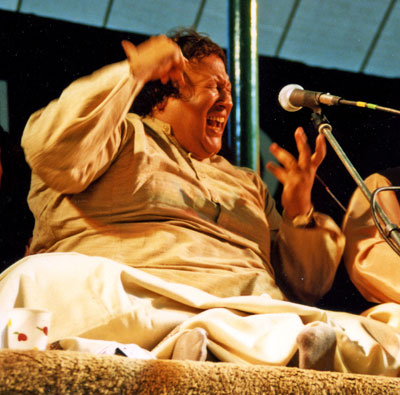

Today, the Qawwāli tradition continues in Pakistan and around the world, thanks to Nusrat Fateh Ali Khan's great genius and pioneering perserverance. His nephews Rizwan and Muazzam Ali Khan have their own party as does the reknowned Ustad Rahat Nusrat Fateh Ali Khan. These practicing Qawwāli also do not shy from collaboration with Western artists.
Fortunately for us, a grand legacy of Qawwāli expertise has been left to enjoy. Nusrat Fateh Ali Khan's body of work is vast and much of it is still available for purchase. However, one need not search far for examples of this modern master's unequalled talent, and his unadulterated devotion to Allah as well as to his people's singular musical traditional. This is Qawwāli!
Nusrat Fateh Ali Khan introduces a "qual" called "Man Kunto Maula"
"The Spirit of Nusrat Fateh Ali Khan" - interview by Andy Carvin
Nusrat.org - comprehensive tribute site
Live Performance - a "qual" titled "Ah Jaa Tenu Akhiyan Udeek Diyan" with Englsih subtitles
Nusrat.info - many, many music samples, translated lyrics and more
"NFAK: How the World Discovered Qawwali" - nice article with many links
Sufi Kalam - article about NFAK's biography by Dr. Pierre-alain Baud
13.8.10
Relief for Drowning Pakistan
When disaster struck in Haiti, in the form of a hurricane, the US government and citizenry rallied to support the devastated population there. After all, Haitians live all over this country, and they are our neighbors.

photo credit: read-news.info

As disaster strikes again, this time in Pakistan in the form of massive floods, we should realize how important it is to support the suffering population there in whatever way possible. Here's one way:

Donate to UNICEF
Due to the very real threat of water-borne diseases, there is no better time to give to aid groups in the region, no matter what you hear in the news about how charitable monies are spent. This flooding will affect at least 20 million lives; if there's even a remote chance that your dollars could help Pakistan's people, then the time to give is now. Below are some other avenues:

7.8.10
Listen: It's Unwinese
Ever hear of Stanley Unwin (1911-2002) and his invented, modified English gibberish called Unwinese? Well, neither had I until a friend (a Brit and a Burger -- from Luxembourg, that is) shared with me this golden folly of yesteryear. Remarkabold!
The fact is this Unwin, a workingman and a family man prior to achieving comedic fame in the 1950's , was a natural voice actor awaiting discovery. Just have a listen to any of these tracks from StanleyUnwin.com. His sound effects, too, are perfectly timed and you'll wish his stories would never end.

photo courtesy of LiberalEngland
It all started at the request of his children around bed time. Just like any good dad, he obliged nightly, but in doing so he began to entertain even himself by telling his stories in a fanciful, rollicking, mixed-up language. The mystery is that Unwinese is completely 'understandabold' because the changes in each word seem to preserve the original just enough. Imagine falling asleep to this!
To see this Unwinese in print is another way to appreciate its complexity. The word combinations, although sometimes befuddling, seem to make sense after some cursory consideration. Open your ears to the sound of your own voice with this 'politito' analysis, again from LiberalEngland:
Fundamold to this new Europe is the swap and trade it. At first we have it all back and forward across the borders with “please have your passy portit open for inspection”.
And this is of a great waste of time, with estimate have it and 20 billion Euro a year – and that’s without the countit and the declimly point in the wrong place!
Unfortumost – all shame and sobit – the Britly people are not keen and soldy. What they ask of the Britly passport? What of the pound and perch and of the Queen and reignit herself?
Hear their cryimost: give me bendy bananas or death and end it!
Find out plenty more about Stanley Unwin, his rocky beginnings, and his unconventional path to English comedy legend in this obituary from the Guardian. Or, as a final throwback, enjoy this clip of dear, dear Prof. Unwin advertising a fancy little piece of technology in its day:
3.8.10
"Talkin' nomenclature, man!"
Again comes the time to rename / rebrand the blog. No, it's not for marketing purposes; it's simply to infuse some vigor into the little spot I've carved out of the crowded cloud. So, I'm moving on from 'mutatis mutandis' and I'm adopting this new name: 'res ipsa loquitur'. The phrase typically refers to legal negligence of some sort, some glaring oversight on the part of a defendant which is evident to all actors in the court.
The translation from the Latin is "the thing speaks for itself" and could be followed by (and I like this bit!) another phrase: 'sed quid in infernos dicit' which roughly means "but what the hell does it say?" So, maybe the negligence isn't quite so obvious after all!
My wise friend would be so pleased that I'm nabbing such a legal term. Of course, I always twist the meaning somewhat for my own purposes, and I'm going to deem that "just fine!" What you find here is self-evident. Whether you read just one post or search back through the years, maybe you'll be able to discern the 'quid in infernos dicit'.
The translation from the Latin is "the thing speaks for itself" and could be followed by (and I like this bit!) another phrase: 'sed quid in infernos dicit' which roughly means "but what the hell does it say?" So, maybe the negligence isn't quite so obvious after all!
My wise friend would be so pleased that I'm nabbing such a legal term. Of course, I always twist the meaning somewhat for my own purposes, and I'm going to deem that "just fine!" What you find here is self-evident. Whether you read just one post or search back through the years, maybe you'll be able to discern the 'quid in infernos dicit'.
27.7.10
Chucho Valdés: 'El Maestro' del Jazz Cubano
From my bootleg vault, here's a live selection recorded at an inspiring concert in Marquette, MI in the Winter of 2003. The legendary Cuban pianist Jesus "Chucho" Valdés leads a group of young jazz players whose ages perhaps just add up to that of Sr. Valdes at the time.
In 1979, members included Jesús "Chucho" Valdés, piano; Enrique Plá, drums; Carlos Emilio Morales, guitar; Paquito D'Rivera, clarinet and sax; Arturo Sandoval, trumpet; Carlos Del Puerto, bass; Oscar Valdés, vocals and percussion; Carlos Averhoff, flute and sax; Jorge Varona, trumpet; Jorge Alfonso and Armando Cuervo, percussion. D'Rivera and Sandoval left 1980; José Luis Cortés joined.
Various laudatory comments for Irakere on FlyGlobalMusic:
“One of the finest jazz ensembles in the world” LA Times
“One of the best big bands in the world” Itunes
“Among Cuba’s most influential bands” Discogs
“Chucho Valdes is the greatest jazz pianist in Cuba, perhaps one of the greatest pianists in the world” Time Magazine
“Arturo Sandoval is arguably the most prodigious trumpeter of his generation” The Guardian
Chucho Valdes --2-- Live by afctank
El Maestro's work can be found in so many manifestations from his recent recordings with his father Bebo Valdés all the way back to the groundbreaking Afro-Cuban jazz project with the supergroup he helped form in 1972, Irakere.
From the abridged Irakere discography by Wilson & Alroy's Record Reviews:In 1979, members included Jesús "Chucho" Valdés, piano; Enrique Plá, drums; Carlos Emilio Morales, guitar; Paquito D'Rivera, clarinet and sax; Arturo Sandoval, trumpet; Carlos Del Puerto, bass; Oscar Valdés, vocals and percussion; Carlos Averhoff, flute and sax; Jorge Varona, trumpet; Jorge Alfonso and Armando Cuervo, percussion. D'Rivera and Sandoval left 1980; José Luis Cortés joined.
Various laudatory comments for Irakere on FlyGlobalMusic:
“One of the finest jazz ensembles in the world” LA Times
“One of the best big bands in the world” Itunes
“Among Cuba’s most influential bands” Discogs
“Chucho Valdes is the greatest jazz pianist in Cuba, perhaps one of the greatest pianists in the world” Time Magazine
“Arturo Sandoval is arguably the most prodigious trumpeter of his generation” The Guardian
25.7.10
The Art of...?
This existential street art is located in the Mission District of San Francisco. The alleyway is famous for its graffiti, admittedly of a wide-ranging quality. The view of the alley itself is pictured within the figure at center.

Do you know this piece? Do you know its maker? I do not. Please help me to solve the mystery.
24.7.10
Burma VJ ~ Another Secret Worth Exposing
DVD Review
BurmaVJ: Reporting From a Closed Country
Another Secret Worth Exposing by Alexander Tank
July, 28 2010
Generally, the Academy Awards ‘Documentary Feature’ category comprises an intriguing and often highly entertaining cross-section of the world’s most fascinating narratives. This year’s winner, The Cove, let viewers into a secretive world of animal abuses and the vying parties who respectively seek to conceal or expose the heinous, brutal crimes, in this case against wild bottlenose dolphins. Despite The Cove’s ultra-high production values and engaging, spy thriller plot lines, another film in this category deserved the international attention that only an Oscar can provide: the risk-taking political reportage and the breathtaking bravery of protesters in BurmaVJ by Anders Østergaard and Lise Lense-Møller.
Whether it’s called Burma or Myanmar, the oppressive military regime ironically named the State Peace and Development Council (SPDC) has quietly cultivated an environment of political repression since seizing power after violently crushing a student uprising in 1988. The gripping film is narrated by the founder of a street journalism collective, the Democratic Voice of Burma (DVB), appearing in the film under the alias “Joshua”. For most of the film, Joshua communicates with a team of street journalists armed with only video cameras and their remarkable courage. Cleverly concealing their cameras, their ultimate weapons to expose the military junta, the video journalists covertly document what has become known as the “Saffron Uprising” beginning in August of 2007 as a response to rapidly rising fuel costs brought on, after decades of oppression, by the government’s removal of protective subsidies.
The protests continue into the fall, and as students and demonstrators for the opposition are arrested and detained, throngs of Buddhist monks, voicing messages of peace and kindness in their billowing traditional saffron robes, join the non-violent effort to loosen the SPDC’s suffocating grasp on the lives of the Burmese people. With Nobel Prize winning democracy advocate Aung San Suu Kyi sequestered in a heavily guarded compound, the monks gradually escalate their protest and are quickly joined by students and the Burmese citizenry, all under the watchful eye of the junta’s generals via soldiers and plainclothes police in the streets. Over the course of days, a Buddhist monastery is raided by government agents and tens of monks are arrested in the bloody, repressive sweep. The mass of the uprising only increases as the daily protests gain momentum.
All the while, the DVB’s video journalists bravely capture the tumultuous and disturbing events on film. The internet, too, is a major player in the story as journalist leader Joshua works to disseminate the shocking images from a temporary outpost in neighboring Thailand. When a Japanese journalist is killed while filming the people’s peaceful revolt, that video is also leaked to the global media and the government’s taut cover of silence is temporarily broken, but the fight to spread the truth about the SPDC continues even under mortal threat to the video journalists and the protesters they capture on camera.
Despite its ramifications, with its documented human rights abuses and egregious military repression, BurmaVJ was passed over for an Academy Award in favor of a story about animal rights. This is perhaps the most telling aspect of 2009’s Oscar cycle: While important in its own right, a film about dolphins prevailed over a film about people whose lives and livelihoods are daily threatened by a violent and secretive military regime that actively engages in fervent censorship, keeping this unbelievably important secret from the rest of the world. Joshua and the DVB’s VJ’s, the Buddhist monks, and the Burmese people deserve for their story to be known and BurmaVJ is the ultimate conveyance for their ongoing struggle.
 photo courtesy of lib.hku.hk
Burma VJ: Reporting From a Closed Country - the official site
Free The VJ's - take action
NY Times take on Burma VJ - review with interviews, by John Anderson
BurmaVJ: Reporting From a Closed Country
Another Secret Worth Exposing by Alexander Tank
July, 28 2010
Generally, the Academy Awards ‘Documentary Feature’ category comprises an intriguing and often highly entertaining cross-section of the world’s most fascinating narratives. This year’s winner, The Cove, let viewers into a secretive world of animal abuses and the vying parties who respectively seek to conceal or expose the heinous, brutal crimes, in this case against wild bottlenose dolphins. Despite The Cove’s ultra-high production values and engaging, spy thriller plot lines, another film in this category deserved the international attention that only an Oscar can provide: the risk-taking political reportage and the breathtaking bravery of protesters in BurmaVJ by Anders Østergaard and Lise Lense-Møller.
Whether it’s called Burma or Myanmar, the oppressive military regime ironically named the State Peace and Development Council (SPDC) has quietly cultivated an environment of political repression since seizing power after violently crushing a student uprising in 1988. The gripping film is narrated by the founder of a street journalism collective, the Democratic Voice of Burma (DVB), appearing in the film under the alias “Joshua”. For most of the film, Joshua communicates with a team of street journalists armed with only video cameras and their remarkable courage. Cleverly concealing their cameras, their ultimate weapons to expose the military junta, the video journalists covertly document what has become known as the “Saffron Uprising” beginning in August of 2007 as a response to rapidly rising fuel costs brought on, after decades of oppression, by the government’s removal of protective subsidies.
The protests continue into the fall, and as students and demonstrators for the opposition are arrested and detained, throngs of Buddhist monks, voicing messages of peace and kindness in their billowing traditional saffron robes, join the non-violent effort to loosen the SPDC’s suffocating grasp on the lives of the Burmese people. With Nobel Prize winning democracy advocate Aung San Suu Kyi sequestered in a heavily guarded compound, the monks gradually escalate their protest and are quickly joined by students and the Burmese citizenry, all under the watchful eye of the junta’s generals via soldiers and plainclothes police in the streets. Over the course of days, a Buddhist monastery is raided by government agents and tens of monks are arrested in the bloody, repressive sweep. The mass of the uprising only increases as the daily protests gain momentum.
All the while, the DVB’s video journalists bravely capture the tumultuous and disturbing events on film. The internet, too, is a major player in the story as journalist leader Joshua works to disseminate the shocking images from a temporary outpost in neighboring Thailand. When a Japanese journalist is killed while filming the people’s peaceful revolt, that video is also leaked to the global media and the government’s taut cover of silence is temporarily broken, but the fight to spread the truth about the SPDC continues even under mortal threat to the video journalists and the protesters they capture on camera.
Despite its ramifications, with its documented human rights abuses and egregious military repression, BurmaVJ was passed over for an Academy Award in favor of a story about animal rights. This is perhaps the most telling aspect of 2009’s Oscar cycle: While important in its own right, a film about dolphins prevailed over a film about people whose lives and livelihoods are daily threatened by a violent and secretive military regime that actively engages in fervent censorship, keeping this unbelievably important secret from the rest of the world. Joshua and the DVB’s VJ’s, the Buddhist monks, and the Burmese people deserve for their story to be known and BurmaVJ is the ultimate conveyance for their ongoing struggle.
 photo courtesy of lib.hku.hk
 Burma VJ: Reporting From a Closed Country - the official site
Free The VJ's - take action
NY Times take on Burma VJ - review with interviews, by John Anderson
16.7.10
Why, I say "Howdy"
I've never been a Texan. Of course, I've been there, driven across its endless width, bored silly until reaching Big Bend National Park and the darkest, star-filled sky I've ever gazed upon, but that's beside the point I'm making. Even though ranchers and barbecue and football aren't all that important to me, the greeting I seem to default to is one used by some folks with those interests (yes, I'm fine with a bit o' the ol' stereotyping here!). Dangit, I like to say howdy! In fact, it's my preferred salutation, and I had to consider it before I could figure out why.
If you say, "How are you?" there's bound to be some sort of potential answer there. In passing, this could lead to a Larry David-coined "stop'n'chat" of an often undetermined length. I'm just so busy that I can't take that chance.
If you say a simple "hi" or "hello" you'd better accompany that with a genuine, friendly smile or at least a little eye twinkle or you may come across as rather terse. In the end, a more succinct head nod with a slight curl under of the lower lip and chin might serve just as well. Think of Jerry Seinfeld in the bakery waiting for Elaine's number to be called. She waits anxiously as Jerry bides his time with a black-and-white frosted cookie, snacking in silent solidarity with the stoic but friendly-faced black man across the store who's engaged in the very same. The knowing glance -- the head nod, lower lip purse -- is all they need.
Why not try a "What's up?" or a slightly hipper sounding "wussup?" Still, there's an imbedded question there, even though it's a fairly typically dismissed piece of punctuation. I don't need to hear "nothin'" or "not much" because I can gather that much without asking.
How about a simple and to the point "Yo." If it's not too intensely delivered, this can work well, but there is the ring of the poseur in it. No, I didn't grow up on Flatbush Ave. and yes, I do have some favorite hip hop tracks, but alas it's not what my parents taught me as an appropriate greeting -- sort of prompts the same reaction as the classic "Hey is for horses" if delivered too abruptly.
This brings me back to good ol' trusty "howdy". As a shortened version of the far more cowboy "How do?", I feel it does the job of acknowledging others without implying "pardner" for the most part. Also, it invites not in the least, any length of stop'n'chat because, without any inflection at the end, a solid "howdy" successfully loses its original inquisitive ring.
So, if you can't pause and have a real conversation, and if you just want to be friendly to strangers, try a "Howdy" once in a while. Better yet, some good, old-fashioned eye contact might do the trick; "pardner" that with a toothy smile (or even a toothless smile) and you've got yourself a polite enough greeting for almost any scenario, not that you needed my help with that!
If you say, "How are you?" there's bound to be some sort of potential answer there. In passing, this could lead to a Larry David-coined "stop'n'chat" of an often undetermined length. I'm just so busy that I can't take that chance.
If you say a simple "hi" or "hello" you'd better accompany that with a genuine, friendly smile or at least a little eye twinkle or you may come across as rather terse. In the end, a more succinct head nod with a slight curl under of the lower lip and chin might serve just as well. Think of Jerry Seinfeld in the bakery waiting for Elaine's number to be called. She waits anxiously as Jerry bides his time with a black-and-white frosted cookie, snacking in silent solidarity with the stoic but friendly-faced black man across the store who's engaged in the very same. The knowing glance -- the head nod, lower lip purse -- is all they need.
Why not try a "What's up?" or a slightly hipper sounding "wussup?" Still, there's an imbedded question there, even though it's a fairly typically dismissed piece of punctuation. I don't need to hear "nothin'" or "not much" because I can gather that much without asking.
How about a simple and to the point "Yo." If it's not too intensely delivered, this can work well, but there is the ring of the poseur in it. No, I didn't grow up on Flatbush Ave. and yes, I do have some favorite hip hop tracks, but alas it's not what my parents taught me as an appropriate greeting -- sort of prompts the same reaction as the classic "Hey is for horses" if delivered too abruptly.
This brings me back to good ol' trusty "howdy". As a shortened version of the far more cowboy "How do?", I feel it does the job of acknowledging others without implying "pardner" for the most part. Also, it invites not in the least, any length of stop'n'chat because, without any inflection at the end, a solid "howdy" successfully loses its original inquisitive ring.
So, if you can't pause and have a real conversation, and if you just want to be friendly to strangers, try a "Howdy" once in a while. Better yet, some good, old-fashioned eye contact might do the trick; "pardner" that with a toothy smile (or even a toothless smile) and you've got yourself a polite enough greeting for almost any scenario, not that you needed my help with that!
14.7.10
Remember Harvey Pekar
 photo credit: RhymesWithChoice
The Original (Goodbye Splendor) by Anthony Bourdain ~
Still stubbornly latched on the fringe himself, Bourdain eulogizes Cleveland's underground comic book legend, jazz writer, & blue-collar cultural icon, Harvey Pekar.

Fresh Air from WHYY ~ Terry Gross and the crew pay tribute to the late Pekar in various interviews, one with wife Joyce Brabner, from 2003 and 2005.
Unmistakable authenticity and an unpretentious demeanor contradict his own self-criticism. While before him Kerouac and Warhol pranced, showered in compliments, this fella trudged the daily path of an artful life, like living the best runs of an inspired improvisation in between all the pops and scratches in the cut.
"Everybody's like everybody else, and everybody's different from everybody else." ~ Harvey Pekar
6.7.10
Tenzin Gyatso turns 75
"The purpose of our lives is to be happy."
 photo courtesy of bbc.co.uk
 photo courtesy of bbc.co.uk
Images to commemorate the 75th birthday of the
14th Dalai Lama
Tenzin Gyatso


14th Dalai Lama
Tenzin Gyatso
"There is no need for temples, no need for complicated philosophies. My brain and my heart are my temples; my philosophy is kindness."

"We can never obtain peace in the outer world until we make peace with ourselves."
"Remember that not getting what you want is sometimes a stroke of luck."
photo courtesy of allydirectory.com

13.6.10
Lhasa De Sela
This clip features a very appealing animation style, and the song by Montreal-based artist Lhasa de Sela is subtly beautiful yet melancholic, managing to avoid the suicidal tendencies of so much contemporary art/folk pop -- sleepy and gorgeous! The old world, harp-fed sparkles add to the ambiance, as though the streets of the French-Canadian landscape were translated to the shores of the Baltic Sea.
Other tracks from her self-titled album Lhasa carry the same drifting style, making you feel as if you're in a row boat with her, lolling in the tide of life's irrational regularity. Even in the mundane, there is mystery, and Lhasa's soulful timbre helps take you there.
Link to Lhasa De Sela's official website & MySpace to listen to other tracks. Her biography reveals the roots of her ethereal, spiritual sound. Explore!
Other tracks from her self-titled album Lhasa carry the same drifting style, making you feel as if you're in a row boat with her, lolling in the tide of life's irrational regularity. Even in the mundane, there is mystery, and Lhasa's soulful timbre helps take you there.
Link to Lhasa De Sela's official website & MySpace to listen to other tracks. Her biography reveals the roots of her ethereal, spiritual sound. Explore!
31.5.10
Well said, Kid!
After all the heavy subject matter here, I've decided some levity is in order. This track, a mash-up of sorts, was recorded in Michigan in 2005 or so (can't say for sure). The utter cuteness was too much for me to keep to myself. Enjoy Lea's extemporaneous interpretation of Dr. Seuss!
LeaPhraseMash by afctank
LeaPhraseMash by afctank
Crude | Blunders | Continued
The fact that I'm even following up on the earlier post about the Gulf oil spill is worst of all. The hope was that the gushing, collosal engineering mistakes 5,000 ft below the shimmering Gulf's surface would have been capped by now. It is simply flabbergasting that BP and its host of collaborators have yet to stop or even slow the flow of oil and natural gas in the Gulf of Mexico. There is hardly an upside to this epic environmental disaster, but one is there nonetheless.
There was "top hat", then little "top hat", then the "junk shot" and the "mud shot" and of course, the "muddy junk shot"; however, the most important word I've heard bandied about is this: moratorium. Halting deepwater drilling projects and taking time to investigate the Murphy's law circumstances that led to the deadly Deepwater Horizon explosion are prudent (gladly taking that word back from a previous administration) steps at this critical juncture (reclaiming that one, too!). In the meantime, President B.H.O. should gather up his favorite back-pocket legislators, grab Dr. Steven Chu and get crackin' on renewable energy options and green-jobs creation--these were some decent sized planks in the platform, remember?
There was "top hat", then little "top hat", then the "junk shot" and the "mud shot" and of course, the "muddy junk shot"; however, the most important word I've heard bandied about is this: moratorium. Halting deepwater drilling projects and taking time to investigate the Murphy's law circumstances that led to the deadly Deepwater Horizon explosion are prudent (gladly taking that word back from a previous administration) steps at this critical juncture (reclaiming that one, too!). In the meantime, President B.H.O. should gather up his favorite back-pocket legislators, grab Dr. Steven Chu and get crackin' on renewable energy options and green-jobs creation--these were some decent sized planks in the platform, remember?
If the deaths of those Transocean employees could do any good, it will be in forcing the Obama administration, the Interior Department, and fossil fuel interests to go about their business in a safer more considerate way. No longer will the surgeon slice and dice without thinking about sewing Mother Earth back up again. If these companies can't prove their effective contingency planning, then they plain aren't invited into the operating theater! No swim daiper? Then, sorry, baby can't come into the pool; uh, BP, now we know you're not wearing your swim daiper.

Jon Stewart (a.k.a. Stewbeef) runs down the clean-up debacle in a hilarious segment from The Daily Show, May 13, 2010, especially enjoyable due to its clever jabs at the always piss-poor Detroit Lions and astute recognition of Mayan endtimes indicators. Enjoy!
Subscribe to:
Posts (Atom)