Showing posts with label inspiration. Show all posts

6.2.15

Woke Up on the RIght Side of the Bed


I do have plenty to be thankful about.
How about you?

The longer version of this tune is in the Sound Recordings archive at CulturalEquity.org.  The online repository is packed with Lomax's field recordings, films, interviews, festival performances, photographs, and so much more--the living history of our country's sonic and visual culture.

4.1.15

Reasonable Tidbits

"The eye sees only what the mind is prepared to comprehend" - Robertson Davies


And since I've always been a fan of chiasmus, "...act like a man of thought and think like a man of action" - Henri Bergson

26.11.14

R.L. Burnside & Alan Lomax

Alan Lomax is well known as the pre-eminent field recordist and folklorist who helped bring the musical traditions of Appalachia and the Mississippi Delta to the public interest (setting aside his trove of recordings from around the world).  Together with his pioneer folklorist father, John Avery Lomax, their impact on American culture reverberates still. 

For a narrow slice of the Lomax legacy--and a subject close to my heart--collected here are films he made of R.L. Burnside of Holly Springs, Mississippi. I came to know Burnside's music after a series of late 90's remixes on Fat Possum Records and listened back from there.  On a trip to New Orleans, I spotted him in these historic photos, probably taken before he was ever recorded.


These clips offer a look into a verdant, peaceful place where, after long sweltering workdays, Burnside cultivated his sound, picking at home into dusk and playing juke joints into night.

The first tune below is from Sound Machine Groove, an album released in 1997 but recorded in1979 & '80. The film was shot two months before I was born.  In college, I listened to this song over and over--couldn't get enough of that shuffling feel!


Here Burnside's sons get into it.  You can imagine these kids playing along with their dad before they could manage instruments.


Those 90's remixed blues tunes, oddly enough, put R.L. Burnside on folks' radar.  It's where I first heard him, and in one of the tunes he calls out, "On drums, my grandson, Cedric Burnside...".

I've since seen Cedric Burnside playing live to a sparsely occupied venue in Athens, GA.  Most people there didn't understand the tradition that this young guy was carrying forward.  Despite the meager crowd, he was as solid singing behind the drum set as his grandfather was behind a guitar.

One of the comments under this video says it all:  Cedric Burnside is "the best example of a self-actualized person I have ever seen. Pure joy!" Here he is doing a mean hambone with longtime collaborator Trent Ayers.  See if you don't agree.


R.L. Burnside - bio and discography at Fat Possum
R. L. Burnside - Delta Boogie interview

Alan Lomax - at CultureEquity.org, field recordings & plenty more

14.11.14

Escher & Hundertwasser Prints

I've drifted back over to Seattle's superb Davidson Galleries and continued collecting images (at least virtually).  Escher caught my eye on the main page--iconic, legendary--but so too did Hundertwasser for his richly colored and textured works--and what a name!

ESCHER
We always gravitate towards M.C. Escher's masterworks of perspective, the tessellations, intricate patterning and bold graphics.  Along with the trademark images, this time a few lesser known pieces stood out (buy them here); the first helps to see into his process, the precision and density of his line work.  The second is a classic Eastern natural scene, a catfish (or koi) submerged in monochromatic autumn.  The last two are more commercial work, doubtless Escher's bread & butter in his early career before reaching mythical status.  His command of the medium is still unmatched and as striking as ever.

Regular Division of the Plane I, 1957
Woodcut in red on wove paper.
9-1/2 x 7-1/8 inches.

Three Worlds,   1955
Lithograph
14-1/4 x 9-3/4 inches

Lute (III),  1931
From XXIV EMBLEMATA. Woodcut on buff wove paper
7-1/8 x 5-1/2 inches

Peacock (Second Titled Page),   1931
From XXIV EMBLEMATA. Woodcut on buff wove paper
7 x 5-3/8 inches


HUNDERTWASSER:
The following is from Davidson's literature on Freidensreich Hundertwasser (prints here):
[Hundertwasser] was largely self-taught apart from a few months at the Academy of Fine Arts in Vienna and the École des Beaux-Arts in Paris. While he admired members of Die Wiener Schule des Phantastischen Realismus (Viennese Fantastic Realists), it was with the richly colored and patterned surfaces of work by Gustav Klimt, Walter Kampmann and Egon Schiele that he found greatest resonance.
Hundertwasser's extensive graphic output began in 1967 and was characterized by hybrid forms that enmesh human and natural elements while using highly saturated colors, metallic imprints and carefully  ,calculated color variations within the printing of an edition.
The parallels to Klimt are evident, especially his framed, "cubbyhole" surfaces and use of metallic pigments.  The fact that he was self-taught brought to mind Earl Cunningham and maritime paintings I'd seen once in Orlando's Menello Museum of American Art; Cunningham's buildings in particular have that same tweaky, rickety feel with distorted perspective, the kind Escher would have scoffed off the paper.

These two below were made for the 1972 Munich Olympics, not necessarily remembered for sporting achievements but instead for an infamous terrorist act.  Beautiful colors printed ahead of dark days.


Olympische Speile München, 1972 (2 variations shown)
Silk screen in 21 colors with metal imprints in 5 colors 
and an electrostatic application of felt fibrils. 
40-1/2 x 25 inches.

One of Five Seaman, 1975
Silk screen in 18 colors with metal imprints in 2 colors   
33-5/8 x 22-7/8 inches.

Maybe it's the mustard color or the head shape in this last one, but I think of Os Gemeos, the twin Brazilian street artists who've been befriended by graffiti darling Banksy and lauded by international art critics.  Here's a write-up of their 2013 "Anglo-Paulista" collaboration for Banksy's residency in NYC.

18.7.11

America ReCycled: Pedaling with Purpose

Brothers can have a rare bond, and the Brothers Hussin are no exception with their creative, two-wheeled endeavor to traverse our great nation in an effort to explore and "restore local culture".  I learned about the America ReCycled project via Tim Hussin's excellent photo blog titled Meanderings.  His work caught my eye for its clarity and a sense of objectivity.  The images read like documents, demonstrative yet intriguing, deftly capturing time and space and sentiment. 

Some road gear via thussin.blogspot.com

As for the continental bike trip, Tim and Noah Hussin used Kickstarter.com to gear up for the expedition, and they've been writing and filming the adventure with regular, extensive updates posted to AmericaReCycled.org via their solar-powered laptop. The timeline is a bit fuzzy, but their fundraising "mission statement" indicates plans for posts from the road (many interesting reports are up already), film segments, and later on a book and a feature-length documentary.  According to the site:
All across the country, people are finding innovative ways to come together and make revolutionary change on a local level, to regain control of their lives, rediscover independence, and recycle the American Dream.
Follow along on their journey.  These guys have an eye for ecclectic, innovative living, and they capture it all expertly (looks like in HD).  So far, the project, which documents unique communities, is really worth watching as the brothers reveal, essentially, our own American backyard.

AmericaReCycled - the project site with the first slick video segments!
Meanderings - Tim Hussin's photo blog

16.3.11

Brian Smith (of Odd Trio, Georgia Guitar Quartet) Speaks: "Daedalus" @ Canopy Studios

If you're listening to the news, it's hard to disagree with the sentiment found in Chinua Achebe's title for his 1958 masterpiece "Things Fall Apart".  While all is in flux half a world away, in our own backyard musician and composer Brian Smith has been busy bringing worlds together with the premiere of his latest musical suite titled "Daedalus". 

On Saturday, March 19th at 7pm and again on Sunday, March 20th at 3pm, Canopy Studio at the Chase Warehouses in Athens, GA will host a remarkable union of original music and gorgeous aerial artistry, joined under the vision of composer Brian Smith with his troupe of talented musicians (including wife-flutist-trapeze artist, Natalie Smith, members of Georgia Guitar Quartet, Odd Trio, Maps and Transit) and aerialists performing on trapeze, silks, hoops, even bellydancing!  

Brian was kind enough to discuss "Daedalus", his inspirations and his process, in a recent interview:


AT: What was the inspiration for this particular suite of compositions? I know that the Greek myth is the central theme, but is there any other driving force or catalyst that led you to create this work? Does it help push you that not many people are doing this kind of avant-garde, chamber music performance in the indie-rock dominated landscape of Athens, GA? You're part of an impressive network of very talented musicians, and it's got to be exhilirating to join forces in this way.

BSmith: The inspiration for this work came about at the last Canopy show actually. Julie [Phillips] was performing a silks piece to a duet that I wrote for Natalie [Smith] and myself and the silks looked like wings and there was a big drop in the piece. It made me think of Icarus and I thought it would be neat to write a piece for Julie to perform based on Icarus. When rereading the Icarus story, however, I noticed that I felt more of a connection to Daedalus rather than Icarus. I really felt the tragedy of a father losing his child now that I’m a father as well. Also, Daedalus appears in so many other well known Greek myths and in most cases is the catalyst, so I thought it would be interesting to follow his story.

Here in Athens, there are so many great musicians doing so many great things, I feel like a drop in the bucket. I think everyone here pushes the envelope and blurs the lines of style and concept. It’s very inspiring to be immersed within such a place. As a composer, I feel like I just have to do what I do and hope someone likes it.

It’s absolutely exhilirating. I feel so lucky to be able to work with so many amazing musicians and aerialists and dancers and it’s even better to know that they are all good friends. It’s nice to have a reason to get all these folks together in one place. I like to think that I’m just creating a platform for all of these great artists to shine and have a good time making music.

AT: In previous discussions, you've mentioned mathematics and number theory -- like the Fibonacci Sequence that describes nature's spirals as in a sunflower -- as those relate to music. How do you use number theory to inspire your pieces, and are there particular rhythmic patterns that the audience can listen out for during the upcoming performances of "Daedalus" ?

BSmith: Absolutely. Over the past few years I’ve been developing my writing style using what I call “numerical symbology”. I got the idea from Carl Jung’s and Joseph Campbell’s idea of the collective unconscious, wherein universal archetypes are similarly expressed throughout human culture worldwide. Joseph Campbell discusses the idea of archetypes within world mythology characters and symbols. I think people have the same universal symbolic perception and experience about numbers, their shape, sound and meaning. I have tried to craft the pieces using some basic number symbols as well as more deeply hidden symbols for those who care to study the score more closely. I also think that there are certain musical mathematical symbols expressed in pitch, harmony and rhythm. Whether someone considers themselves “musical” or not does not matter in terms of their perception of these symbols. It is the people’s like or dislike of the music itself that illustrates the symbol’s success. With this work, I tried to pull many cords within people’s psyche. We’ll see if it come across.

AT: The Cretan labyrinth is part of the story of Daedelus. Is there any purposeful misdirection in the work, at all? Do you want the listener to feel a sense of confusion at any point on the way to a deeper resolution, that epiphany moment when the puzzle is solved?

BSmith: I found the labyrinth story of Daedalus to be the big connector of the entire story. In this work, the piece “Labyrinth” is the big connector of the work as a whole. The piece is subtitled “Puzzle Piece” and the piece itself is a big puzzle. If someone studies the score, the piece can be solved. I created 3 “tries”, basically 3 different scores, that help in solving the puzzle.

For the listener, there are big chunks missing in the piece and recognizable melodies arise that help determine the solution. The epiphany moments will perhaps come after the concert is over. All the pieces of the work draw from the “Labyrinth” and all the pieces lead to the “Labyrinth” in some way. It’s a cornerstone.

AT: Based on some of the main character's actions, I'm not sure he's such a friendly mythic hero. Are there certain melodic devices or key signatures that you prefer to use to depict that feeling of fleeting malice or impropriety? Not a nice Uncle, really!

BSmith: Actually, I felt like Daedalus was a sort of tragic hero, a very human figure. He’s also one of those characters that really undergoes a change over the course of his life and suffers greatly for the folly of his younger days. I think he really tries to do the right thing for the most part, but due to his past transgression with Perdix, he always seems to end up in tragic situations. But, he also helps a lot of people on the way, stands up against the wicked rule of King Minos, is respected at his craft and is well taken care of by the generosity of others. Overall, he’s quite a balanced figure symbolically. I use octaves to represent Daedalus as well as the key of b-flat. All the characters have their own musical gestures, pitches, intervals and keys. (i.e. - Icarus is chromatic falling gestures, the notes f and f#, 9ths and the key of F) As a dad, I think Daedalus does what he has to do in the given situation. Well aware of the risks, but without many options. Fatalistic, I guess.

AT: I realize that composition and arranging are arduous processes; are there modern tools that make the job a little less painstaking, or is it still a lot of sharpening the quill, mending holes in the parchment, cleaning up spilled ink and managing frustration, fending off mental illness? I know you know the image I'm drawing from: Amadeus, the scene with the cue ball on the billiards table, repetitvely banking off the cushions and back into Mozart's hand as he fervently scratches away at a masterpiece.

BSmith: Ha! Well, for me personally, I fret and stew and tweek and change pieces a lot before they get printed and I’m usually still making changes at rehearsals. I spend a lot of time in my head going over and over things. Probably get a little too obsessive at times. By the time I get to the computer, things move pretty fast. I like the speed of entering the music on the computer and I like not having to use a pencil or pen to make everything look pretty. I have poor penmanship and it hurts my hand to have to be that meticulous. I think all musicians stew over their work and are probably never completely satisfied. I think you just try to make each piece you write the best that it can be and when it’s time to let it go you have to let it go, warts and all.

Thanks to the composer for the insights that will make the experience of "Daedalus, a work by Brian Smith" all the richer.  For more details about the two shows on March 19th and 20th at Canopy Studio, follow links below:

The MusicSmiths
Canopy Studio
Georgia Guitar Quartet

15.2.11

Kyle Dawkins (of Maps and Transit) Speaks!

According to the Maps and Transit site, "Kyle Dawkins has released two solo recordings under his own name, Conasauga (2002) and Walls became the world.(2004) and is a member of acclaimed chamber ensemble The Georgia Guitar Quartet. He lives and works in Athens, Georgia."

Collaborator and wife Julie Phillips is "a trapeze and aerial silks instructor at Canopy Studio and is a member of their acclaimed repertory company. She is also a bassist, percussionist, and writer."

The following is an email interview with Kyle Dawkins conducted in late 2010 after the release of the Maps and Transit project Songs for Divining in September, 2010.

AT: The instrumentation on the album is so unique and was dubbed "folktronica" at some point. How much of the sound is guided by the instruments themselves, or is it the sound in your mind's ear (so to speak) that dictates those choices? Can you recall any "happy accidents" as far as combining instruments to achieve a brand new quality of sound? Which instruments might be on your "dream list" regardless of cost -- is there a sound you're chasing that you could harness with a little help from Bill Gates?

KD: Many of the "happy accidents" happened as a result of the unpredictability of the stringed instruments that I was using. I've got some old mandolins and other stuff that have these really idiosyncratic, messed-up tones as a result of warped necks, frets, etc. I thought it gave the songs a sort of creaky, homemade feel. I love the sound of really antiquated or broken-down acoustic instruments. You can get sounds out them that you couldn't get otherwise if it was a new instrument off the shelf somewhere. Lately, I've been really into mellotrons. I love the often out-of-tune, fluctuating tape loops and it's spooky sort of canned sound. I used a bunch of "virtual" mellotrons from different sound applications on my computer but it's really hard to approximate the sound of a real one which I've yet to even try out. So yeah, I'd like a mellotron from Santa or Bill Gates.

AT: I'm sure this varies greatly, but how long does it take you to create a song in this way, with all the layers and pieces? Also, do you give express consideration, as you work out a new track, to how it might be performed live?

KD: I'll usually write the songs and then Julie and I will listen to it and figure out ways to juggle the parts using a combination of samplers. Usually the parts that would be interesting to see played live are the ones we rehearse and the more textural sounds we farm in using the samplers. The sampler parts are usually the ones that are more computer-based and aren't necessarily playable on guitars or mandolins or whatever. Usually a song will take me a day or two to write and a couple more days of Julie and I rehearsing and listening. Some songs seem to take forever though for whatever reason. Lately, we've been in the process of planning more collaborative song writing processes where we build the songs up as a duo instead of a composition that was written on a computer and figured out later as a band performance.

AT: Besides Applachia, which other regions of the world seem to contribute to these compositions. Is the Celtic tradition something you look to or particularly enjoy outside of writing and performing?

KD: I sometimes draw a lot from Asian and mid-Eastern folk instruments and melodies, some Sufi, and Indonesian music too. The Celtic influence is there mostly as a point of reference for certain melodies.


logo courtesy of  Georgia Guitar Quartet

AT: You both are into fine art and design (and you've collaborated with painter Chris Wyrick in the past), so if you were to assign a color scheme to this album, what would it be? To put it another way, what is the "look" of your sound?

KD: I wanted some parts of the album to have a murky, underwater, brambles-and-vines-everywhere kind of texture combined with the feeling of hearing music from the inside of a dusty music box. Those aren't colors exactly but they're places. I don't usually get a sense of color when I'm writing music as much as a sense of texture or place.

AT: As I listen to your album, I see so many images in my mind, and I know that response is individual to the listener. Have you ever been approached by filmakers who want to use your music as a soundtrack to a "talkie" ?

KD: I haven't done any soundtracks but it's something I've always wanted to do. Filmmaker anyone? Email me at kyledawkins75@gmail.com

Image by Bob Brussack courtesy of Athensview.com

AT: Along those same lines, it would be amazing to see some of your aerial artistry set to this music (and I have live at Canopy Studios!). Have you considered making a music video incorporating your other artistic endeavours?

KD: We've been in conversation about doing something like this with different people around town so yeah, hopefully something will be in the cards soon.

Songs for Divining ~  listen and download
Maps and Transit on Myspace ~ listen and enjoy

* Take note of an upcoming event featuring Julie Phillips' aerial work and Kyle Dawkins' guitar:

The Canopy Studio performance will feature aerial artistry on trapeze and silks with accompanying compositions by Brian Smith (Georgia Guitar Quartet) with Dawkins on guitar, among many other talented musicians.  It's bound to be an enchanting, memorable event that shouldn't be missed.  If you can be in Athens, GA, score some tickets!


Two shows plus an open house prior:

Saturday, March 19th @ 7:00  & 
Sunday, March 20th @ 2:00 

Sunday, March 6th @ 4 - 6 pm Canopy Studio open house

13.1.11

Drip Drop

Since the snow and ice event on Sunday, the South has been slowly, very slowly thawing out daily only to completely refreeze again by sundown. So far, schools have had an unprecedented 4 consecutive snowdays! We're calling it
"Snowcation 2011".

I saw these thousand icy fellows, and they reminded me that it's not so chilly everywhere especially at the poles, forgotten places that are supposed to be solid, untouchable geographic constants. This installation by Brazilian artist Nele Azevedo, sponsored by the World Wildlife Fund, sought to highlight that environmental fragility. These little guys say so much by simply sitting there dripping!

Nele Azevedo's Melting Men on the Concerty Hall steps at Gendarmenmarkt in Berlin:

one fresh Melting Man in Berlin from unurth.com

fisheye view of Azevedo's Melting Men greenupdate.wordpress.com

The little fellows can be seen in photos from around the world spreading awareness about climate change.

27.12.10

The Tones Between: Photographs by Greg Seman

In 2008, I made a point to present some of my favorite images by photographer Gregory Seman. Since then, my old friend's profile has grown higher while his work continues to delve deeper into the subtle quietude of landscapes we foolishly careen past so much of the time.


Marquette Rooftops, 2008 : Greg Seman

The places are beautiful, but more than place, Seman is capturing time and light in a way that the old masters would revere. He's represented by the Halsted Gallery in Bloomington Hills, Michigan, as well as in the cloud at Greg Seman Photography. At Halsted, his name appears alongside the greats: Ansel Adams, Henri Cartier Bresson, Wynn Bullock, Imogen Cunnigham, Yosuf Karsh, Michael Kenna, Andre Kertesz, Edward Steichen, Jerry Uelsmann, all those Westons, Minor White -- among well-renowned others and some whose work I still should seek out.
a favorite by Minor White (1908 - 1976)
Today, I'm so proud to have, by chance, found a Greg Seman image in the February 2011 Special Issue of B + W. I picked it up as I do on most book store stops, and as I flipped through the images within I thought, "Maybe I'll just glance at the table of contents just in case..." and, in fact, there it was on page 139:
Ice Flows, Frankfort Pier, 2009 : Greg Seman
The 'Merit Award' shot, taken along the Lake Michigan shore, is emblematic of his compositions -- dynamic nature, refined vision, impeccably smooth tonalities, juxtaposed textures, pristine printing technique -- and the result is a sense of that spot at that moment, something that couldn't be recreated if a person gazed out from there, even an hour later. The skill and diligence it takes to craft such a vision is laudable and worthy of the respect that's begun flowing just like the ice pictured above.
Moonlit River, 2007 : Greg Seman

14.11.10

Emily Pilloton: On a Brand New (Design) Tack

It's exhilarating to discover someone whose work is making a real difference. This could be a giant like Muhammad Yunus, your fourth grade teacher, or someone like Emily Pilloton. Her work with Project H Design, the charitable organization she founded, "supports, inspires, and delivers product design initiatives for Humanity, Habitats, Health, and Happiness."

The initiatives and the sustainable ideals behind all aspects of this grassroots work are so admirable and will undoubtedly become a precedent for educational design -- fingers crossed that someone is watching and paying attention.


As the project gains steam, Pilloton and cohorts reap the rewards of higher-exposure which amplifies the project's core tenets:

1) There is no design without (critical) action.We are not a social club, nor do we host green drinks events. We do projects that exist in the real world, that have partners, impact, and results. We work as a team, rather than for individual glory.

2) We design WITH, not FOR.We work with partners, not for clients. We bring end users to the table from day one, making them fellow designers. We co-create with unexpected partners, and listen/learn first about social issues we may not fully understand.

3) We document, share, and measure.We record all work as a means to measure qualitatively and quantitatively, and ask for feedback as a means to constantly improve. Our designs are never "done." We share practices between project teams so that we never have to start from zero.

4) We start locally, and scale globally.Our projects are local responses to global problems, and are designed to serve as models for broader application. We look first to our own back yards, with the ultimate goal of scaling and improving products as systems that can work anywhere.

5) We design systems, not stuff.We create solutions and systems that are not driven by material or consumption. We "take the product out of product design" to question the traditional models, and design solutions that enable something greater than the object itself: enterprises, impact, etc.

6) We build.We get dirty. We tweak and prototype and test and bend. We know how to work in a woodshop, and how to weld, mill, and machine. We believe that knowing how things are built makes you a better designer, and that understanding the design process makes you a better builder. We make sure our ideas come to life.

This approach shouldn't be limited to design. Sensitivity to place and culture is something that's conspicuously lacking throughout our society, from the strip mall sprawl beyond the Beltway to the one-size-fits-all standardized tests we force upon anyone and everyone. Change is incremental, and Pilloton, with her team of innovators, is assuredly a leader to watch--and hopefully emulate--in the future.

Project H Design - the main thing on her plate
Inhabitat - a vast design site / Pilloton is managing editor
Dwell - an insightful interview by Alissa Walker
TED - read her profile / find other inspiring talks!

11.11.10

"Shake it to the Left; shake it to the Right!"

The System comic from notquitewrong.com

Now from a 2004 interview with Terry Gross on NPR's Fresh Air :

"The only thing I like about the Left versus the Right is that the Left seems to care more about people, and the Right seems to care more about property, as a generalization." -- George Carlin

10.10.10

Kenosha Kid @ Caledonia Lounge | 'Land of Obey' Release Show

In case you ever doubted they would, Kenosha Kid strikes again with a blazing-hot brand to last you all the way through pigskin season and beyond!

Melodies that sooth like Icy-Hot (or Vapo-Rub, whichever Mama gave ya!), searing instrumental improvisations, rhythmic sizzling behind ethereal bass foundations -- it's all in store for the hearty, the brave, the future residents of Kenosha Kid's newest release: Land of Obey.

So, if you're in Athens this weekend, "put your face on" and then prepare to have the layers peeled off at the hands of Kenosha Kid this Friday night at the Caledonia Lounge!

Listen up: you don't have to swagger into the Caledonia blind. Use your x-ray ears and get into Land of Obey before it hits the streets like a magical frog fallen from the heavens. You'd be a fool not to get a little preview, Dawg!

chimp listener image from athensmusicjunkie


16.8.10

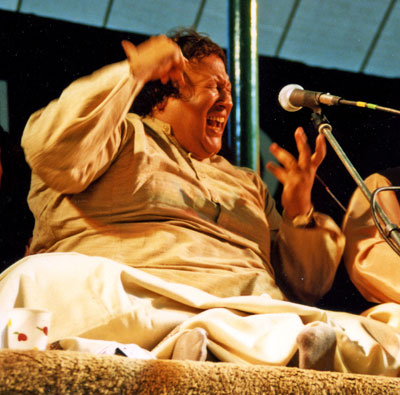
Nusrat Fateh Ali Khan ~ Shahen-shah-e-Qawwāli

On the 13th anniversary of his death, it is with great reverence that I memorialize one of the most significant traditional musicians on modern record. He was the shining star of a six centuries old line of mystic Sufi devotees who, to this day, comunally worship Allah through ecstatic musical flights during marathon sessions. He was Ustad Nusrat Fateh Ali Khan (1948 -1997), a Qawwāli master, among the most gifted vocalists ever to sing the sacred poetry of Islam.

Cover of his 1st international release on the Real World label: Shahen-shah

photo courtesy of Bluesmen's World (Music)

According to his biography, the young Nusrat Fateh Ali Khan (نصرت فتح على خاں) aimed to become a "doctor or an engineer" but soon after showed a fledgling interest in the family business of Qawwāli and began his subsequent tutelage under first his father, studying tabla, and then his uncles Mubarak Ali Khan and Ustad Salamat Ali Khan.
The young Nusrat Fateh Ali Khan's rise to greatness was rapid and steady, starting with his first performance, called chehlum in Urdu, forty days after his father's death. Decades of performance followed starting with a broadcast on Radio Pakistan in 1971 known as Jashn-e-Baharan, his first as the leader of his family's Qawwāli "party", featuring devotional singing "mainly in Urdu and Punjabi and occasionally in Persian, Brajbhasha and Hindi."

Nusrat Fateh Ali Khan's first performance outside Pakistan


Beyond traditional Qawwāli performances in the company of his "party", Nusrat Fateh Ali Khan gave his ancestral form of devotional music a brand new face through various successful collaborations with Western artists and other musical masters of the sub-continent.

One of the most recognizable contributions for Western audiences is his duet with Eddie Vedder for the Dead Man Walking film soundtrack. Vedder's unmistakable, grimaced croon is paired with Nusrat Fateh Ali Khan's soaring, airy tones, the ethereal tambre of which carry the compostion to a spiritual plane. The two voices, the anthemic power of Pearl Jam's frontman and the veteran Qawwali's controlled rising and falling, together create a texture that seems chiseled of the same ancient stone. As it fades into the landscape of the film's narrative, the track titled "The Face of Love" transcends any moral implication and becomes itself an effortless message of multicultural harmony. It is but one example of Nursat Fateh Ali Khan's absolute commitment to promulgating Qawwali music as classically-honed forms joined modern media.

photo credit: Tim Hall of Redferns Music Picture Library via bbc.co.uk
 
Today, the Qawwāli tradition continues in Pakistan and around the world, thanks to Nusrat Fateh Ali Khan's great genius and pioneering perserverance. His nephews Rizwan and Muazzam Ali Khan have their own party as does the reknowned Ustad Rahat Nusrat Fateh Ali Khan. These practicing Qawwāli also do not shy from collaboration with Western artists.
Fortunately for us, a grand legacy of Qawwāli expertise has been left to enjoy. Nusrat Fateh Ali Khan's body of work is vast and much of it is still available for purchase. However, one need not search far for examples of this modern master's unequalled talent, and his unadulterated devotion to Allah as well as to his people's singular musical traditional. This is Qawwāli!

Nusrat Fateh Ali Khan introduces a "qual" called "Man Kunto Maula"


"The Spirit of Nusrat Fateh Ali Khan" - interview by Andy Carvin
Nusrat.org - comprehensive tribute site
Live Performance - a "qual" titled "Ah Jaa Tenu Akhiyan Udeek Diyan" with Englsih subtitles
Nusrat.info - many, many music samples, translated lyrics and more
"NFAK: How the World Discovered Qawwali" - nice article with many links
Sufi Kalam - article about NFAK's biography by Dr. Pierre-alain Baud

14.7.10

Remember Harvey Pekar

photo credit: RhymesWithChoice

The Original (Goodbye Splendor) by Anthony Bourdain ~
Still stubbornly latched on the fringe himself, Bourdain eulogizes Cleveland's underground comic book legend, jazz writer, & blue-collar cultural icon, Harvey Pekar.

image courtesy of Ben Temple Smith

Fresh Air from WHYY ~ Terry Gross and the crew pay tribute to the late Pekar in various interviews, one with wife Joyce Brabner, from 2003 and 2005.

Unmistakable authenticity and an unpretentious demeanor contradict his own self-criticism. While before him Kerouac and Warhol pranced, showered in compliments, this fella trudged the daily path of an artful life, like living the best runs of an inspired improvisation in between all the pops and scratches in the cut.

"Everybody's like everybody else, and everybody's different from everybody else." ~ Harvey Pekar

6.7.10

Tenzin Gyatso turns 75

"The purpose of our lives is to be happy."

photo courtesy of bbc.co.uk
Images to commemorate the 75th birthday of the
14th Dalai Lama
Tenzin Gyatso

"There is no need for temples, no need for complicated philosophies. My brain and my heart are my temples; my philosophy is kindness."


"We can never obtain peace in the outer world until we make peace with ourselves."
 
"Remember that not getting what you want is sometimes a stroke of luck."


27.3.10

Thanks to Stuart Udall

photo credit: historycentral.com

Thanks to Ken Burns and PBS, I'd heard of Stuart Udall before he died recently at the age of 90. In career terms, Udall was the forward-looking conservationist who served as Secretary of the Interior under Presidents Kennedy and Johnson. Under his tenure, our nation expanded a mandate of stewardship for our natural surroundings that began with John Muir and Theodore Roosevelt. This excerpt from the New York Times article by Keith Schneider and Cornelia Dean illustrates his legacy:
Few corners of the nation escaped Mr. Udall’s touch. As interior secretary in the Kennedy and Johnson administrations, he presided over the acquisition of 3.85 million acres of new holdings, including 4 national parks — Canyonlands in Utah, Redwood in California, North Cascades in Washington State and Guadalupe Mountains in Texas — 6 national monuments, 9 national recreation areas, 20 historic sites, 50 wildlife refuges and 8 national eashores. He also had an interest in preserving historic sites, and helped saved Carnegie Hall from destruction.
Having visited certain of these treasured lands, I feel a direct debt of gratitude to Udall and his compatriots who recognized that his generation (as does ours today) held the power to preserve this continent's natural history for forthcoming Americans even in the face of strident opposition.

His descriptions of the Guadalupe Mountains hit home for me and helped to conjure up memories of days and nights spent at the foot of that great, monolithic ship's prow in Texas: the feel of the cool air, the sound of crunching footsteps as they echoed up canyon walls, and the magic of the life-giving streams trickling down the valley. Stuart Udall saw the grand value of these now heralded places before most others, and we should consider ourselves lucky that he did.

"Plans to protect air and water, wilderness and wildlife are in fact plans to protect man." - Stuart Udall

8.2.10

Dan Nettles (of Kenosha Kid) Speaks


image courtesy of nowtrecords.org

This was the project, from Kenosha Kid founder Dan Nettles, that brought the Athens, GA guitarist into my view. His invigorating reimagining of the soundtrack for Buster Keaton's Steamboat Bill was an indication that Nettles was frying bigger jazz fish than other, more pop/rock oriented crews in the sonically legendary area of Northeast Georgia.
Treat yourself to a truly revelatory cinematic experience and catch the Robert Osborne Film Festival's screening of Steamboat Bill Jr. with Kenosha Kid providing the live soundtrack.
Saturday, 4:00 PM The Classic Center, Athens, GA
Buster Keaton's Steamboat Bill Jr. (Silent Film - 1928) w
ith a special live music accompaniment by Kenosha Kid


As it turns out, Dan Nettles does an equally fine job expressing himself and his vision with words as he does with his guitar in his ensemble Kenosha Kid. Check out the Q & A below, and enjoy the Steamboat Bill video to get an audio-visual sense of the group's style:
a.f.c.tank : Another Georgian, the iconic James Brown, was famous for his band leading techniques, with all the kicks, and stomps cueing the band to "hit it" or "quit it". So, when you direct other musicians in an ensemble, do you use your guitar neck like the conductor's baton or is the unity between instruments achieved mainly through the rehearsal process?

Dan Nettles : it all comes from playing together and learning to read one another. of course, that can be quite difficult in the dark during a movie for instance, but over time we get a pretty good idea of where each of us is headed musically speaking. after all, in bands that have a great "band sound", the music is all about a unique vocabulary that only that band speaks. i also have the incredible fortune to play with musicians who have impeccable instincts. there ARE two important body cues that get used a lot... one we all use is the "end of solo face" (meeting the eyes of bandmates, bugging them slightly, sticking out tongue, things like that), and the other is called "the foot" (when i wave a foot in the air, on the next big downbeat we move on).

a.f.c.t. : Is there an influence who you consciously have to keep yourself from emulating or do you find that kind of "quoting" a way of paying homage to forebearers?

Nettles : over the past ten years or so, i just try to keep the creative juices flowing. if something sounds good to me, i run with it as far as i can. i rarely worry if it "sounds too much like.." or "i need to make it sound different from..." simply because EVERYTHING has been played before, and probably better than i can do it. the few exceptions might be that during the writing process i may tweak the compositionin a particular direction, but usually i try to hold off from any over-editing until the thought is complete.

as far as homage to forebearers, what have they ever done for me?? haha, i joke... BUT in a way all the music we play is a nod to the great music gods out there, who are surely listening. if only they could also pay the band...
a.f.c.t. : Describe your sense of time during the act of composing / rehearsing / performing? Is there a kind of time warp when you find that zone?
Nettles : composing: time stretching can occur, usually in correlation to how much fun i am having. it definitely re-wires my brain, and after 4 or 5 hours writing it is difficult to re-enter the real world and converse with people sometimes. my vices of coffee and cigarettes also ensure that ever couple hours i step back and reflect.
rehearsing: any rehearsal is too long!
a.f.c.t. : Do you feel like jazz is becoming more or less accesible to the audience or is it veering more toward the esoteric side with time / key signatures that are just too tough for the average listener to grasp? Is it easier to set off composing a new work when you have a specific public in mind?
Nettles : ever since bebop, jazz seems to have remained a fringe art form. content like rhythmic or harmonic density seem to be a factor... most listeners just don't like (or never got a chance to like because they never get to hear it) complicated music. just look at all the crappy, content-free, smooth jazz record sales! on the other hand, the music should be fun, and full of life, and not complicated for its own sake. again and again, if you go to a fusion show, or a prog-rock show, or a "guitar god" show, the audience is made up of guys with their arms crossed "assessing the technique/gear" and their bored-to-hell girlfriends. it can become adolescent, boring and athletic... none of the reasons i got into making music! another thought: jazz very often becomes the victim of its own traditions, dogma, or history. jazz "went to school" after it left the clubs, and that set up the performers and audiences with a whole list of expectations that miles or coltrane would probably find quite amusing.
hmmm... usually my starting point is more involved with "who is playing" over "who is listening". i absolutely must write music that the band likes to play! if they didn't, who in their right mind would put up with all the BS that comes along with it? plus, an audience ALWAYS can tell when the band is enjoying what they are doing. they may never know what's going on, but they always respond to us when we are really giving all we can to the music.
a.f.c.t. : Is there a favorite lick that you tend to use frequently or it is always fresh and different every time? That has to be a challenge when you're playing out all the time, having to reinvent your vocabulary again and again.
Nettles : new vocabulary comes in and out, and also there're the moments of true improvising when i get to work completely in the moment. i also rely a lot on my bandmates to "feed me" with unexpected material to work off of. some nights might be a great show where i just basically played my parts right and let the band go crazy, or vice versa. it's all agive and take, and i don't mind using words... sentences... stories...that i've used before to say something meaningful. and hell, it's always a new day, and we are all different people than we were yesterday.
a.f.c.t. : Most nights you've got some pretty tight curls going on up there under your headband. Who gave you your notoriously kinky locks?
Nettles : haha! laziness. for a period of time i just stopped thinking about getting a haircut. it got too long to see, and i just tied it up, and it's been that way for a while now... who knows, maybe i will get ashampoo sponsorship?


Find more music videos from Kenosha Kid on Youtube.
Thanks go to Dan for his gracious participation and for keeping jazz alive in Athens, GA! Kenosha Kid's official site gives the feeling that Dan Nettles and his crew are up to plenty besides inventing soundtracks to classic silent films, so head over and have a look and a listen!

29.10.09

Odilon Redon


The Buddha (1905) ~ Bertrand-Jean (Odilon) Redon

image courtesy of artinthepicture.com

This image is one of my favorite oil paintings from any time period. I'm not sure why I enjoy it so much, but I think it's something in the way the objects and figures seem to float on top of the lush backgrounds, appearing separate from the landscape but not completely detached.

The effect is surrealist, in a sense, but Redon's subject matter, mostly still-lifes with plenty of natural themes, lends a calming tone to the work overall. The fact that the French artist was a skilled printmaker draws me in further. There is much more to discover about this underrated master.

This vision of the Buddha with the Bodhi Tree is one that appears in a few of Redon's paintings and I appreciate the Buddhist mythology, the serenity of the classic pose, as well as the vibrant but earthy color palette.

For more exquisite paintings by Redon, visit Odilon-Redon.org. Another site, OdilonRedon.net, can provide some more detailed biographical info.