Showing posts with label social responsibility. Show all posts

1.12.10

In the Land of the Maya...

...activists at the Belizean "Reef Summit" ask if this is...

image provided by:  New Scientist
...at least for their beloved coral wonder. Even as world leaders meet in Cancun for climate talks this week, this sandy but hearty group, and indeed all the world's environmentalists, consider what the future holds if climate change is not addressed earnestly and pro-actively. The ancient Maya predicted that 2012 -- or Decemeber 21st to be exact -- would represent a moment of "great change" for the world and all her children. We'll see...

Hunt around for yourself; it's practically impossible to read anything online that isn't coming from the New Age sects, Christian fundamentalists, or good ol' doomsday fanatics -- some of whom are one in the same!
 
image from lamanai.net
However, I can proudly say that the first I learned of the Mayan astrological predictions was on a visit to Lamanai, a grand Mayan ruin within the Belizean rainforest, then accessible only by boat. The Mayan curator of the site's tiny but fascinating museum explained the ancient warning signs of an impending disaster in 2012.
He spoke of:

* drinking water relagated to "egg-shell containers" -- bottled water perhaps?
* "noisy, giant dragonflies carrying men" -- helicopters he surmised.
* and finally the acceptance of "one world currency" -- could that be the dollar?

14.11.10

Emily Pilloton: On a Brand New (Design) Tack

It's exhilarating to discover someone whose work is making a real difference. This could be a giant like Muhammad Yunus, your fourth grade teacher, or someone like Emily Pilloton. Her work with Project H Design, the charitable organization she founded, "supports, inspires, and delivers product design initiatives for Humanity, Habitats, Health, and Happiness."

The initiatives and the sustainable ideals behind all aspects of this grassroots work are so admirable and will undoubtedly become a precedent for educational design -- fingers crossed that someone is watching and paying attention.


As the project gains steam, Pilloton and cohorts reap the rewards of higher-exposure which amplifies the project's core tenets:

1) There is no design without (critical) action.We are not a social club, nor do we host green drinks events. We do projects that exist in the real world, that have partners, impact, and results. We work as a team, rather than for individual glory.

2) We design WITH, not FOR.We work with partners, not for clients. We bring end users to the table from day one, making them fellow designers. We co-create with unexpected partners, and listen/learn first about social issues we may not fully understand.

3) We document, share, and measure.We record all work as a means to measure qualitatively and quantitatively, and ask for feedback as a means to constantly improve. Our designs are never "done." We share practices between project teams so that we never have to start from zero.

4) We start locally, and scale globally.Our projects are local responses to global problems, and are designed to serve as models for broader application. We look first to our own back yards, with the ultimate goal of scaling and improving products as systems that can work anywhere.

5) We design systems, not stuff.We create solutions and systems that are not driven by material or consumption. We "take the product out of product design" to question the traditional models, and design solutions that enable something greater than the object itself: enterprises, impact, etc.

6) We build.We get dirty. We tweak and prototype and test and bend. We know how to work in a woodshop, and how to weld, mill, and machine. We believe that knowing how things are built makes you a better designer, and that understanding the design process makes you a better builder. We make sure our ideas come to life.

This approach shouldn't be limited to design. Sensitivity to place and culture is something that's conspicuously lacking throughout our society, from the strip mall sprawl beyond the Beltway to the one-size-fits-all standardized tests we force upon anyone and everyone. Change is incremental, and Pilloton, with her team of innovators, is assuredly a leader to watch--and hopefully emulate--in the future.

Project H Design - the main thing on her plate
Inhabitat - a vast design site / Pilloton is managing editor
Dwell - an insightful interview by Alissa Walker
TED - read her profile / find other inspiring talks!

13.8.10

Relief for Drowning Pakistan

When disaster struck in Haiti, in the form of a hurricane, the US government and citizenry rallied to support the devastated population there. After all, Haitians live all over this country, and they are our neighbors.

photo credit: read-news.info

As disaster strikes again, this time in Pakistan in the form of massive floods, we should realize how important it is to support the suffering population there in whatever way possible. Here's one way:

Donate to UNICEF

Due to the very real threat of water-borne diseases, there is no better time to give to aid groups in the region, no matter what you hear in the news about how charitable monies are spent. This flooding will affect at least 20 million lives; if there's even a remote chance that your dollars could help Pakistan's people, then the time to give is now. Below are some other avenues:

USAID Pakistan

Doctors Without Borders / Médecins Sans Frontières (MSF)

UNHCR - The UN Refugee Agency

World Food Programme

Mercy Corps

24.7.10

Burma VJ ~ Another Secret Worth Exposing

DVD Review
BurmaVJ: Reporting From a Closed Country

Another Secret Worth Exposing by Alexander Tank
July, 28 2010


Generally, the Academy Awards ‘Documentary Feature’ category comprises an intriguing and often highly entertaining cross-section of the world’s most fascinating narratives. This year’s winner, The Cove, let viewers into a secretive world of animal abuses and the vying parties who respectively seek to conceal or expose the heinous, brutal crimes, in this case against wild bottlenose dolphins. Despite The Cove’s ultra-high production values and engaging, spy thriller plot lines, another film in this category deserved the international attention that only an Oscar can provide: the risk-taking political reportage and the breathtaking bravery of protesters in BurmaVJ by Anders Østergaard and Lise Lense-Møller.

Whether it’s called Burma or Myanmar, the oppressive military regime ironically named the State Peace and Development Council (SPDC) has quietly cultivated an environment of political repression since seizing power after violently crushing a student uprising in 1988. The gripping film is narrated by the founder of a street journalism collective, the Democratic Voice of Burma (DVB), appearing in the film under the alias “Joshua”. For most of the film, Joshua communicates with a team of street journalists armed with only video cameras and their remarkable courage. Cleverly concealing their cameras, their ultimate weapons to expose the military junta, the video journalists covertly document what has become known as the “Saffron Uprising” beginning in August of 2007 as a response to rapidly rising fuel costs brought on, after decades of oppression, by the government’s removal of protective subsidies.

The protests continue into the fall, and as students and demonstrators for the opposition are arrested and detained, throngs of Buddhist monks, voicing messages of peace and kindness in their billowing traditional saffron robes, join the non-violent effort to loosen the SPDC’s suffocating grasp on the lives of the Burmese people. With Nobel Prize winning democracy advocate Aung San Suu Kyi sequestered in a heavily guarded compound, the monks gradually escalate their protest and are quickly joined by students and the Burmese citizenry, all under the watchful eye of the junta’s generals via soldiers and plainclothes police in the streets. Over the course of days, a Buddhist monastery is raided by government agents and tens of monks are arrested in the bloody, repressive sweep. The mass of the uprising only increases as the daily protests gain momentum.

All the while, the DVB’s video journalists bravely capture the tumultuous and disturbing events on film. The internet, too, is a major player in the story as journalist leader Joshua works to disseminate the shocking images from a temporary outpost in neighboring Thailand. When a Japanese journalist is killed while filming the people’s peaceful revolt, that video is also leaked to the global media and the government’s taut cover of silence is temporarily broken, but the fight to spread the truth about the SPDC continues even under mortal threat to the video journalists and the protesters they capture on camera.

Despite its ramifications, with its documented human rights abuses and egregious military repression, BurmaVJ was passed over for an Academy Award in favor of a story about animal rights. This is perhaps the most telling aspect of 2009’s Oscar cycle: While important in its own right, a film about dolphins prevailed over a film about people whose lives and livelihoods are daily threatened by a violent and secretive military regime that actively engages in fervent censorship, keeping this unbelievably important secret from the rest of the world. Joshua and the DVB’s VJ’s, the Buddhist monks, and the Burmese people deserve for their story to be known and BurmaVJ is the ultimate conveyance for their ongoing struggle.

photo courtesy of lib.hku.hk

Burma VJ: Reporting From a Closed Country - the official site

Free The VJ's - take action

NY Times take on Burma VJ - review with interviews, by John Anderson

31.5.10

Crude | Blunders | Continued

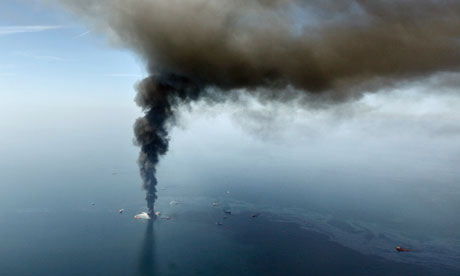
The fact that I'm even following up on the earlier post about the Gulf oil spill is worst of all. The hope was that the gushing, collosal engineering mistakes 5,000 ft below the shimmering Gulf's surface would have been capped by now. It is simply flabbergasting that BP and its host of collaborators have yet to stop or even slow the flow of oil and natural gas in the Gulf of Mexico. There is hardly an upside to this epic environmental disaster, but one is there nonetheless.

There was "top hat", then little "top hat", then the "junk shot" and the "mud shot" and of course, the "muddy junk shot"; however, the most important word I've heard bandied about is this: moratorium. Halting deepwater drilling projects and taking time to investigate the Murphy's law circumstances that led to the deadly Deepwater Horizon explosion are prudent (gladly taking that word back from a previous administration) steps at this critical juncture (reclaiming that one, too!). In the meantime, President B.H.O. should gather up his favorite back-pocket legislators, grab Dr. Steven Chu and get crackin' on renewable energy options and green-jobs creation--these were some decent sized planks in the platform, remember?

If the deaths of those Transocean employees could do any good, it will be in forcing the Obama administration, the Interior Department, and fossil fuel interests to go about their business in a safer more considerate way. No longer will the surgeon slice and dice without thinking about sewing Mother Earth back up again. If these companies can't prove their effective contingency planning, then they plain aren't invited into the operating theater! No swim daiper? Then, sorry, baby can't come into the pool; uh, BP, now we know you're not wearing your swim daiper.

photo courtesy of The Guardian

Jon Stewart (a.k.a. Stewbeef) runs down the clean-up debacle in a hilarious segment from The Daily Show, May 13, 2010, especially enjoyable due to its clever jabs at the always piss-poor Detroit Lions and astute recognition of Mayan endtimes indicators. Enjoy!

28.4.10

Crude | Coal | Dangers | Blunders


Warning: This is the start of a diatribe, and I'm even going to criticize...the President! No, I'm not a right-wing nutcase, and no, I'm not a bleeding heart liberal (or what Libertarian radio nut Neal Boortz would call a "bed-wetting Liberal"). I'm simply someone with an opinion, and this is my forum, so here we go!

Close on the heels of a disastrous coal mine accident in West Virginia, the Gulf of Mexico is now becoming a vast oil slick thanks to our pals at British Petroleum. The spill -- which is still emanating from the well-head deep in the Gulf -- is the result of a massive explosion that cost several employees their lives. Just as in the case of the coal mine in West Virginia, the loyal workers were after energy to be harvested for our consumption.

photo courtesy of The Guardian


Very recently our fine President attended a memorial service in the mourning coal-mining region of Raleigh County, West Virginia to pay his respects for the lives lost in the mine shaft collapse at the Upper Big Branch Mine owned by the Massey Energy Company. Commentators emphasized that mining for high quality coal in extremely deep mines is highly dangerous and the companies (and presumably the employees doing the real work) understand the heightened degree of risk. Pockets of volatile methane gas, as were thought to be the deadly culprit in this incident, can turn a typical underground workday into tragedy for miners, several of whom have gone on record saying that they would never recommend mining as a profession to their children.

I don't recall the timing, but President Obama's announcement that a widened area in the Gulf would be opened to offshore drilling, such as BP's debilitated Deepwater Horizon outfit, could not have been more insensitive considering the freshness of the WV accident. Instead of admitting the potential dangers of continuing on a path of home-harvested fossil fuel consumption, Obama in essence has given Big Oil a free pass to do as it will in our coastal vicinity. No, we may not ever see the drilling platforms because they'll be situated more than 125 miles from any Gulf coastline, but that does not make the inherent threat of man-made disaster any less frightening.

So, as BP's busted Deepwater Horizon well continues to gush black gold, at a depth of 5,000 feet below the Gulf's now slick surface, executives have admitted that the "containment dome" technology they're employing may or may not even work to minimize what may eventually be recognized as the most severe environmental disaster of this century thus far. Take a look at these Nature Conservancy photos of the Gulf Coast because chances are we won't see this kind of pristine coastal wetland habitat for a very, very long while.

Even though it is a desperate environmental situation on a grand scale, there are ways to help. There are individuals and groups (including BP, of course) doing the arduous work of cleaning up the spill, but they embark on a years-long struggle.

photo courtesy of Reuters

Now I wonder, is this what President Obama had in mind when he approved the expansion of the drilling zone in the Gulf? If this isn't a clear enough omen, then a more dire warning will never come. The eased "Drill, baby, drill!" restrictions are exactly what Obama opposed in his Presidential campaign, and his propensity toward compromise, while admirable and effective at times, in this case has proven him a fool in eco-political terms. Where is the "green energy" sector he spoke about so enthusiastically for all those heady months? Was all that simply rhetoric -- just one big "read my lips" ploy? I hope not.

Listen up: I'll venture to say that the majority of Americans don't want sullied coasts, unswimmable seas, dead wildlife, dead workers, nor do we want impervious, ungovernable corporations profit-making in our waters without regard for the safety of the American citizenry or our delicate North American ecosystems.

Check out the progress of the clean-up effort and the extent of the environmental damage with these Coast Guard updates.

Hopefully, this Gulf coast oyster reef restoration work by The Nature Conservancy was not in vain.

5.4.10

Avoiding Heavy Metal... in Seafood

After seeing the Academy Award winning documentary for 2010, The Cove, I swore to write off sushi forever. I think I knew about dangerous mercury levels in certain fish like bluefin tuna (and even large, fresh water fish species) before seeing the film which focuses on the plight of dolphins, specifically those cetaceans being slaughtered in Taiji, Japan (which continued at least until the film's release in Japan this year). However, I've enjoyed many a sushi marathon in various states, and I admit that it's a dining pleasure that has not been easy to forsake.


For Earth Day's 40th anniversary, The Nature Conservancy is making an effort to address the problem of mercury in the seafood we consume. The only way to avoid mercury build-up in humans is to avoid eating those sea creatures with high-levels as a result of predation which acts to concentrate the toxin in organisms' flesh.
Of course, enjoy the sea's bounty, but be careful what you buy and what you order! Here are some links to help aid in the tricky seafood selection process:
FishPhone - a clever little text-message service to help you choose which fish...
Seafood WATCH - Monterrey Bay Aquarium's downloadable pocket guides for seafood shopping
The Nature Conservancy - go directly to the article by Kate Frazer, "From Sea to Plate"

27.1.10

Haiti | Paste Magazine | Donate | Listen

Paste Magazine, well known as a source of indie "cool" in the music world, has made donating to disaster relief for beleaguered Haiti even easier. The initiative offers free music downloads from a vault of 250 songs to those who donate via the Songs for Haiti drive, and, rather remarkably, as a thank you gift to those who have contributed via other organizations.

This does not mean helping should always be rewarded. This is technology working for the greater good. It is "on your honor" so please don't abuse it; just use it to do some good for our neighbors in El Caribe.

Songs for Haiti

19.1.10

The Cove

Typically, if I'd come across a film about dolphins and activists, I'd probably dismiss it thinking, "It's been done. We all know about Greenpeace." However, The Cove, from director Louie Psihoyos in coordination with the Oceanic Preservation Society, is far from the conventional stories we've all heard about "Flipper" and his (and her actually!) fellow cetaceans.

With extensive interviews from Ric O'Barry, original trainer to television's "Flipper" and a dolphin activist ever since, The Cove is perhaps the most unnerving, disheartening yet exhilarating and enthralling documentary film you're likely to see.


By the end, if you have even a sliver of a heart, you'll be deeply sympathetic to the plight of the world's dolphins but also to the state of the oceans in general. Just by shedding light on one dolphin "killing cove" in Japan, the film's organizers have opened the flood gates of international compassion, and hopefully action as well, that will lead to end of these abhorrent practices.

Despite the inherent weight of the work's message, the OPS team has produced a captivating spy tale full of cat-and-mouse reconnaissance, covert operations, breathless near misses, and triumphantly OO7-esque surveillance. Put all this together and you have what deserves to win the Oscar for best documentary film of 2009.

Some of the scenes involving a pair of champion free divers are quite breathtaking. In an underwater world that is made up essentially of sound and sound alone, dolphins and whales are generally perturbed by s.c.u.b.a. equipment, so these especially gifted divers are able to commune with the creatures without restrictions -- just beings sharing an environment together.

There are so many ways you can help: One way is to completely avoid consuming large fish species in foods like sushi and sashimi (your neurons will thank you for keeping them free from mercury exposure which is a central theme of the greater environmental issues presented in The Cove); another way is to start with the Internet and find out how to contribute in any way possible.

TheCoveMovie.com
SaveJapanDolphins.org
TakePart.com
Facebook.com/causes
OPSociety.org

21.12.09

Humming a Different Tune

While it may be new compared to the song of Kyoto, the new Copenhagen Accord on climate change regulation may not be exactly the kind of progress we needed, but at the least it sounds like a secondary step in a positive direction.

Sunday's New York Times editorial sums it up and at once highlights just what I thought was wrong with the media's treatment of the conference and its goals despite the intense preparations made by participating factions:

The global climate negotiations in Copenhagen produced neither a grand success nor the complete meltdown that seemed almost certain as late as Friday afternoon. Despite two years of advance work, the meeting failed to convert a rare gathering of world leaders into an ambitious, legally binding action plan for reducing greenhouse gas emissions. It produced instead a softer interim accord that, at least in principle, would curb greenhouses gases, provide ways to verify countries’ emissions, save rain forests, shield vulnerable nations from the impacts of climate change, and share the costs.

Now, after the fact, it seems fine to pin a good deal of the credit on Mr. Obama and his eleventh hour efforts to save the disintegrating negotiations from failure. This new accord may be a save of sorts, but the article overstates the case that our man in Washington was the main catalyst.

President Obama deserves much of the credit. He arrived as the talks were collapsing, spent 13 hours in nonstop negotiations and played hardball with the Chinese. With time running out — and with the help of China, India, Brazil and South Africa — he forged an agreement that all but a handful of the 193 nations on hand accepted.

Nonetheless, the heavy-hitters (or more aptly named, "heavy smokers") are now further obligated to make significant changes in climate regulation in their home countries, although I won't qualify the U.S. target of 17% reduction by 2020 as any kind of glorious illustration of leading by example. At the very least, we and all the rest of the most noxious emitters are dancing to the same tune for now, and it seems that the world's leaders can agree that this climate cycle is, for the most part, man-made and should thus be addressed and ameliorated by the same guilty party.

So, even after months of negativity and doubt, there is an accord, with real emissions targets on the horizon, to which governments and corporations must adhere. This should be the christening needed to send a new, greener ship on an inter-continental voyage to sweep fossil fuels, hopefully along with last century's other environmental ills, right out the back door like so much useless grit.

8.12.09

Copenhagen | Hopenhagen

The climate talks in Copenhagen: It's clearly an "all your eggs in one basket" kind of deal. However, it's better that the "eggs" ride along in any basket as opposed to being kicked around like golf balls "foot-wedged" from the rough. If we leave it up to lawmakers alone, though, we may end up scrambled anyway, but that's an entirely different discussion.

Admittedly, the Kyoto Protocol has served the world's governments as a framework within which they can build and implement environmentally conscious policies. What has been disturbing about all the lead up to the Copenhagen talks is that most new agencies and media figures have been repeating their skepticism at reaching any kind of binding climate agreement.

Even as the talks get underway, the media is poisoning the diplomatic dynamic, one that is inherently fragile and often emotionally charged, by continuing to convey only the doubts surrounding the summit. The media should report on the talks day-to-day, bringing the public a snapshot of a restricted, influential slice of the democratic process; leave conjecture to the think-tanks and just see what happens instead of jinxing the whole affair with negative projections.

As a media leader, The New York Times is doing the prescribed job at least: the organization is trying to present a multi-faceted look at Copenhagen while using Kyoto as a reference point (maybe the only one available). Check out the piece on the Kyoto Protocol's effect on carbon emissions and we begin to see from where the negative outlook for results in Copenhagen sprung forth. The interactive page-by-page diagram is particularly informative.

For the most part, the media has put a figurative "dark cloud" over Copenhagen where a literal cloud has already formed -- over there and over here and everywhere in between. My hope is that humanitarian vision and idealism will prevail over the practicalities of economic strength and profit trajectories as related to emissions legislation. Our leaders need to see that, in addition to supporting bottom-up, grassroots conservation efforts that keep local economies thriving and green, they need to put the U.S. in a political and economic position to lead by example and let that ecologically-minded position trickle down to developing world where the environmental battles can still be fought and won, as well.

We all have a responsibility to "quit smoking" fossil fuels, as we've learned to do so well since the Industrial Revolution, and begin sipping green energy to the benefit of the entire earthly system. Let's hope that those in Copenhagen can find a path through the concrete jungle of rhetoric and greed to a healthier planet for us all -- one where human rights, economic fortitude, and environmental impacts all still matter.

14.10.09

The Objects of Our Lives

I had been waiting for this film to be released on DVD and, thankfully, it did live up to all the hype and glowing reviews. It was guaranteed that the film would have a smooth, stylish yet highly informative flow based on Gary Hustwit's previous film on the ubiquitous font Helvetica. In terms of career continuity, Hustwit has again taken the viewer on a thought-provoking journey into good design and the reasons for it, this time via an examination of the objects we encounter and use daily.


One aspect of the film, however, did leave me wishing for a more thorough treatment and that was the discussion of sustainability regarding the life cycles of these quotidian objects. More than ever, a valid concern for consumers of these objects (that is to say, all the products we allow into our experience) is what we will do with them once they've worn out.

Certain designers and critics featured in Objectified did address this issue. Bill Moggridge, of the design firm IDEO, expressed his firm's interest in the addition of value through the repeated use of an object so that as the manufactured product ages and becomes "broken in", its value to the user increases either due to increased functionality (i.e. stiff leather hiking boots) or because of sentimentality (i.e. an antique fountain pen used to compose a love letter).

Overall, the film was engaging and enlightening, even if you have only a cursory interest in design. It's a good time to try to spot the products that have crossed your path over the years and also to see whether you agree or disagree with the considerations and justifications behind their design.

Find out more at the film's official website:
Objectifed ~ a documentary film by Gary Hustwit

21.7.09

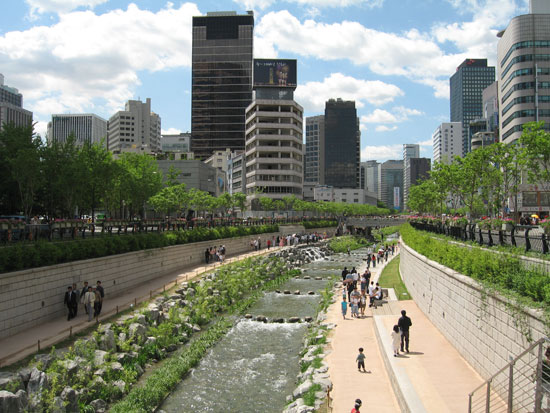
Cheonggyecheon - The Heart of Seoul's Green Rehabilitation

After learning about this ambitious project on the PBS documentary design series " e2 " I sought out some more information. The endeavor had its critics but there can be no argument: the city of Seoul is far better off for having agreed to this expensive but worthwhile renovation of an urban eyesore into a cosmopolitan, "green" jewel.

A decent overview of the Cheonggyecheon River Restoration project from Spacing Toronto will help to see all the phases from the demolition of the expressway to the finishing of the promenade that has become the heart of Seoul's social life.

Images from the Rights of Way blog show the remnants of the original elevated expressway that orginal covered the river. Ironically, the mayor who originally spearheaded the elevated highway was the very same who pushed for the rehabilitation and restoration of the Cheonggyecheon River. So, in the end, it's a good thing that some politicians, in their search for approval, end up backing projects that actually improve quality of life.

Check out this pdf. hosted by cepis.org for more images and information.

Playing For Change

By now, most people have heard of the Playing For Change project. If not, check out the video or follow the links below and discover this shrewd, philanthropic, unifying approach to appreciating the world's buskers and their product: music!

Playing For Change - Mark Johnson, Founder


Be a part of the project -- go to:

Playing For Change Foundation - Whitney Kroenke Burditt, Executive Director

16.7.09

Chiyu Chen's Hybrid Bike System

Designer Chiyu Chen has conceived of an ingenious transit system that encourages the use of sustainable transportation by crediting people for renting and riding bicycles. His Hybrid2 system consists of a fleet of rentable bicycles that are capable of generating and storing kinetic energy, which is then used to power the city’s hybrid electric buses. Simply rent a bike, charge it up with kinetic energy from pedal power, and then return it to a kiosk – the station feeds energy into the city’s smart grid, and you receive a credit towards your next bus pass!

The answer to the climate crisis is going to come in myriad forms. This transit model, centering around bikes and buses, may be part of the solution. Consider it.

Find more info on the Hybrid2 Bike Rental System at inhabitat.com

30.6.09

To Shed Light...

In my opinion, a good idea deserves to be spread around.

A group of three designers, jointly know as the Civil Twilight Collective , has recently been recognized on NPR.org as the winner of Metropolis Magazine’s Next Generation Design Competition for an innovative adaptation to conventional streetlighting. The lunar-resonant streetlight intelligently adjusts brightness in correspondence with the phases of the moon and in doing so would stand to save significant amounts of energy, energy that currently dissipates into the night illuminating very little that the moon (in its brighter phases) is not already.

The inspiration for such a creative approach to outdoor, public lighting is little more than common sense, but by the same token, if it's such an obvious idea, then why had no one thought of it previously? The point may be that by adopting an ecologically "smart" system such as lunar-resonant streetlights , no corporation, no entities besides the manufacturer and
the designers stand to gain anything from its implementation.


This is where the currently snowballing shift from antiquated, greed-driven, profit-making ventures to sustainable, earth and human-friendly, social business models amasses some serious speed. With no material "wants" to calculate on behalf of its creators, lunar-resonant streetlights (like most socially beneficial inventions) simply cover the needs of their beneficiaries which is to brighten the night while conserving energy resources and also perceptibly reducing light pollution in urban centers.


Other intriguing projects by the Civil Twilight Collective:

Origami Kayak
Mycofarmhouse

9.6.09

Green Sky Above

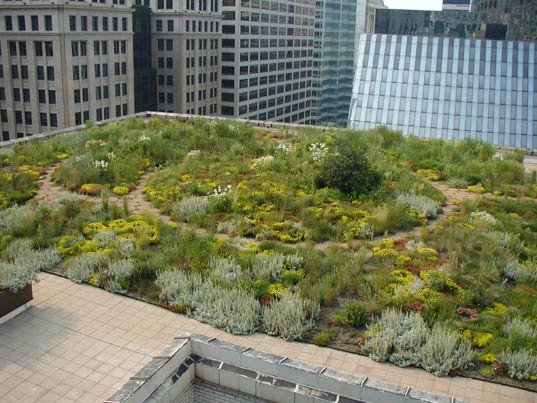
If green roofs are good enough for rural Norwegians and Dubai's business men, then why not us?


Green Roofs Australia reports that New York City is the fastest growing area for incorporating green roofs into new and existing structures, most of which are on commercial buildings. The potential for positive environmental impact with these relatively simple green roofing/walling systems is, at this stage, beyond measurement. For these eco-friendly, and human-friendly, steps to take hold, the effort must be a concerted one, though, or the true benefits might only extend to those within view of the new verdant rooftops.

At left is the William McDonough-designed visitor center at the Bernheim Arboretum & Research Forest outside Louisville, KY with its green roof of native species  -- a lucky pitstop this summer on a trip back down South!


If a public relations campaign can garner enough interest and support from both the corporate and government side, soon enough those antiquated folks with shingles, tar paper, cedar shake and tin above their heads will begin to feel significantly out-of-style. Perhaps keeping up with the Jones's will be the key to making skylines greener nationwide with the beneficial results trickling down to us all, after the sedum(s) on the roof get their drink, of course.

That's the idea and the effect is gorgeous, in many ways, depending on the sophistication of the design. The commercial applications seem long overdue.


2.6.09

GoodGuide.com ~ Consider the Impact of Consumer Behavior

I heard about this informational site on the P.R.I. syndicated radio program Tech Nation.

Did you ever wonder how toxic that floor cleaner really is for you or your family?
Is a Cheez-It that bad for your health? How about the health of the planet? What was its carbon-footprint before it ended up munched? Which is the most environmentally friendly water bottle, so we can avoid a lifetime of trashed plastic bottles?

Find out all you wanted to know about the environmental, biological, and social impacts of the products we use at GoodGuide.com. It's a powerful resource that's getting better and more comprehensive all the time. Use it to get the economy rolling again, in an environmentally conscious way.