Showing posts with label history. Show all posts

6.2.15

Woke Up on the RIght Side of the Bed


I do have plenty to be thankful about.
How about you?

The longer version of this tune is in the Sound Recordings archive at CulturalEquity.org.  The online repository is packed with Lomax's field recordings, films, interviews, festival performances, photographs, and so much more--the living history of our country's sonic and visual culture.

24.12.14

"If today was Christmas Eve..."

I'd been posting these family photos to Facebook where they seem to land like a snowflake on an outstretched tongue.  Something about social media has gotten to me, in a bad way: The fleeting, scrolling, trending nature of everything, a post like a glare off a mirror to elicit a smile or provoke a thought then fades into the feed never to be revisited.  Here I can come back and remember.

The Huron River outside Hamburg, MI

From the vaults of Frederick H. Tank, Sr. via my father, F.H.Tank, Jr. and his preservation of these negatives:  Christmas & Days Past.

Little Freddy seems fairly pleased with the globe Santa left for him.

Grandma didn't much enjoy having her picture made by the time she and Grandpa Tank moved up to Traverse City in the '80s, so this is a rare, placid shot of her.  She loved to hang the tinsel though!

Helen (Jordan) Tank


Uncle Larry

Freddy & Larry circa 1948


My dad and his dad circa 1938.


My grandpa had a fine eye for composition and could nail an exposure. Back in the day, this took practice, persistence & patience, all of which he had.  This shot of my dad and my uncle is one of my favorites--Rockwellian and classically American--taken just after World War II when no doubt the future looked very exciting, indeed!

14.1.14

Even More Selected Podcasts

Some time ago I put together a short list of worthwhile podcasts. Here are a few more to keep that list going.   Try these out on a walk or a commute or wherever you want to engage your imagination and/or be inspired.

UnFictional - KCRW puts together compelling stories from the Independent Producer Project, a great way to hear perspectives from storytellers who might not cut through the greater internet din. Here's a start for you: the tale of Nature Boy, a.k.a. eden ahbez, a California ascetic whose spiritual journey was a precursor to West Coast "hippie" culture.

RTÉ Radio 1 - This is not where I originally heard the story of a German paraglider who was hopelessly ensnared by an Australian thunderhead during competition, but if that gripping survival story is any indication, the Irish radio giant has plenty more quality pieces to discover.

Smithsonian Folkways: Sounds to Grow On - An interest in field recordings and American roots music led me to this set of programs, chock full of rare Folkways Records treasures presented by the son of Moses Asch, the label's founder.


The whole collection is illuminated by the historical insights provided by Michael Asch & folklorists making these a pleasure to delve into. The episode titled Talking About the Blues exemplifies the depth of the music and cultural context found throughout the series (above, Big Bill Broonzy, one of my favorites).

Judge John Hodgman - The comedian/writer host is a middle-aged eccentric with a lush mustache and a distinctive worldview.  If you can handle a fair dose of hipster geekery, try out one of these entertaining mock trials based on:
"real life disputes on issues such as: 
-is chili a soup or a stew? 
-is this room in my house called an “office” or a “den” or “a room full of junk.” 
-when is it may someone else’s Chinese food be legally considered abandoned property?  
-is it OK to rifle through the trash for prize coupons in a Canadian pizza parlor? 
-is a machine gun a robot?  
Then I tell the disputants who is right and who is wrong." 
It's good fun (if not Maximum Fun) but be prepared to suffer through some adolescent cackling.  You do it for Click and Clack, don't you?

A little more about J. Hodgman from the multi-talented Steven Weinberg via Brooklyn Based

Enjoy...and tell me: What podcasts are you enjoying lately?


23.1.11

Kerouac to Brando: "...put up your dukes and write!"


The following letter was a plea from a counter-culture idol to a budding star of the gritty, NYC film culture to get something done, to get (more) famous, to get rich. Kerouac uses words like "wanta" and calls the American movie industry an "outmoded dinosaur" as he goads Marlon Brando into turning On The Road into a feature.
letter hosted on boingboing.net

Thanks to legend-in-the-making, singer/songwriter/producer/bizarro West Coaster Chuck Prophet for posting this via Twitter or Facebook or some such socio-digital vehicle. Cheers, Chuck!

7.8.10

Listen: It's Unwinese

Ever hear of Stanley Unwin (1911-2002) and his invented, modified English gibberish called Unwinese? Well, neither had I until a friend (a Brit and a Burger -- from Luxembourg, that is) shared with me this golden folly of yesteryear. Remarkabold!


The fact is this Unwin, a workingman and a family man prior to achieving comedic fame in the 1950's , was a natural voice actor awaiting discovery. Just have a listen to any of these tracks from StanleyUnwin.com. His sound effects, too, are perfectly timed and you'll wish his stories would never end.

photo courtesy of LiberalEngland

It all started at the request of his children around bed time. Just like any good dad, he obliged nightly, but in doing so he began to entertain even himself by telling his stories in a fanciful, rollicking, mixed-up language. The mystery is that Unwinese is completely 'understandabold' because the changes in each word seem to preserve the original just enough. Imagine falling asleep to this!

To see this Unwinese in print is another way to appreciate its complexity. The word combinations, although sometimes befuddling, seem to make sense after some cursory consideration. Open your ears to the sound of your own voice with this 'politito' analysis, again from LiberalEngland:

Fundamold to this new Europe is the swap and trade it. At first we have it all back and forward across the borders with “please have your passy portit open for inspection”.

And this is of a great waste of time, with estimate have it and 20 billion Euro a year – and that’s without the countit and the declimly point in the wrong place!

Unfortumost – all shame and sobit – the Britly people are not keen and soldy. What they ask of the Britly passport? What of the pound and perch and of the Queen and reignit herself?

Hear their cryimost: give me bendy bananas or death and end it!


Find out plenty more about Stanley Unwin, his rocky beginnings, and his unconventional path to English comedy legend in this obituary from the Guardian. Or, as a final throwback, enjoy this clip of dear, dear Prof. Unwin advertising a fancy little piece of technology in its day:

24.7.10

Burma VJ ~ Another Secret Worth Exposing

DVD Review
BurmaVJ: Reporting From a Closed Country

Another Secret Worth Exposing by Alexander Tank
July, 28 2010


Generally, the Academy Awards ‘Documentary Feature’ category comprises an intriguing and often highly entertaining cross-section of the world’s most fascinating narratives. This year’s winner, The Cove, let viewers into a secretive world of animal abuses and the vying parties who respectively seek to conceal or expose the heinous, brutal crimes, in this case against wild bottlenose dolphins. Despite The Cove’s ultra-high production values and engaging, spy thriller plot lines, another film in this category deserved the international attention that only an Oscar can provide: the risk-taking political reportage and the breathtaking bravery of protesters in BurmaVJ by Anders Østergaard and Lise Lense-Møller.

Whether it’s called Burma or Myanmar, the oppressive military regime ironically named the State Peace and Development Council (SPDC) has quietly cultivated an environment of political repression since seizing power after violently crushing a student uprising in 1988. The gripping film is narrated by the founder of a street journalism collective, the Democratic Voice of Burma (DVB), appearing in the film under the alias “Joshua”. For most of the film, Joshua communicates with a team of street journalists armed with only video cameras and their remarkable courage. Cleverly concealing their cameras, their ultimate weapons to expose the military junta, the video journalists covertly document what has become known as the “Saffron Uprising” beginning in August of 2007 as a response to rapidly rising fuel costs brought on, after decades of oppression, by the government’s removal of protective subsidies.

The protests continue into the fall, and as students and demonstrators for the opposition are arrested and detained, throngs of Buddhist monks, voicing messages of peace and kindness in their billowing traditional saffron robes, join the non-violent effort to loosen the SPDC’s suffocating grasp on the lives of the Burmese people. With Nobel Prize winning democracy advocate Aung San Suu Kyi sequestered in a heavily guarded compound, the monks gradually escalate their protest and are quickly joined by students and the Burmese citizenry, all under the watchful eye of the junta’s generals via soldiers and plainclothes police in the streets. Over the course of days, a Buddhist monastery is raided by government agents and tens of monks are arrested in the bloody, repressive sweep. The mass of the uprising only increases as the daily protests gain momentum.

All the while, the DVB’s video journalists bravely capture the tumultuous and disturbing events on film. The internet, too, is a major player in the story as journalist leader Joshua works to disseminate the shocking images from a temporary outpost in neighboring Thailand. When a Japanese journalist is killed while filming the people’s peaceful revolt, that video is also leaked to the global media and the government’s taut cover of silence is temporarily broken, but the fight to spread the truth about the SPDC continues even under mortal threat to the video journalists and the protesters they capture on camera.

Despite its ramifications, with its documented human rights abuses and egregious military repression, BurmaVJ was passed over for an Academy Award in favor of a story about animal rights. This is perhaps the most telling aspect of 2009’s Oscar cycle: While important in its own right, a film about dolphins prevailed over a film about people whose lives and livelihoods are daily threatened by a violent and secretive military regime that actively engages in fervent censorship, keeping this unbelievably important secret from the rest of the world. Joshua and the DVB’s VJ’s, the Buddhist monks, and the Burmese people deserve for their story to be known and BurmaVJ is the ultimate conveyance for their ongoing struggle.

photo courtesy of lib.hku.hk

Burma VJ: Reporting From a Closed Country - the official site

Free The VJ's - take action

NY Times take on Burma VJ - review with interviews, by John Anderson

5.4.10

Jai Alai : The Original Basque Ball

Over the Easter holiday, I had the opportunity to witness firsthand the fast-paced sport of jai alai. Stepping into the Orlando Jai Alai Fronton (that's was the arena for the sport is called) was like walking into a sliver of Miami Vice-era Florida with plenty of colorful characters lurking about each with a glimmer of hope for the upcoming match. I posted a few bets, nothing ambitious, but the main draw was to witnesss the game play itself -- to verify why they call it "the fastest game in the world"!

The height of jai alai's popularity ---> the moustachioed 70's

photo courtesy of brooksfile.files.wordpress.com

According to historians, jai alai was originally played bare-handed against the wide and tall church walls in the Basque region of Northern Spain. The game comes to us via Cuba and then Miami and eventually the Eastern Seaboard of the U.S. as well as gambling centers in the American West. Now a significant draw for wagerers, it seems that wherever the colonizing Spanish went, jai alai, or any of a handful of other "ball and a wall" games followed.

It's tough to get a true sense of the speed, agility, and coordination required of the players, but this video does a good job illustrating the dimensions of the game and the ever-present element of fear. The fundamentals of the catching and throwing are not that difficult to master; the real challenge is to muster up the 'cojones' to get in front of the speeding 'pelota', to scoop it and whip it, and at an angle that will make it hard to field on the rebound!


The History of Basque Pelota in The Americas - a comprehensive work on the history of jai alai from its origins in Spain by Carmelo Urza of the University of Nevada, Reno.

National Jai Alai Association - the skinny on the sport and its history from the pros in 'los estates'

H2G2 at The Beeb - a decent little "guidebook" write up about modern jai alai for the curious few

Florida Gaming Corp. - what the gamblers have to say about jai alai history

27.3.10

Thanks to Stuart Udall

photo credit: historycentral.com

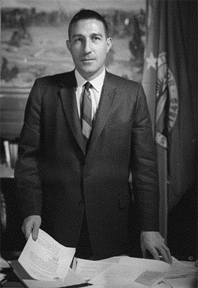
Thanks to Ken Burns and PBS, I'd heard of Stuart Udall before he died recently at the age of 90. In career terms, Udall was the forward-looking conservationist who served as Secretary of the Interior under Presidents Kennedy and Johnson. Under his tenure, our nation expanded a mandate of stewardship for our natural surroundings that began with John Muir and Theodore Roosevelt. This excerpt from the New York Times article by Keith Schneider and Cornelia Dean illustrates his legacy:
Few corners of the nation escaped Mr. Udall’s touch. As interior secretary in the Kennedy and Johnson administrations, he presided over the acquisition of 3.85 million acres of new holdings, including 4 national parks — Canyonlands in Utah, Redwood in California, North Cascades in Washington State and Guadalupe Mountains in Texas — 6 national monuments, 9 national recreation areas, 20 historic sites, 50 wildlife refuges and 8 national eashores. He also had an interest in preserving historic sites, and helped saved Carnegie Hall from destruction.
Having visited certain of these treasured lands, I feel a direct debt of gratitude to Udall and his compatriots who recognized that his generation (as does ours today) held the power to preserve this continent's natural history for forthcoming Americans even in the face of strident opposition.

His descriptions of the Guadalupe Mountains hit home for me and helped to conjure up memories of days and nights spent at the foot of that great, monolithic ship's prow in Texas: the feel of the cool air, the sound of crunching footsteps as they echoed up canyon walls, and the magic of the life-giving streams trickling down the valley. Stuart Udall saw the grand value of these now heralded places before most others, and we should consider ourselves lucky that he did.

"Plans to protect air and water, wilderness and wildlife are in fact plans to protect man." - Stuart Udall

19.2.10

Throw Down Your Heart | Bela Fleck

Bela Fleck's enthralling documentary film retraces the
evolution of the banjo from its roots in Africa. When I saw the film, I knew I had to write about it if only to alert all my many banjo playing friends out there (the number keeps growing!).

As it turns out, Marc Gabriel Amigone at the Afrobeat Blog has already done a fine review, so I'll just let you get it from there. Self-dubbed 'Afro Marc' has an excellent thing going, and his spot seems to be the place to get your finger on the pulse of Afrobeat music's history and its recent resurgence.

Here's a little taste of what makes Throw Down Your Heart so special (Fleck meets Anania Ngoliga in Tanzania, finding the first in a string of musical soulmates):


ThrowDownYourHeart.com

18.1.10

MLK: In His Own Words

It is a beautiful, sun-filled day in the South. On this day, our country honors the memory and legacy of the late Dr. Martin Luther King, Jr. His own words speak best to his mission of equality and justice which continues to this day.

Today's Christian Science Monitor has published a collection of quotes:
• Hatred paralyzes life; love releases it. Hatred confuses life; love harmonizes it. Hatred darkens life; love illuminates it.

• I believe that unarmed truth and unconditional love will have the final word in reality. That is why right, temporarily defeated, is stronger than evil
triumphant. –Nobel Peace Prize Acceptance Speech, Dec. 10, 1964

• Let no man pull you low enough to hate him.

• Returning violence for violence multiplies violence, adding deeper darkness to a night already devoid of stars... Hate cannot drive out hate: only love can do that.

• I submit that an individual who breaks a law that conscience tells him is unjust, and who willingly accepts the penalty of imprisonment in order to arouse the conscience of the community over its injustice, is in reality expressing the highest respect for the law.

• When you are right you cannot be too radical; when you are wrong, you cannot be too conservative.

• Injustice anywhere is a threat to justice everywhere. –letter from Birmingham jail, April 16, 1963

• The good neighbor looks beyond the external accidents and discerns those inner qualities that make all men human and, therefore, brothers. –"Strength to Love"

• I submit to you that if a man hasn't discovered
something he will die for, he isn't fit to live.

• The ultimate measure of a man is not where he stands in moments of comfort and convenience, but where he stands at times of challenge and controversy.
–"Strength to Love"

1.10.09

Chiasmus for the Rest of Us

As a Libra, and in keeping with the current blog title about introspection and self-knowledge, it's time to delve into a little literary device called chiasmus. Why? Just for fun...and because it's a rhetorical technique that is still used often even though it's ancient in origin. Even connections to Christ on the cross have been made to the format of chiasmus, so it carries its weight.

Any dictionary will tell you that chiasmus comes from the Greek "χιάζω or chiázō" which means "in the shape of the letter X". According to Wikipedia.org the device is used in speech and in prose to achieve a kind of parallelism of thoughts and to establish a sense of balance (hence my zodiacal connection).

My own introduction to chiasmus came from its more recent, but still historical usage, in African American literature of the 19th and early 20th centuries. I've never quite been able to devise any decent 'chiasmi' of my own, so I'll borrow from the masters to illustrate its power and eloquence when employed correctly and efficiently.

Here we go with a some examples I enjoyed from the wikipost:

"Mankind must put an end to war or war will put an end to mankind." John F. Kennedy

"You have seen how a man was made a slave; you shall see how a slave was made a man." Frederick Douglass

"I’d rather have a bottle in front of me than a frontal lobotomy." Tom Waits

"Well, it's not the men in your life that counts, it's the life in your men." Mae West

"In peace sons bury their fathers, but in war fathers bury their sons." Croesus

This last is partuicularly appropriate for our times. Chiasmus can be succinct or befuddling. Sometimes the phrase's meaning jumps off the page and other times it requires some turning over in the mind. In more contemporary uses, like the Tom Waits quote, quirkiness and humor are what make the chiasmus form ring so truthfully.

Our President is a fan -- I've heard him use chiasmus more than once in speeches on the campaign trail -- but then again so are folks like Regis Philbin and your next door neighbor, probably when he's trying to sound wise from over the fence.

So, I declare, chiasmus for them and chiasmus for the rest of us!


24.9.09

Cicero's 'Civiliter'

Upon the suggestion of a dear wise friend, I've undertaken a course of much-needed 'catch-up' in regard to my liberal arts education, specifically in the realm of ancient Greek philospohy and its bleedover into Roman schools of thought.

My friend recommended Cicero, whom he himself regards as a rhetorical and oratorical friend, as a start. I suppose it might sound strange to think of an ancient superstar speaker and thinker like Cicero as a friend, but you just have to know the person doing the recommending.

After scratching the surface only, one concept of Cicero's has taken my breath away and it is that of civiliter. Michael Grant, the translator of the Cicero: Selected Works I've borrowed, states that the word itself has no direct translation in modern English, but its meaning approximates:

"like a citizen, like an educated Roman, like a civilized man living as a member of his community."

And Grant continues to assert:

"Among those of the world's codes of behaviour which are within the bounds of practicability, few if any deserve more careful consideration than Cicero's."

So, it may be for this reason that my friend has suggested the much lauded and oft-emulated Cicero to start my literal re-education.

More on the man, Cicero, and the notion of civiliter later.

13.7.09

Jazz: Faces of International Pride amidst Domestic Pain

A recent article in the Christian Science Monitor does an excellent job describing a very unique situation in United States' history related to domestic equal rights and our international image. Read for yourself and see if this dichotomy is, for you, as striking and thought-provoking as it was for me.

The following rhetorical questions are emblematic of the article's general tone which describes the State Department's employment of African-American jazz musicians for government sponsored tours across what was then the Soviet Union and various African and Middle Eastern regions:

What was it like for these black musicians to headline celebratory concerts for newly decolonized African nations on the one hand, but still not be able to stay in hotels south of the Mason-Dixon line back home? What was it like to travel under the auspices of a country known abroad for, as saxophonist Paul Jeffrey was told in Italy, white men being the boss of black men?
(By Carla Murphy Contributor to The Christian Science Monitor
from the July 10, 2009 edition
)


So, just as these musicians where escorted around the world to serve as an egalitarian, collective and creative face for the nation at large, the same talented and renowned citizens, because of their heritage and complexion, would have been discriminated against without a second thought in their own home country. Even with a fundamentally sound mission, the State Dept. tours were, at heart, hypocritical public relations campaigns designed to globally promote an American ideal that had hardly begun to gain momentum at home, regardless of the known fact that equality and inalienable rights had been and still are our constitutional guarantees.

Find out more about the traveling exhibition of photographs, called Jam Session: America's Jazz Ambassadors Embrace the World, that documents this fascinating international tour by some of the greatest jazz musicians of all time.

29.6.09

A National Face

I absolutely love it when journalists, talking heads, public commentators and like decide to generalize on the so-called "core values" of a particular nation. These blanket statements almost always come across as sweeping stereotypes yielding only the tiniest indication of the nation or its citizens' identities. A beneficial practice for the youth of any country might be to make an acquaintance, better yet a friend, from a country other than one's own so as to instill, from an early age, a sense that even though a group may gather under a common, national umbrella, those in its shadow rarely possess more than just a few similar traits.


The best of these generalizations are quite detailed and as such have already narrowed their scope; the resulting idea is conveyed successfully. For example, in the Christian Science Monitor today (29.06.2009) the author James Miller states, "One of the core principles of traditional Chinese culture is that of harmony between humans and nature." If delivered by a news anchor or commentator, surely this statement would be reduced for shorter attention spans and might come out as something like, "The Chinese people believe in harmony between humans and nature." The latter comment is far less truthful than the former and this is the tendency of most media voices today; the goal is to get the point across while including the fewest details necessary.


This makes for a portrayal of the world, its people and its dynamics, that is two-dimensional at best and at worst, a gross misrepresentation of reality. As it is, the world is a full of tonalities of truth, varying from the purest of positive events and actions to the most heinous of malicious occurrences. To dissect our lives and our environment with such a cleaver, one that slices only black and white hunks of generalization, is the great disservice that corner-cutters on the boob tube provide us.


It's true; one could rightfully question: "What do you expect? It's free." However, the dangerous cost of this type of distilled dissemination of facts is our narrowed perspective which inevitably leads to misunderstanding and intolerance of others.

Most often, I balk at the notion that, "Americans are..." something or some way across the board. These stereotypes hardly apply to me or anyone I know. And this is not to say that I'm so unique that nobody can pin me to a category. I'm plenty normal, but the deeper fact is that no nation's face, even of the most ethnically homogeneous culture, can be sufficiently described by the use of just a few adjectives or the bandying about of blindly adopted stereotypes.