Showing posts with label arte. Show all posts

14.11.14

Escher & Hundertwasser Prints

I've drifted back over to Seattle's superb Davidson Galleries and continued collecting images (at least virtually).  Escher caught my eye on the main page--iconic, legendary--but so too did Hundertwasser for his richly colored and textured works--and what a name!

ESCHER
We always gravitate towards M.C. Escher's masterworks of perspective, the tessellations, intricate patterning and bold graphics.  Along with the trademark images, this time a few lesser known pieces stood out (buy them here); the first helps to see into his process, the precision and density of his line work.  The second is a classic Eastern natural scene, a catfish (or koi) submerged in monochromatic autumn.  The last two are more commercial work, doubtless Escher's bread & butter in his early career before reaching mythical status.  His command of the medium is still unmatched and as striking as ever.

Regular Division of the Plane I, 1957
Woodcut in red on wove paper.
9-1/2 x 7-1/8 inches.

Three Worlds,   1955
Lithograph
14-1/4 x 9-3/4 inches

Lute (III),  1931
From XXIV EMBLEMATA. Woodcut on buff wove paper
7-1/8 x 5-1/2 inches

Peacock (Second Titled Page),   1931
From XXIV EMBLEMATA. Woodcut on buff wove paper
7 x 5-3/8 inches


HUNDERTWASSER:
The following is from Davidson's literature on Freidensreich Hundertwasser (prints here):
[Hundertwasser] was largely self-taught apart from a few months at the Academy of Fine Arts in Vienna and the École des Beaux-Arts in Paris. While he admired members of Die Wiener Schule des Phantastischen Realismus (Viennese Fantastic Realists), it was with the richly colored and patterned surfaces of work by Gustav Klimt, Walter Kampmann and Egon Schiele that he found greatest resonance.
Hundertwasser's extensive graphic output began in 1967 and was characterized by hybrid forms that enmesh human and natural elements while using highly saturated colors, metallic imprints and carefully  ,calculated color variations within the printing of an edition.
The parallels to Klimt are evident, especially his framed, "cubbyhole" surfaces and use of metallic pigments.  The fact that he was self-taught brought to mind Earl Cunningham and maritime paintings I'd seen once in Orlando's Menello Museum of American Art; Cunningham's buildings in particular have that same tweaky, rickety feel with distorted perspective, the kind Escher would have scoffed off the paper.

These two below were made for the 1972 Munich Olympics, not necessarily remembered for sporting achievements but instead for an infamous terrorist act.  Beautiful colors printed ahead of dark days.


Olympische Speile München, 1972 (2 variations shown)
Silk screen in 21 colors with metal imprints in 5 colors 
and an electrostatic application of felt fibrils. 
40-1/2 x 25 inches.

One of Five Seaman, 1975
Silk screen in 18 colors with metal imprints in 2 colors   
33-5/8 x 22-7/8 inches.

Maybe it's the mustard color or the head shape in this last one, but I think of Os Gemeos, the twin Brazilian street artists who've been befriended by graffiti darling Banksy and lauded by international art critics.  Here's a write-up of their 2013 "Anglo-Paulista" collaboration for Banksy's residency in NYC.

10.6.11

More Ukiyo-e & Other Prints

Because it was such a pleasant chore last time, I've decided to reprise my virtual print collecting expedition.  Finding a golden trove like Davidson Galleries out of Seattle, WA (last time I went searching for viscosity prints) was a stroke of luck that opened my eyes to the vastness of printmaking as a genre. 

Snow in the Countryside (1909) by Kamisaka Sekka

These selections draw from more traditional roots: some Japanese woodcuts and a talented contemporary artist thrown in for contrast.  This print by Sekka has all the movement of a fierce winter storm, and it's achieved with so few shapes; it's a testament to the striking simplicity and grace of the discipline.  I just enjoy looking at these when I click through, and I hope you do, too.

Of all the Japanese woodcuts, those by Kawase Hasui, in particular, had a way of capturing the essence of fleeting nature, a gust of wind or a snowflake melting on a windowpane, that could transport the viewer into the moment, into the light of the past.  The glowing grey-blue gradation in this Shōwa-era print deftly depicts the rising crystalline moonlight.  One can almost imagine the feel of the cold granite in the foreground, smoothed over centuries by nightly winds rushing through the valley below.

Kiyomizu Temple Kyoto (1933) by Kawase Hasui

Now I realize the last image here is not strictly a print, but the concept of remaking Ukiyo-e via digital photography -- and executing it so immpecably -- meant I had to include it.  The Canadian artist, Jeff Wall (1946 - ), is a master in a highly orchestrated, directorial style of photography.  According to Greg Fallis of Sunday Salon, hosted by Utata.org:

A great deal of Wall’s work seems to be an attempt to be such a “painter.” He even recreates the work of painters he believes met Baudelaire’s standard. For example, Wall is quite taken with the woodcuts of Hokusai, a Japanese artist who lived in the late 18th and early 19th century. In the following woodcut, Hokusai depicted a sort of Cartier-Bresson moment…a decisive moment.
Hokusai
Wall recreated the scene on a cranberry farm in rural Canada. In keeping with his obsessive, directorial style, he staged the photograph with great care. He selected the location to match Hokusai’s wind-bent trees. He had the subjects crouch and hold their hats similar to Hokusai’s. He recreated the hat that was blown away, and the scattering of papers. And yet he made it a completely contemporary image by setting it in a Canadian landscape and including the line of telephone poles.
JeffWall1
Wall’s photo has all the drama and spontaneity of Hokusai’s woodcut. There is a wonderful sense of immediacy and tension. How was he able to create such an atmosphere and still reproduce Hokusai’s image so faithfully? By using the magic of digital imagery. Wall’s image is actually a composite of more than 100 separate photographs taken over two winters.
Fallis continues to explain how huge these prints are on display, taking up an entire wall of a gallery on a lightbox, but beyond this reincarnation of a great Hokusai print, its accuracy and emotion, I find the philosophy behind the work to be inspired and thoughtful.  Just as in the prints by Hasui and Sekka, the everyday is elevated to historical significance through the remarkable rendering of these scenes.

16.3.11

Brian Smith (of Odd Trio, Georgia Guitar Quartet) Speaks: "Daedalus" @ Canopy Studios

If you're listening to the news, it's hard to disagree with the sentiment found in Chinua Achebe's title for his 1958 masterpiece "Things Fall Apart".  While all is in flux half a world away, in our own backyard musician and composer Brian Smith has been busy bringing worlds together with the premiere of his latest musical suite titled "Daedalus". 

On Saturday, March 19th at 7pm and again on Sunday, March 20th at 3pm, Canopy Studio at the Chase Warehouses in Athens, GA will host a remarkable union of original music and gorgeous aerial artistry, joined under the vision of composer Brian Smith with his troupe of talented musicians (including wife-flutist-trapeze artist, Natalie Smith, members of Georgia Guitar Quartet, Odd Trio, Maps and Transit) and aerialists performing on trapeze, silks, hoops, even bellydancing!  

Brian was kind enough to discuss "Daedalus", his inspirations and his process, in a recent interview:


AT: What was the inspiration for this particular suite of compositions? I know that the Greek myth is the central theme, but is there any other driving force or catalyst that led you to create this work? Does it help push you that not many people are doing this kind of avant-garde, chamber music performance in the indie-rock dominated landscape of Athens, GA? You're part of an impressive network of very talented musicians, and it's got to be exhilirating to join forces in this way.

BSmith: The inspiration for this work came about at the last Canopy show actually. Julie [Phillips] was performing a silks piece to a duet that I wrote for Natalie [Smith] and myself and the silks looked like wings and there was a big drop in the piece. It made me think of Icarus and I thought it would be neat to write a piece for Julie to perform based on Icarus. When rereading the Icarus story, however, I noticed that I felt more of a connection to Daedalus rather than Icarus. I really felt the tragedy of a father losing his child now that I’m a father as well. Also, Daedalus appears in so many other well known Greek myths and in most cases is the catalyst, so I thought it would be interesting to follow his story.

Here in Athens, there are so many great musicians doing so many great things, I feel like a drop in the bucket. I think everyone here pushes the envelope and blurs the lines of style and concept. It’s very inspiring to be immersed within such a place. As a composer, I feel like I just have to do what I do and hope someone likes it.

It’s absolutely exhilirating. I feel so lucky to be able to work with so many amazing musicians and aerialists and dancers and it’s even better to know that they are all good friends. It’s nice to have a reason to get all these folks together in one place. I like to think that I’m just creating a platform for all of these great artists to shine and have a good time making music.

AT: In previous discussions, you've mentioned mathematics and number theory -- like the Fibonacci Sequence that describes nature's spirals as in a sunflower -- as those relate to music. How do you use number theory to inspire your pieces, and are there particular rhythmic patterns that the audience can listen out for during the upcoming performances of "Daedalus" ?

BSmith: Absolutely. Over the past few years I’ve been developing my writing style using what I call “numerical symbology”. I got the idea from Carl Jung’s and Joseph Campbell’s idea of the collective unconscious, wherein universal archetypes are similarly expressed throughout human culture worldwide. Joseph Campbell discusses the idea of archetypes within world mythology characters and symbols. I think people have the same universal symbolic perception and experience about numbers, their shape, sound and meaning. I have tried to craft the pieces using some basic number symbols as well as more deeply hidden symbols for those who care to study the score more closely. I also think that there are certain musical mathematical symbols expressed in pitch, harmony and rhythm. Whether someone considers themselves “musical” or not does not matter in terms of their perception of these symbols. It is the people’s like or dislike of the music itself that illustrates the symbol’s success. With this work, I tried to pull many cords within people’s psyche. We’ll see if it come across.

AT: The Cretan labyrinth is part of the story of Daedelus. Is there any purposeful misdirection in the work, at all? Do you want the listener to feel a sense of confusion at any point on the way to a deeper resolution, that epiphany moment when the puzzle is solved?

BSmith: I found the labyrinth story of Daedalus to be the big connector of the entire story. In this work, the piece “Labyrinth” is the big connector of the work as a whole. The piece is subtitled “Puzzle Piece” and the piece itself is a big puzzle. If someone studies the score, the piece can be solved. I created 3 “tries”, basically 3 different scores, that help in solving the puzzle.

For the listener, there are big chunks missing in the piece and recognizable melodies arise that help determine the solution. The epiphany moments will perhaps come after the concert is over. All the pieces of the work draw from the “Labyrinth” and all the pieces lead to the “Labyrinth” in some way. It’s a cornerstone.

AT: Based on some of the main character's actions, I'm not sure he's such a friendly mythic hero. Are there certain melodic devices or key signatures that you prefer to use to depict that feeling of fleeting malice or impropriety? Not a nice Uncle, really!

BSmith: Actually, I felt like Daedalus was a sort of tragic hero, a very human figure. He’s also one of those characters that really undergoes a change over the course of his life and suffers greatly for the folly of his younger days. I think he really tries to do the right thing for the most part, but due to his past transgression with Perdix, he always seems to end up in tragic situations. But, he also helps a lot of people on the way, stands up against the wicked rule of King Minos, is respected at his craft and is well taken care of by the generosity of others. Overall, he’s quite a balanced figure symbolically. I use octaves to represent Daedalus as well as the key of b-flat. All the characters have their own musical gestures, pitches, intervals and keys. (i.e. - Icarus is chromatic falling gestures, the notes f and f#, 9ths and the key of F) As a dad, I think Daedalus does what he has to do in the given situation. Well aware of the risks, but without many options. Fatalistic, I guess.

AT: I realize that composition and arranging are arduous processes; are there modern tools that make the job a little less painstaking, or is it still a lot of sharpening the quill, mending holes in the parchment, cleaning up spilled ink and managing frustration, fending off mental illness? I know you know the image I'm drawing from: Amadeus, the scene with the cue ball on the billiards table, repetitvely banking off the cushions and back into Mozart's hand as he fervently scratches away at a masterpiece.

BSmith: Ha! Well, for me personally, I fret and stew and tweek and change pieces a lot before they get printed and I’m usually still making changes at rehearsals. I spend a lot of time in my head going over and over things. Probably get a little too obsessive at times. By the time I get to the computer, things move pretty fast. I like the speed of entering the music on the computer and I like not having to use a pencil or pen to make everything look pretty. I have poor penmanship and it hurts my hand to have to be that meticulous. I think all musicians stew over their work and are probably never completely satisfied. I think you just try to make each piece you write the best that it can be and when it’s time to let it go you have to let it go, warts and all.

Thanks to the composer for the insights that will make the experience of "Daedalus, a work by Brian Smith" all the richer.  For more details about the two shows on March 19th and 20th at Canopy Studio, follow links below:

The MusicSmiths
Canopy Studio
Georgia Guitar Quartet

7.2.11

Maps and Transit ~ Songs for Divining

Kyle Dawkins' string work is precise and warm like a distant voice emanating from a light-soaked church. His musical partner and wife, Julie Phillips, adds clarity and depth with xylophone and bass to make the most recent project from Maps and Transit feel gently sculpted, more manually hewn than digitally. Its sound gives a cinematic impression, painterly and full of atmosphere; even the air in the room where you listen seems to change -- though almost imperceptibly -- from the very first notes. The handy term "folktronica" has been used to describe the overall impression, but such labels only limit the scope of the duo's latest work, Songs for Divining, released on Camomille Music.

More than pairing strings and percussion with laptop beats, the pair has created an amalgam of timbres to make an ethereal whole beyond categorization. Nevertheless, with a fisheye view, the organic sound at its heart envelops influences from chamber music to hushed rock to jangly mountain field recordings.


The album's electronic sounds, far from evoking cold circuitry, resonate as naturally as the analog instruments. Subtle beats, faint tones, and counter-rhythms trickle down from the Appalachian terminus, only an hour's drive from the heart of Athens, GA, where Maps and Transit makes its home. Sonic textures sizzle and fizz beneath bent banjo notes and mandolin tremolos, held together by a windy backdrop, realizing what Dawkins refers to as a "brambles-and-vines" landscape that gives the project a vast root system and a distinct sense of place.

Polyrhythmic galloping and Celtic guitar lines in '
Three Pendulums' help envisage a wide green plain unfolding before a group of haggard wanderers. As a glistening sea rises in the distance, the mood lightens, hopeful yet cautious. The sauntering cycle of the tune seems to skirt the cliffside along the way, pushing a tenuous fragility that's quietly thrilling.

During '
Ponds', Dawkins' nylon strings zing like a faint sitar, but once layered with counter-melodies, the guitars swirl, falling into banjo as snare and hi-hat add accents. Later, one hears rustling cicadas on a nightbreeze, somehow welcomed from thin air yet completely native. These are the often subtle qualities that make Songs for Divining transcendental, intoxicating, and resistant to genre pigeonholes.

Further on, crows create a chorus that binds '
Mr. Arrowood' to an hour of fading light, just as the table is set for a rollicking, quasi-funk patch which features Phillips' talent for adding timely percussive accents as well as driven bass guitar. Time shifts and shuffling, courtesy of a beat-up mandolin, keep things off-kilter contributing to a brief extraterrestrial notion. Here the pair lithely tramps a route seemingly bushwhacked by the likes of electronica heavies Aphex Twin or Amon Tobim. Without straying too widely, though, the song is resolved with a familiar, delicate banjo as birds again take wing.

These nine compositions by
Maps and Transit flow down and through a riparian zone, like a creek bound to join its kin, less a riled river and more a hundred life-supporting rivulets finding their entropic course. The listener, too, can find a route through time and terrain, first in the blind, then sensing the way under the quiet guidance of this duo's thoughtful musical vision.

Maps and Transit released Songs for Divining Sept. 17, 2010 on Montreal's Camomille Music.

13.1.11

Drip Drop

Since the snow and ice event on Sunday, the South has been slowly, very slowly thawing out daily only to completely refreeze again by sundown. So far, schools have had an unprecedented 4 consecutive snowdays! We're calling it
"Snowcation 2011".

I saw these thousand icy fellows, and they reminded me that it's not so chilly everywhere especially at the poles, forgotten places that are supposed to be solid, untouchable geographic constants. This installation by Brazilian artist Nele Azevedo, sponsored by the World Wildlife Fund, sought to highlight that environmental fragility. These little guys say so much by simply sitting there dripping!

Nele Azevedo's Melting Men on the Concerty Hall steps at Gendarmenmarkt in Berlin:

one fresh Melting Man in Berlin from unurth.com

fisheye view of Azevedo's Melting Men greenupdate.wordpress.com

The little fellows can be seen in photos from around the world spreading awareness about climate change.

27.12.10

The Tones Between: Photographs by Greg Seman

In 2008, I made a point to present some of my favorite images by photographer Gregory Seman. Since then, my old friend's profile has grown higher while his work continues to delve deeper into the subtle quietude of landscapes we foolishly careen past so much of the time.


Marquette Rooftops, 2008 : Greg Seman

The places are beautiful, but more than place, Seman is capturing time and light in a way that the old masters would revere. He's represented by the Halsted Gallery in Bloomington Hills, Michigan, as well as in the cloud at Greg Seman Photography. At Halsted, his name appears alongside the greats: Ansel Adams, Henri Cartier Bresson, Wynn Bullock, Imogen Cunnigham, Yosuf Karsh, Michael Kenna, Andre Kertesz, Edward Steichen, Jerry Uelsmann, all those Westons, Minor White -- among well-renowned others and some whose work I still should seek out.
a favorite by Minor White (1908 - 1976)
Today, I'm so proud to have, by chance, found a Greg Seman image in the February 2011 Special Issue of B + W. I picked it up as I do on most book store stops, and as I flipped through the images within I thought, "Maybe I'll just glance at the table of contents just in case..." and, in fact, there it was on page 139:
Ice Flows, Frankfort Pier, 2009 : Greg Seman
The 'Merit Award' shot, taken along the Lake Michigan shore, is emblematic of his compositions -- dynamic nature, refined vision, impeccably smooth tonalities, juxtaposed textures, pristine printing technique -- and the result is a sense of that spot at that moment, something that couldn't be recreated if a person gazed out from there, even an hour later. The skill and diligence it takes to craft such a vision is laudable and worthy of the respect that's begun flowing just like the ice pictured above.
Moonlit River, 2007 : Greg Seman

14.12.10

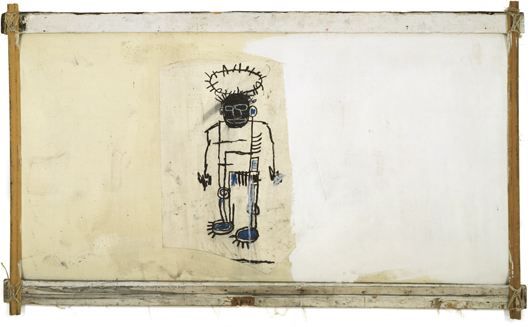
Basquiat & Os Gemeos | Banksy & Guetta

Street art is not what it used to be.


portrait of Jean Michel Basquiat by Warhol

Grafitti: unappreciated by the masses, produced by so-called "street urchins", miscreants and punks, disdained by the authorities, loathed by real estate agents. It still exists in this form. Just look around on the train, the warehouse, the stop sign; what's in that kid's backpack anyway, and why is he running? Maybe you should get a phone number, then give the kid some time to get famous.

A Basquiat sold by Phillips de Pury & Company:
a song at $4, 562, 500 US

Today, Os Gemeos of Sao Paulo, Brasil, lead the new guard of street artists turned gallery darlings. Count the late Jean Michel Basquiat (a.k.a Samo) as one of the first to make the lucrative transition, however deadly that shift may have been for him.


 Os Gemeos work on the street in Sao Paulo: Dailyserving.com

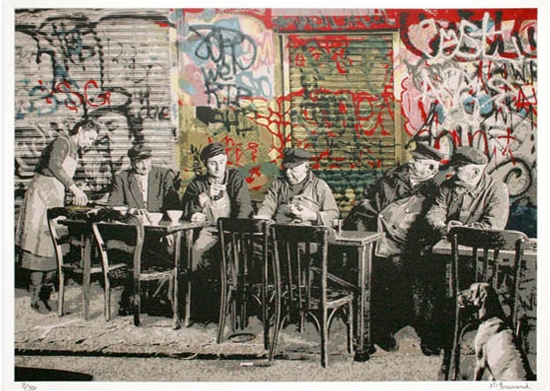
Now Banksy, the subversive street artist, lampoons the entire affair in a new film called Exit Through The Gift Shop. The film details the travails and artwork of one Thierry Guetta, a Frenchman of substantial eccentricity and at least some talent.


a more literal work by London-based Banksy

In the vein of many 'mockumentaries', it's hard to tell the real from the invented in Guetta's story (essentially the story of Guetta filming Banksy at work on the street). Is the film a document of Guetta's rise in the fine art circles or is it an intricate fabrication meant as hype, at once skewering the highbrow collectors and bandwagon trend-surfers? It's hardly a risky game for Guetta whose work is somewhat derivative anyway -- he rips off Warhol without shame and splashes paint around like Pollock. At the hands of Banksy, established cynic of the pavements, he's in for a catapult ride into the stratosphere of high-art superstardom, earned or not.

Guetta's "Le Bistro" signed by Mr. Brainwash, an alias: ukstreetart.co.uk

In any case, Exit Through The Gift Shop is supposed to be a visual treat. So we'll see: who's famous, who gets famous, or who's a famous fake.

The trailer - banksyfilm.com
Guetta's purposely confusing site - mrbrainwash.com
Here's Banksy! - banksy.co.uk
outlines the film's conjured "controversy" - markphilipvenema.worpress.com
a review - slugmag.com
another Basquiat painting (just because) - markphilipvenema.wordpress.com

6.12.10

Georgia Guitar Quartet & Robert Sims

Featuring Brian Smith, one of the musical neighbors from across the street:

Georgia Guitar Quartet & Robert Sims from Paul Hamilton on Vimeo :

I [created this] brief demo with the Georgia Guitar Quartet & Robert Sims.

As a pianist I have collaborated with Robert since 1997 - we are long time friends/colleagues. His talent is immeasurable. In 1999 he won the Gold Medal in the American Traditions Competition, in Savannah, Georgia. He also made his Carnegie
Hall debut in 2005, and returned to Carnegie Hall in 2009 as a guest of Jessye Norman, as part of her HONOR! festival. I was fortunate to play the piano for him on his second appearance, and this was my Carnegie Hall debut. We're performing together in Gibraltar this month (Dec. 20)!

His new partnership with the GGQ is nothing less than extraordinary.
Their arrangements are completely original: with Southern twang and classical
arch! Their artistry is of the highest calibre.

Caleb Vinson (Vimeo user) and I filmed this with two Canon 7D's, in Dekalb, Illinois. The audio was recorded live.

Caleb's exceptional camera moves are his trademark. I have not seen anyone use a DSLR the way he does: it proves that with practice and discipline it is possibe to achieve extremely fluid and unique moves. Well done Caleb!

We're both proud to have captured this short rehearsal with the GGQ and Robert!

Please support these exceptional musicians, you can purchase the music here:

Georgia Guitar Quartet &
Robert Sims

Find out more:

The Georgia Guitar Quartet - classical guitarists and more

Robert Sims - the superb lyric baritone

The Musicsmiths - flute and guitar duo

The Odd Trio - jazz, funk, original compositions, varied freakouts

Maps and Transit - ethereal folk and electronic music

10.10.10

Kenosha Kid @ Caledonia Lounge | 'Land of Obey' Release Show

In case you ever doubted they would, Kenosha Kid strikes again with a blazing-hot brand to last you all the way through pigskin season and beyond!

Melodies that sooth like Icy-Hot (or Vapo-Rub, whichever Mama gave ya!), searing instrumental improvisations, rhythmic sizzling behind ethereal bass foundations -- it's all in store for the hearty, the brave, the future residents of Kenosha Kid's newest release: Land of Obey.

So, if you're in Athens this weekend, "put your face on" and then prepare to have the layers peeled off at the hands of Kenosha Kid this Friday night at the Caledonia Lounge!

Listen up: you don't have to swagger into the Caledonia blind. Use your x-ray ears and get into Land of Obey before it hits the streets like a magical frog fallen from the heavens. You'd be a fool not to get a little preview, Dawg!

chimp listener image from athensmusicjunkie


31.8.10

David Byrne: Housing Sound & Music

Here's a lecture from David Byrne, the greatest college professor you never had! Recording for TED, below is his lecture about the relationship between sound and its contextual space.

He travels sonically from grimy New York nightclubs to West African al fresco drumming to organ-filled European cathedrals to the booming trunks of what folk-singer Greg Brown calls "thump-thump" cars and finally into the forest canopies.

Byrne is knowledgeable and relaxed, oddly handsome and totally enthralling. He's wise and experienced, yet he remains energetic and humorous, and based on his practiced delivery, he's done this talk a few times. Enjoy.


* TED is "a small nonprofit devoted to Ideas Worth Spreading. It started out (in 1984) as a conference bringing together people from three worlds: Technology, Entertainment, Design."

You'll find so many more intriguing and informative segments. Go. Learn. Enjoy.

25.7.10

The Art of...?

This existential street art is located in the Mission District of San Francisco. The alleyway is famous for its graffiti, admittedly of a wide-ranging quality. The view of the alley itself is pictured within the figure at center.


Do you know this piece? Do you know its maker? I do not. Please help me to solve the mystery.

14.7.10

Remember Harvey Pekar

photo credit: RhymesWithChoice

The Original (Goodbye Splendor) by Anthony Bourdain ~
Still stubbornly latched on the fringe himself, Bourdain eulogizes Cleveland's underground comic book legend, jazz writer, & blue-collar cultural icon, Harvey Pekar.

image courtesy of Ben Temple Smith

Fresh Air from WHYY ~ Terry Gross and the crew pay tribute to the late Pekar in various interviews, one with wife Joyce Brabner, from 2003 and 2005.

Unmistakable authenticity and an unpretentious demeanor contradict his own self-criticism. While before him Kerouac and Warhol pranced, showered in compliments, this fella trudged the daily path of an artful life, like living the best runs of an inspired improvisation in between all the pops and scratches in the cut.

"Everybody's like everybody else, and everybody's different from everybody else." ~ Harvey Pekar

16.2.10

Fluxus via Beck

Sometimes it's surprising how a random search, a click, a series of intriguing words can lead to an unexpected place. This is what led me to discover the Fluxus Movement, oddly enough, by way of recording artist Beck.

I've always been a Beck fan (saw him live once in Vegas) and decided to find out if that rumor -- the one where Beck is purportedly the older brother of the all-in-the-family, teeny-"mmm-bopper" group Hanson -- is actually true. As it turns out, he's not a Hanson brother although his surname is Hansen (tiny difference there, eh, like the difference between Swedes and Norwegians). Beck is, however, the progeny of a quietly heralded but influential artistic family.


Chicago Gat by Al Hansen, 1966
Hershey bar wrappers, painted wood, 11 3/4 x 11 3/4
photo credit: banffcentre.ca

Beck's grandfather, Al Hansen, while not credited as a co-founder, was one of the early artists to join George Maciunas, who is credited as the founder, in establishing and disseminating the essential vibe of the largely "d.i.y." Fluxus movement. Beyond that, Beck has said that his grandfather Al was a talented jive-talker and who better to spout-off, in slick but sometimes archaic, street-wise lingo, the virtues of this new, experimental movement. Until recently, Allen Bukoff, a founding member himself, was the most active mouthpiece for Fluxus; check the "Dear Fluxus" link below to find out if that's still the case.

To define Fluxus is a bit tricky; not even the founders could really tell you what it was (is). Good ol' Wikipedia describes the beginnings of the movement in terms of "event scores and Fluxus boxes" the latter of which were diorama-type assemblages of found materials (nothing too complex allowed -- no gold leaf, Gustav!). They may also have simply pointed to the top of a building just as a grand piano was sent careening to an explosive death by gravity. However it looked or sounded or felt, most agree that Fluxus was riding a wave that composer John Cage set in motion with his avant-garde works on mysterious, invented instruments. So, you see, looking into Fluxus becomes a kind of Pandora's Box -- watch out below!


photo credit: museum.mit.edu


You can easily find out more about the Fluxus Movement if you only try:

Audio interview ca. 1977 with Allen Bukoff & George Maciunas -- fascinating, bizarre ramblings from the founders themselves.

The Manifesto is here and now and has been since Maciunas birthed it in 1963.

Fluxus' home in the 21st century.

Dear Fluxus open letter to "the founders" -- Bukoff is off and done and gone according to these only slightly cynical, severely scathing sentiments! Please, let us not grow old and bitter.

15.2.10

Ward Shelley Walks the Timeline

Sometimes art can convey a message in such a way that it's hard not to react. The following is art that needs to be engaged with, examined, studied, pondered, and digested; it's not going to simply hang on a wall and look pretty.

Ward Shelley is an artist who presents material in a very specifically framed manner; the pieces I've been drawn to are his unique timelines with their extravagant detailing and vast yet pidgeon-holed content. I'll let an excerpt from the artist's own "mission statement" do the explaining:

My paintings/drawings are attempts to use real information to depict our understandings of how things evolve and relate to one another, and how this develops over time. More to the point, they are about how we form these understandings in our minds and if they can have, in our culture, some kind of shape. Usually I choose topics from art or cultural history, such as the arc of an artist's career and its influences, or the effect of particular ideas in an aesthetic or political movement. They are "wide-screen", with all information available to the interacting eye at every moment.

Ward Shelley, Who Invented the Avant Garde, ver. 3. Oil and toner on mylar, 159 x 72 cm.

The format of the work seems to be inspired by botanical diagrams, scientific manuals, biological illustrations, and the long tradition of charts and mapping. From the outset, Shelley appears to be an engineer at heart, one who refused to choose the cubicle.

The connectivity of all the distinct bubbles and bits of information is the fascinating part. By showing us a macro view of a topic, Shelley let's the viewer filter out distractions and zoom in on the facts that propel the eye (and the mind) forward in time and in two-dimensional space while never quite letting us escape the weight of the "whole".

The very best examples I could find (with the finest resolution) are at the artist's webiste. The piece above, among others, is discussed in full in a press release issued by the Pierogi Gallery.

I came across post about Ward Shelley's timelines at kottke.org and that piqued my curiosity. There's plenty else to be interested about on that blog, as well, so give it a look.

Find out more at the Lawrimore Project with its close-ups of timeline details.

Read an interview by Chen Tamir found at TreviFlashArtMuseum.org

Visit Ward Shelley's official site at WardShelley.com

25.1.10

Jean Baptiste Reinhardt

...that's Django to you and me!
The man, the legend would have turned 100 this weekend and don't I just wish he had had the longevity of masters (genre jumping here) like Chucho Valdés or Doc Watson. There are many out there who've researched and written on the world's most respected and most emulated Romany, so follow the links below to read more and listen to Django's recorded legacy.
For more info and a chance to listen:
Musical Interlude - excellent article for bmj.com
Django Reinhardt - Joseph Dinkins article for redhotjazz.com
Sample tracks - some samples from 7digital.com
Django Radio - all gypsy jazz on last.fm

9.11.09

Photography: Roy DeCarava

Other Roy DeCarava links of interest:

NPR blog picture show - nice overview of images

NY Times blog - good series of photos
LA Times obituary - died at age 89

The National Public Radio story following the death of photographer Roy DeCarava does a fine job with the biography of the relatively unknown artist. Just a glance at a very few images, though, gives one the notion that he had an unrivaled power of observation and immpecable timing to capture the essence of African-American life in the mid-20th century.


photo courtesy of www.dpgr.gr
DeCarava's subject matter was what he found around his home, the people in the streets or on buses and trains, and with his remarkably keen eye, he was able to capture certain fleeting but very telling moments that most of us would never even notice. A fine example of his astute observational skill comes in the form of this famous image of a subway platform, one in which race plays a central role but is emphasized by space rather than color.


photo courtesy of web.ncf.ca

DeCarava's photographs of jazz legends are some of the finest in the genre. There were others who sidled up to the likes of Duke Ellington and Thelonius Monk, but Roy DeCarava's shots genuinely seem to evoke sound, smoke, heat and excitement, the kind found right there at the foot of the stage (Decarava's Coltrane photo courtesy of arteseanp.blogspot.com).
Whether historically accurate or not, my inclination is to put DeCarava in an elite category with another lover of the street, the patriarch of spontaneity in photography, Cartier-Bresson. And Gordon Parks, that renaissance man of visual, sonic, and written language, is also of DeCarava's era and the two have complimentary styles which are worthy of comparison.

29.10.09

Odilon Redon


The Buddha (1905) ~ Bertrand-Jean (Odilon) Redon

image courtesy of artinthepicture.com

This image is one of my favorite oil paintings from any time period. I'm not sure why I enjoy it so much, but I think it's something in the way the objects and figures seem to float on top of the lush backgrounds, appearing separate from the landscape but not completely detached.

The effect is surrealist, in a sense, but Redon's subject matter, mostly still-lifes with plenty of natural themes, lends a calming tone to the work overall. The fact that the French artist was a skilled printmaker draws me in further. There is much more to discover about this underrated master.

This vision of the Buddha with the Bodhi Tree is one that appears in a few of Redon's paintings and I appreciate the Buddhist mythology, the serenity of the classic pose, as well as the vibrant but earthy color palette.

For more exquisite paintings by Redon, visit Odilon-Redon.org. Another site, OdilonRedon.net, can provide some more detailed biographical info.

30.9.09

Selected Prints

For anyone interested in printmaking, from lithographs and mezzotints to intaglio and drypoints, here is a sample of some incredible work all found at the Davidson Galleries Contemporary Print & Drawing Center. I was floored by the sheer volume and quality of work in this immense collection out of Seattle, WA. Enjoy this sampling, but definitely visit the site itself and explore for yourself.

Lotta Pyykkönen ~ There was no bio available at Davidson Galleries, but I'm guessing this artist is Finnish. Immediately, I notice a parallel to the austere Scandinavian landscapes of Gunnar Norrman previously featured on this blog.


Peter Milton ~ Back in school, a printmaking instructor alerted me to Peter Milton's work and, based on the size and pricing of his work, he may be one of the most prolific and profitable artists currently working the medium. His intaglio almost certainly involves photographic techniques judging from the level of layering in the highly detailed compositions. The following is the bio offered by Davidson Galleries:
Peter Milton is a major force in the printmaking world. Using etching and engraving techniques, Milton often spends a year or more to create his large and complex images. At Yale University under Josef Albers, Milton developed a concern less for the surface appearance of objects, but rather for the explication of their underlying, substantive qualities. Milton conveys meaning through a contextual environment of people, places, and moments in time.

Milton’s imagery frequently draws on elements from the late 19th and early 20th century English and French literary world. Rendering such imagery in a rich tonal scale of black and whites, Milton manages not only capture the mood of another era but also mid-century cinema. He cites among his major influences Ingmar Bergman and Fellini. With time and reflection, a narrative in Milton’s densely symbolic and historically referential images unfolds. Milton has received numerous awards for his prints, has a published book titled Peter Milton: Complete Prints 1960-1996, and is in every major museum collection.

Ben Moreau ~ Again, Davidson provided no biographical info on Moreau. His work, with its comic book/superhero humor, speaks for itself though.


Robert Marx ~ This artist's work very much reminded me of Ralph Steadman's loopy, sketchy style that he used in illustrations for his collaborations with the late Hunter S. Thompson. See the bio provided by Davidson Galleries below:
Robert Marx is part of a small group of important American figurative artists who comment on what it means to be human in an inhuman age. A kindred spirit with such great but often overlooked social protest artists like Leonard Baskin and Leon Golub, Marx's work speaks only to those who wish to be challenged by an artist's idea --those who seek an intense and enduring dialogue with works of art. One of America's most important exponents of the north European expressionist tradition that goes back to Bosch, Grünewald, and Bruegel, Marx's work explores the futility of trying to bring universal order or give conclusive meaning to the human condition.


Shigeki Tomura ~ Again, there are echoes of Gunnar Norrman in terms of the vastness of the landscapes but with a more classical sensibility. Glean more insight from the Davidson Galleries bio below:

The fine, intimate scale drypoints and etchings by Japanese print artist Shigeki Tomura offer spaces of quiet contemplation, where the viewer has an opportunity to pause and reflect.These serene rural landscapes depict a natural world untrammeled by human development; we find only oblique acknowledgement of a human prescence - a pathway or a thatched roof. Tomura’s imagery conveys a stillness in time, but in this quietude, there is a lightness and an implied sense of soft movement - the rustling of wind in the trees, the whisper of thawing snow, or the first drops of rain on leaves. The artist reminds us to recognize and appreciate these poetic moments in the normal context of our lives. Tomura was born in 1951 in Aomori Prefecture, Japan.He studied drawing and printmaking at the IWATE University from 1970 - 1976.Tomura has exhbited in many international print competitions and has earned many rewards for printmaking, including the prestigious Medal of Honor at the Small Graphic Forms Exhibition in Lodz, Poland.This is the first exhibition of his work at the Davidson Galleries Contemporary Prints and Drawing Center since 2000.


Mikio Watanabe ~ See the bio below provided by Davidson Galleries:
Mezzotint artist Mikio Watanabe was born in 1954 in Japan and currently lives in France. He is most known for his elegant, evocative black and white nudes. In these images the artist alternates between full figures and the sensuous ambiguity of closer cropped body parts. The female figure emerges out of the rich, velvety black shadows. Watanabe skillfully manipulates the subtle gradations of gray that are available in a mezzotint with careful burnishing and scraping of the plate. More recently Watanabe has added flora and fauna subjects, using multiple plates for the color. These new works have the same quality of grace and delicacy found in his nudes, but are playful in spirit.
This is Watanabe’s first solo exhibition at Davidson Galleries. His works are part of the permanent collections of the Bibliotheque National in Paris, the Central Academy of Art in Kuala Lumpur and the New Orleans Museum of Art.

Michael Barnes ~ I don't think these figures (more like creatures) are supposed to be humorous, but for me, there's a playful element to them. The cornbelt must hold some mysterious inspiration for Professor Barnes. See bio below:
Michael Barnes, Illinois, studied printmaking at the University of Iowa and is now Associate Professor, Head of Printmaking at Northern Illinois University. His lithographs are from his most recent series featuring strange hybrid creatures he calls The New Breed. This series addresses the human desire to control and possess.


9.7.09

Ghanian Prints

Everyone always remarks upon spotting a brightly colored, finely woven garment: women of Indian descent in their flowing saris, Afghanistan's strictly sheathed mothers and daughters in their vibrant, pale blue, crocheted finery, and the eye-popping central African fabrics fashioned into dresses, skirts, and head scarves.

At Afropop Worldwide's page regarding President Obama's visit to Ghana, I learned that the colors found in that country's traditional fabrics each have special significance.

"Each color in the fabric has meaning, so we recommend some gold for royalty, green for a good harvest, pink and purple for a feminine touch, and blue for peace."

(by Danny Silva and Kwaku Boafo for www.afropop.org )

Below is a fine example of Ewe kente cloth:


Read up on the history of kente and even design your own over at the Smithsonian National Museum of African Art: africa.si.edu