As a Libra, and in keeping with the current blog title about introspection and self-knowledge, it's time to delve into a little literary device called chiasmus. Why? Just for fun...and because it's a rhetorical technique that is still used often even though it's ancient in origin. Even connections to Christ on the cross have been made to the format of chiasmus, so it carries its weight.
Any dictionary will tell you that chiasmus comes from the Greek "χιάζω or chiázō" which means "in the shape of the letter X". According to Wikipedia.org the device is used in speech and in prose to achieve a kind of parallelism of thoughts and to establish a sense of balance (hence my zodiacal connection).
My own introduction to chiasmus came from its more recent, but still historical usage, in African American literature of the 19th and early 20th centuries. I've never quite been able to devise any decent 'chiasmi' of my own, so I'll borrow from the masters to illustrate its power and eloquence when employed correctly and efficiently.
Here we go with a some examples I enjoyed from the wikipost:
"Mankind must put an end to war or war will put an end to mankind." John F. Kennedy
"You have seen how a man was made a slave; you shall see how a slave was made a man." Frederick Douglass
"I’d rather have a bottle in front of me than a frontal lobotomy." Tom Waits
"Well, it's not the men in your life that counts, it's the life in your men." Mae West
"In peace sons bury their fathers, but in war fathers bury their sons." Croesus
This last is partuicularly appropriate for our times. Chiasmus can be succinct or befuddling. Sometimes the phrase's meaning jumps off the page and other times it requires some turning over in the mind. In more contemporary uses, like the Tom Waits quote, quirkiness and humor are what make the chiasmus form ring so truthfully.
Our President is a fan -- I've heard him use chiasmus more than once in speeches on the campaign trail -- but then again so are folks like Regis Philbin and your next door neighbor, probably when he's trying to sound wise from over the fence.
So, I declare, chiasmus for them and chiasmus for the rest of us!


30.9.09
Selected Prints
For anyone interested in printmaking, from lithographs and mezzotints to intaglio and drypoints, here is a sample of some incredible work all found at the Davidson Galleries Contemporary Print & Drawing Center. I was floored by the sheer volume and quality of work in this immense collection out of Seattle, WA. Enjoy this sampling, but definitely visit the site itself and explore for yourself.


Ben Moreau ~ Again, Davidson provided no biographical info on Moreau. His work, with its comic book/superhero humor, speaks for itself though.


Lotta Pyykkönen ~ There was no bio available at Davidson Galleries, but I'm guessing this artist is Finnish. Immediately, I notice a parallel to the austere Scandinavian landscapes of Gunnar Norrman previously featured on this blog.
Peter Milton ~ Back in school, a printmaking instructor alerted me to Peter Milton's work and, based on the size and pricing of his work, he may be one of the most prolific and profitable artists currently working the medium. His intaglio almost certainly involves photographic techniques judging from the level of layering in the highly detailed compositions. The following is the bio offered by Davidson Galleries:
Peter Milton is a major force in the printmaking world. Using etching and engraving techniques, Milton often spends a year or more to create his large and complex images. At Yale University under Josef Albers, Milton developed a concern less for the surface appearance of objects, but rather for the explication of their underlying, substantive qualities. Milton conveys meaning through a contextual environment of people, places, and moments in time.
Milton’s imagery frequently draws on elements from the late 19th and early 20th century English and French literary world. Rendering such imagery in a rich tonal scale of black and whites, Milton manages not only capture the mood of another era but also mid-century cinema. He cites among his major influences Ingmar Bergman and Fellini. With time and reflection, a narrative in Milton’s densely symbolic and historically referential images unfolds. Milton has received numerous awards for his prints, has a published book titled Peter Milton: Complete Prints 1960-1996, and is in every major museum collection.
Ben Moreau ~ Again, Davidson provided no biographical info on Moreau. His work, with its comic book/superhero humor, speaks for itself though.
Robert Marx ~ This artist's work very much reminded me of Ralph Steadman's loopy, sketchy style that he used in illustrations for his collaborations with the late Hunter S. Thompson. See the bio provided by Davidson Galleries below:
Robert Marx is part of a small group of important American figurative artists who comment on what it means to be human in an inhuman age. A kindred spirit with such great but often overlooked social protest artists like Leonard Baskin and Leon Golub, Marx's work speaks only to those who wish to be challenged by an artist's idea --those who seek an intense and enduring dialogue with works of art. One of America's most important exponents of the north European expressionist tradition that goes back to Bosch, Grünewald, and Bruegel, Marx's work explores the futility of trying to bring universal order or give conclusive meaning to the human condition.
Shigeki Tomura ~ Again, there are echoes of Gunnar Norrman in terms of the vastness of the landscapes but with a more classical sensibility. Glean more insight from the Davidson Galleries bio below:
The fine, intimate scale drypoints and etchings by Japanese print artist Shigeki Tomura offer spaces of quiet contemplation, where the viewer has an opportunity to pause and reflect.These serene rural landscapes depict a natural world untrammeled by human development; we find only oblique acknowledgement of a human prescence - a pathway or a thatched roof. Tomura’s imagery conveys a stillness in time, but in this quietude, there is a lightness and an implied sense of soft movement - the rustling of wind in the trees, the whisper of thawing snow, or the first drops of rain on leaves. The artist reminds us to recognize and appreciate these poetic moments in the normal context of our lives. Tomura was born in 1951 in Aomori Prefecture, Japan.He studied drawing and printmaking at the IWATE University from 1970 - 1976.Tomura has exhbited in many international print competitions and has earned many rewards for printmaking, including the prestigious Medal of Honor at the Small Graphic Forms Exhibition in Lodz, Poland.This is the first exhibition of his work at the Davidson Galleries Contemporary Prints and Drawing Center since 2000.
Mikio Watanabe ~ See the bio below provided by Davidson Galleries:
Mezzotint artist Mikio Watanabe was born in 1954 in Japan and currently lives in France. He is most known for his elegant, evocative black and white nudes. In these images the artist alternates between full figures and the sensuous ambiguity of closer cropped body parts. The female figure emerges out of the rich, velvety black shadows. Watanabe skillfully manipulates the subtle gradations of gray that are available in a mezzotint with careful burnishing and scraping of the plate. More recently Watanabe has added flora and fauna subjects, using multiple plates for the color. These new works have the same quality of grace and delicacy found in his nudes, but are playful in spirit.
This is Watanabe’s first solo exhibition at Davidson Galleries. His works are part of the permanent collections of the Bibliotheque National in Paris, the Central Academy of Art in Kuala Lumpur and the New Orleans Museum of Art.

Michael Barnes ~ I don't think these figures (more like creatures) are supposed to be humorous, but for me, there's a playful element to them. The cornbelt must hold some mysterious inspiration for Professor Barnes. See bio below:
Michael Barnes, Illinois, studied printmaking at the University of Iowa and is now Associate Professor, Head of Printmaking at Northern Illinois University. His lithographs are from his most recent series featuring strange hybrid creatures he calls The New Breed. This series addresses the human desire to control and possess.

One Brand of Philanthropy
Disclaimer: By no means is this an endorsement of the work of Russell Brand.
In his recent Comedy Central special, the crass British comedian Russell Brand made one point that I found rather astute. The joke he framed as "Reciprocal Altruism" or thereabouts.
He commented on giving to the homeless and how that generosity is generally not the end of the action but is instead meant to garner a type of cosmic reaction. More correctly, the kindness of giving a dollar or two to a homeless person is, for some, more a form of "karmic" insurance, where one good deed might sort of cover the giver for the rest of the day, thus bestowing a reciprocal amount of good luck for the remainder of the day.
I thought that idea was clever and amusing, but also farily poignant. Is that the only reason we give, to feel good about ourselves? This notion may even apply to large scale philanthropy. You can be sure that Bill and Melinda Gates are feeling pretty lucky considering what they give to the world's impoverished and underserved communities, and they rightly should feel pretty good about it. He's the epitome of extreme dorkiness in most circles, but in the karmic sense, he's like an ancient repository of good luck waiting for the right juncture to be used to the greatest effect.
In his recent Comedy Central special, the crass British comedian Russell Brand made one point that I found rather astute. The joke he framed as "Reciprocal Altruism" or thereabouts.
He commented on giving to the homeless and how that generosity is generally not the end of the action but is instead meant to garner a type of cosmic reaction. More correctly, the kindness of giving a dollar or two to a homeless person is, for some, more a form of "karmic" insurance, where one good deed might sort of cover the giver for the rest of the day, thus bestowing a reciprocal amount of good luck for the remainder of the day.
I thought that idea was clever and amusing, but also farily poignant. Is that the only reason we give, to feel good about ourselves? This notion may even apply to large scale philanthropy. You can be sure that Bill and Melinda Gates are feeling pretty lucky considering what they give to the world's impoverished and underserved communities, and they rightly should feel pretty good about it. He's the epitome of extreme dorkiness in most circles, but in the karmic sense, he's like an ancient repository of good luck waiting for the right juncture to be used to the greatest effect.

Indeed, it's a cynical view of doing good deeds, but I did get "a bit of a laaff" out of it.
24.9.09
Cicero's 'Civiliter'
Upon the suggestion of a dear wise friend, I've undertaken a course of much-needed 'catch-up' in regard to my liberal arts education, specifically in the realm of ancient Greek philospohy and its bleedover into Roman schools of thought.
My friend recommended Cicero, whom he himself regards as a rhetorical and oratorical friend, as a start. I suppose it might sound strange to think of an ancient superstar speaker and thinker like Cicero as a friend, but you just have to know the person doing the recommending.
After scratching the surface only, one concept of Cicero's has taken my breath away and it is that of civiliter. Michael Grant, the translator of the Cicero: Selected Works I've borrowed, states that the word itself has no direct translation in modern English, but its meaning approximates:
"like a citizen, like an educated Roman, like a civilized man living as a member of his community."
And Grant continues to assert:
"Among those of the world's codes of behaviour which are within the bounds of practicability, few if any deserve more careful consideration than Cicero's."
So, it may be for this reason that my friend has suggested the much lauded and oft-emulated Cicero to start my literal re-education.
More on the man, Cicero, and the notion of civiliter later.
My friend recommended Cicero, whom he himself regards as a rhetorical and oratorical friend, as a start. I suppose it might sound strange to think of an ancient superstar speaker and thinker like Cicero as a friend, but you just have to know the person doing the recommending.
After scratching the surface only, one concept of Cicero's has taken my breath away and it is that of civiliter. Michael Grant, the translator of the Cicero: Selected Works I've borrowed, states that the word itself has no direct translation in modern English, but its meaning approximates:
"like a citizen, like an educated Roman, like a civilized man living as a member of his community."
And Grant continues to assert:
"Among those of the world's codes of behaviour which are within the bounds of practicability, few if any deserve more careful consideration than Cicero's."
So, it may be for this reason that my friend has suggested the much lauded and oft-emulated Cicero to start my literal re-education.
More on the man, Cicero, and the notion of civiliter later.
23.9.09
New Name, New Cycle
Since the last go 'round, the title 'per volar su nata' has stood here as a mantra to really make this thing fly and for the most part, it has some air under it now, mostly hot air, but bouyant and flavorful nonetheless.
This time around, I'll go with 'nosce te ipsum' - Latin for "know thyself" - so as to treat the blog as a reflection of my own thoughts and interests (just for fun and as a tiny salute to my family heritage, I've included the original Greek in the title). Taken as a whole, the content and commentary in this collection of posts is gradually helping to illuminate my own dreams and fascinations.
And so, onward.
This time around, I'll go with 'nosce te ipsum' - Latin for "know thyself" - so as to treat the blog as a reflection of my own thoughts and interests (just for fun and as a tiny salute to my family heritage, I've included the original Greek in the title). Taken as a whole, the content and commentary in this collection of posts is gradually helping to illuminate my own dreams and fascinations.
And so, onward.
16.9.09
Chucky en la Ciudad de la Primavera Eterna
If this were Twitter or Facebook, I'd be reporting:
Sitting here listening to Chuck Prophet's new album ¡Let Freedom Ring!
The "making of" story is a good one -- see what I mean by checking out the video.
As Prophet's sound becomes more and more palatable for the masses, his sentiment keeps him apart from the mainstream. It seems hopeful that he'll finally be able to cash in without selling out in terms of sound or message. The majority of comments out there reaffirm that the prolific Prophet is a most underrated artist. Regardless, Chuck Prophet is becoming ever-wiser along the pitfall-laden path of the American songwriter, and as a pure rocker, he's just as raw and raucous as ever.
Clearly, the vibrancy of Mexico City has soaked in and Chucky himself admits he'll never be the same!
Sitting here listening to Chuck Prophet's new album ¡Let Freedom Ring!
The "making of" story is a good one -- see what I mean by checking out the video.
As Prophet's sound becomes more and more palatable for the masses, his sentiment keeps him apart from the mainstream. It seems hopeful that he'll finally be able to cash in without selling out in terms of sound or message. The majority of comments out there reaffirm that the prolific Prophet is a most underrated artist. Regardless, Chuck Prophet is becoming ever-wiser along the pitfall-laden path of the American songwriter, and as a pure rocker, he's just as raw and raucous as ever.
Clearly, the vibrancy of Mexico City has soaked in and Chucky himself admits he'll never be the same!
15.9.09
Disclaimer: Dimestore Wisdom Has Its Cost
Shouldn't we be calling this "Dollarstore" wisdom now? Whatever the name, these casual truths and observations have there place and sometimes, it seems, I think that place is here.
Admittedly, we're all wise and simultaneously naïve, so the net gain is nearly negligible. Does that mean I shouldn't comment here on the state of American malaise, consumerism, simple pleasures, or the like?
The answer to that and other questions posed here is of no real consequence. Therefore, I'll continue to spout off on whatever I dare and the lack of comment on any of it will speak more to its worth than could the words themselves.
In other words and with significantly more brevity, "Boo-hoo!"
Admittedly, we're all wise and simultaneously naïve, so the net gain is nearly negligible. Does that mean I shouldn't comment here on the state of American malaise, consumerism, simple pleasures, or the like?
The answer to that and other questions posed here is of no real consequence. Therefore, I'll continue to spout off on whatever I dare and the lack of comment on any of it will speak more to its worth than could the words themselves.
In other words and with significantly more brevity, "Boo-hoo!"
3.9.09
Life is Banal: Isn't that Fabulous?
Typically, life is mundane and you probably didn't need me to alert you to the fact. Just think of the vast and numerous economies that have been fabricated and marketed to alleviate the excruciating boredom that some folks live with daily. I've been lucky in the sense that my mind tends to wander, taking me places via curiosity, thankfully keeping me from any kind of debilitating, introverted implosion. Others, the not-so-lucky sorts, have succumbed to the sirens of sulking and self-loathing. I've been that sort before, too.
So, life can be pretty boring. Fine. Taking out the trash, scooping the cat litter, walking the dog, doing the dishes -- they're all tedious and tiresome and if you let them, these tasks and the inherent drudgery could just be the ballast that sinks you into some form of interminable depression.
But if you try, and it's not that hard, you'll see that the sum of these activities, these daily challenges and chores, is life, and in some strange sense, that's a relief. There can be a subtle, quiet pleasure in the simplicity of it all. What's more, if every single day were filled with monumental events like graduation, marriage, childbirth, and the like, then just imagine the pressure that would befall you every morning. For me, the relief is in the satisfaction of knowing that today will hold at least some mild excitement. But, even if it doesn't, that's not going to be all that bad.
Maybe at the heart of all this is the midwestern sentiment expressed so succinctly in the following, oft-uttered reply to most greetings:
"How ya' doin'?" someone will ask, and you'll reply, "Not too bad."
And that's the honest truth. Really, life could always be a good deal worse. In Sweden, the sentiment has its own dedicated word -- lagom -- which means something close to "good enough". Okay, but clearly some out there are not going to settle for just fine and dandy and they're going to want more.
This brings me to the next attitude that people adopt to make it through the day, one I can relate to, but only barely. I'll call it the slant of the "hyperbolic sharer". This is the guy who comes back to work on Monday and when people ask about his weekend, he goes into some envy-inducing monologue about how spectacular were the things he did:
"It was fabulous. We took out the sunfish and criss-crossed the bay, doin' like six or eight knots, and just had a tremendous time! My kid did an amazing job at the tiller! You should've seen her! Just wonderful! How about you? What did you get up to?"
That's just fine; I'm happy for the guy, sincerely. But, did you notice all the exclamations? This is the person who's living life while consciously making every day something to rave about and brag about, like he or she had been just plain waiting for you to ask. I have nothing personal against this type of person, but this guy really makes it tough to measure up when you start to tell about your walking the dog or taking the kid to the playground.
Along with the happy-go-lucky, glass-half-full optimism of the "hyperbolic sharer", there is an accompanying sense that this person is better than you as a result of his or her actions which are always so supremely excellent and thus deeply gratifying and fulfilling on every level. When we converse, we compare ourselves to one another, consciously or not, and mostly this is natural and harmless. However, when the joyful, ego-maniacal narcissists come around, they can have a fairly toxic impact on others who aren't so self-assured.
In the end, if the Swedes were to weigh in between the aficionados of banality and the self-promoting embellishers, you probably could guess what they would say. Some statuesque blonds would smile, only slightly, and calmly suggest:
"Follow the Buddhists on the Middle Way and be happy...but not too happy. Lagom."
So, life can be pretty boring. Fine. Taking out the trash, scooping the cat litter, walking the dog, doing the dishes -- they're all tedious and tiresome and if you let them, these tasks and the inherent drudgery could just be the ballast that sinks you into some form of interminable depression.
But if you try, and it's not that hard, you'll see that the sum of these activities, these daily challenges and chores, is life, and in some strange sense, that's a relief. There can be a subtle, quiet pleasure in the simplicity of it all. What's more, if every single day were filled with monumental events like graduation, marriage, childbirth, and the like, then just imagine the pressure that would befall you every morning. For me, the relief is in the satisfaction of knowing that today will hold at least some mild excitement. But, even if it doesn't, that's not going to be all that bad.
Maybe at the heart of all this is the midwestern sentiment expressed so succinctly in the following, oft-uttered reply to most greetings:
"How ya' doin'?" someone will ask, and you'll reply, "Not too bad."
And that's the honest truth. Really, life could always be a good deal worse. In Sweden, the sentiment has its own dedicated word -- lagom -- which means something close to "good enough". Okay, but clearly some out there are not going to settle for just fine and dandy and they're going to want more.
This brings me to the next attitude that people adopt to make it through the day, one I can relate to, but only barely. I'll call it the slant of the "hyperbolic sharer". This is the guy who comes back to work on Monday and when people ask about his weekend, he goes into some envy-inducing monologue about how spectacular were the things he did:
"It was fabulous. We took out the sunfish and criss-crossed the bay, doin' like six or eight knots, and just had a tremendous time! My kid did an amazing job at the tiller! You should've seen her! Just wonderful! How about you? What did you get up to?"
That's just fine; I'm happy for the guy, sincerely. But, did you notice all the exclamations? This is the person who's living life while consciously making every day something to rave about and brag about, like he or she had been just plain waiting for you to ask. I have nothing personal against this type of person, but this guy really makes it tough to measure up when you start to tell about your walking the dog or taking the kid to the playground.
Along with the happy-go-lucky, glass-half-full optimism of the "hyperbolic sharer", there is an accompanying sense that this person is better than you as a result of his or her actions which are always so supremely excellent and thus deeply gratifying and fulfilling on every level. When we converse, we compare ourselves to one another, consciously or not, and mostly this is natural and harmless. However, when the joyful, ego-maniacal narcissists come around, they can have a fairly toxic impact on others who aren't so self-assured.
In the end, if the Swedes were to weigh in between the aficionados of banality and the self-promoting embellishers, you probably could guess what they would say. Some statuesque blonds would smile, only slightly, and calmly suggest:
"Follow the Buddhists on the Middle Way and be happy...but not too happy. Lagom."
2.9.09
Chopsticks: Diner's Yield Sign
NOTE: This post had been read a lot, amazingly. Thus, I must point out that it was clearly written from the perspective of a chopstick novice. I've seen folks annihilate bowls of Phở with hyper-efficient scoops and slurps. In the intervening years since I wrote this, I've gotten a bit more adept with this utensil; I'm still slower than when using a fork, though.
If you didn't grow up using chopsticks at every meal, you may be just as slow at using them as I am. However, I'm realizing now that that's not such a bad thing. Anything that helps us slow down and appreciate life, in whatever way, must be a good thing (and no, that's not a Martha Stewart rip-off -- I'm simply stealing that phrase back for the rest of us!).
The clear truth is the more we hurry through life, the more we tend to miss. With chopsticks, and especially for the non-proficient operator, each and every bite is an individual process of combining ingredients (as the chef intended us to do) and then delicately but accurately delivering those items for tasting -- the best part!
How many times have you gotten that perfectly assembled mixture just millimeters from your mouth when - schlop! - the whole delicious thing plops back into your bowl or onto your plate? This is the crucial moment: If you sigh and let frustration dominant, then you've lost the battle with the noodle bowl, but if you concentrate and try again, you'll get it and all the careful picking with the chopsticks will have been a success!
Just imagine what this does for the ego of the eater; each bite that reaches the mouth is, in essence, a tiny "job well done" for the diner with its own built in reward. On the Western side, the fork is nothing short of forged, mechanical efficiency. There is nothing romantic about it and the task it helps the user to perform is completed with little grace or skill. Sure, the handhold is critical, as with the chopsticks, but even tiny toddlers can incorporate proper posture into this early expression of fine motor skills. For me, watching the same age kid handle chopsticks gracefully is a completely different, and thoroughly impressive accomplishment.

Even with the accompanying slurping and smacking, chopsticks and their efficient use help someone like me to slow down, taste and savor each bite for the world of flavors contained therein. If not for a little natural clumsiness, I might revert back to my primeval self and simply gorge without relish.
So, pass me the chopsticks, and I'll dive into the dish, even if it's only one grain of rice at a time! After all, I learned in third grade with a wonderful, patient teacher, Mrs. Fidler, and that was Cheerio by tiny Cheerio (yes, hooking through the center hole was considered cheating!).
NOTE: This post had been read a lot, amazingly. Thus, I must point out that it was clearly written from the perspective of a chopstick novice. I've seen folks annihilate bowls of Phở with hyper-efficient scoops and slurps. In the intervening years since I wrote this, I've gotten a bit more adept with this utensil; I'm still slower than when using a fork though. It's always wise to slow down--just a little--and savor things.
If you didn't grow up using chopsticks at every meal, you may be just as slow at using them as I am. However, I'm realizing now that that's not such a bad thing. Anything that helps us slow down and appreciate life, in whatever way, must be a good thing (and no, that's not a Martha Stewart rip-off -- I'm simply stealing that phrase back for the rest of us!).
The clear truth is the more we hurry through life, the more we tend to miss. With chopsticks, and especially for the non-proficient operator, each and every bite is an individual process of combining ingredients (as the chef intended us to do) and then delicately but accurately delivering those items for tasting -- the best part!
How many times have you gotten that perfectly assembled mixture just millimeters from your mouth when - schlop! - the whole delicious thing plops back into your bowl or onto your plate? This is the crucial moment: If you sigh and let frustration dominant, then you've lost the battle with the noodle bowl, but if you concentrate and try again, you'll get it and all the careful picking with the chopsticks will have been a success!
Just imagine what this does for the ego of the eater; each bite that reaches the mouth is, in essence, a tiny "job well done" for the diner with its own built in reward. On the Western side, the fork is nothing short of forged, mechanical efficiency. There is nothing romantic about it and the task it helps the user to perform is completed with little grace or skill. Sure, the handhold is critical, as with the chopsticks, but even tiny toddlers can incorporate proper posture into this early expression of fine motor skills. For me, watching the same age kid handle chopsticks gracefully is a completely different, and thoroughly impressive accomplishment.
Even with the accompanying slurping and smacking, chopsticks and their efficient use help someone like me to slow down, taste and savor each bite for the world of flavors contained therein. If not for a little natural clumsiness, I might revert back to my primeval self and simply gorge without relish.
So, pass me the chopsticks, and I'll dive into the dish, even if it's only one grain of rice at a time! After all, I learned in third grade with a wonderful, patient teacher, Mrs. Fidler, and that was Cheerio by tiny Cheerio (yes, hooking through the center hole was considered cheating!).
NOTE: This post had been read a lot, amazingly. Thus, I must point out that it was clearly written from the perspective of a chopstick novice. I've seen folks annihilate bowls of Phở with hyper-efficient scoops and slurps. In the intervening years since I wrote this, I've gotten a bit more adept with this utensil; I'm still slower than when using a fork though. It's always wise to slow down--just a little--and savor things.
1.9.09
Selected Podcasts
The following is a conglomeration of podcasts I've come across recently that occupy a unique auditory niche in the cyberlandscape. Check out a few and see if you relate to the content and creative delivery methods offered:
Radiolab - a fine set of science-based podcasts from WNYC that each explore a particular theory, notion, or subject such as memory, laughter, chaos, and so on.
Downtown Soulville - Mr. Fine Wine spins selected soul records (mostly 45's) for New Jersey's WFMU and he does it well - see related blog post from this summer for a direct link to WFMU.
NPR's Planet Money - some of the best explanations (in laymen's terms) of the current financial crisis -actually makes credit default swaps and mortgage backed securities comprehensible!
Daptone Jukebox - a nicely presented blog from the folks at Brooklyn's Daptone Records including excellent soul, funk and afrobeat podcasts with informative playlists, artist backstories, and more -sounds and looks slick!
Radiolab - a fine set of science-based podcasts from WNYC that each explore a particular theory, notion, or subject such as memory, laughter, chaos, and so on.
Downtown Soulville - Mr. Fine Wine spins selected soul records (mostly 45's) for New Jersey's WFMU and he does it well - see related blog post from this summer for a direct link to WFMU.
NPR's Planet Money - some of the best explanations (in laymen's terms) of the current financial crisis -actually makes credit default swaps and mortgage backed securities comprehensible!
Daptone Jukebox - a nicely presented blog from the folks at Brooklyn's Daptone Records including excellent soul, funk and afrobeat podcasts with informative playlists, artist backstories, and more -sounds and looks slick!
31.8.09
Mr. Fine Wine spins on WFMU
Hailing from Jersey, Mr. Fine Wine puts out some of the most unique, far-reaching, deep-delving soul music playlists of anyone on the airwaves. Many of his broadcasts (on Friday nights as "Downtown Soulville") can be streamed rather easily via wfmu.org so click it and enjoy some classics mixed in with a whole bevy of rare finds.

Very fine!

21.7.09
Cheonggyecheon - The Heart of Seoul's Green Rehabilitation
 After learning about this ambitious project on the PBS documentary design series " e2 " I sought out some more information. The endeavor had its critics but there can be no argument: the city of Seoul is far better off for having agreed to this expensive but worthwhile renovation of an urban eyesore into a cosmopolitan, "green" jewel.
A decent overview of the Cheonggyecheon River Restoration project from Spacing Toronto will help to see all the phases from the demolition of the expressway to the finishing of the promenade that has become the heart of Seoul's social life.
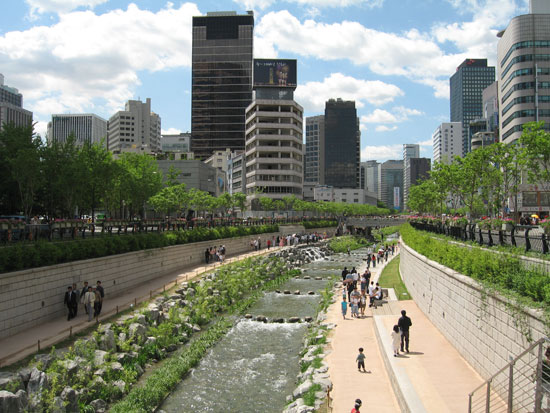
Images from the Rights of Way blog show the remnants of the original elevated expressway that orginal covered the river. Ironically, the mayor who originally spearheaded the elevated highway was the very same who pushed for the rehabilitation and restoration of the Cheonggyecheon River. So, in the end, it's a good thing that some politicians, in their search for approval, end up backing projects that actually improve quality of life.
Check out this pdf. hosted by cepis.org for more images and information.
Playing For Change
By now, most people have heard of the Playing For Change project. If not, check out the video or follow the links below and discover this shrewd, philanthropic, unifying approach to appreciating the world's buskers and their product: music!
Playing For Change - Mark Johnson, Founder
Be a part of the project -- go to:
Playing For Change Foundation - Whitney Kroenke Burditt, Executive Director
16.7.09
Chiyu Chen's Hybrid Bike System


Designer Chiyu Chen has conceived of an ingenious transit system that encourages the use of sustainable transportation by crediting people for renting and riding bicycles. His Hybrid2 system consists of a fleet of rentable bicycles that are capable of generating and storing kinetic energy, which is then used to power the city’s hybrid electric buses. Simply rent a bike, charge it up with kinetic energy from pedal power, and then return it to a kiosk – the station feeds energy into the city’s smart grid, and you receive a credit towards your next bus pass!
The answer to the climate crisis is going to come in myriad forms. This transit model, centering around bikes and buses, may be part of the solution. Consider it.
Find more info on the Hybrid2 Bike Rental System at inhabitat.com
Subscribe to:
Posts (Atom)