Showing posts with label innovation. Show all posts

29.9.11

Paulo Coelho: Follow a Wise Rabbit Down the Hole

Remarkably, the renowned Brazilian writer Paulo Coelho is a vocal proponent of the piracy of his own works.  Piracy has such a powerful connotation that "sharing" may be a more apt description.  Coelho's books have been translated by other writers and fans into myriad languages, and now they bounce around in digital form for anyone to enjoy.  Like most creators who share their work in this way, Coelho depends upon the premise that those who take pleasure in his writing will eventually buy hard copies.  And when this model of dissemination works, it really works.

Read on about the author's views on piracy and much more at paulocoelhoblog.com

Of course, I've read The Alchemist with its intoxicating, timeless narrative.  Like any great work, its simplicity and exoticism make it a classic fable.  For me, next on deck from Coelho must be The Pilgrimage, which follows his autobiographical journey on the famed Camino de Santiago de Compostela.

This one, O Livro dos Manuais, is a "practical guide for your life" according to the jacket, and I perused the work in it's entirety online, for free.  Although you should check it out in .pdf form, it'd be worth buying for the vibrant illustrations alone!  Que linda obra de verdade!

14.11.10

Emily Pilloton: On a Brand New (Design) Tack

It's exhilarating to discover someone whose work is making a real difference. This could be a giant like Muhammad Yunus, your fourth grade teacher, or someone like Emily Pilloton. Her work with Project H Design, the charitable organization she founded, "supports, inspires, and delivers product design initiatives for Humanity, Habitats, Health, and Happiness."

The initiatives and the sustainable ideals behind all aspects of this grassroots work are so admirable and will undoubtedly become a precedent for educational design -- fingers crossed that someone is watching and paying attention.


As the project gains steam, Pilloton and cohorts reap the rewards of higher-exposure which amplifies the project's core tenets:

1) There is no design without (critical) action.We are not a social club, nor do we host green drinks events. We do projects that exist in the real world, that have partners, impact, and results. We work as a team, rather than for individual glory.

2) We design WITH, not FOR.We work with partners, not for clients. We bring end users to the table from day one, making them fellow designers. We co-create with unexpected partners, and listen/learn first about social issues we may not fully understand.

3) We document, share, and measure.We record all work as a means to measure qualitatively and quantitatively, and ask for feedback as a means to constantly improve. Our designs are never "done." We share practices between project teams so that we never have to start from zero.

4) We start locally, and scale globally.Our projects are local responses to global problems, and are designed to serve as models for broader application. We look first to our own back yards, with the ultimate goal of scaling and improving products as systems that can work anywhere.

5) We design systems, not stuff.We create solutions and systems that are not driven by material or consumption. We "take the product out of product design" to question the traditional models, and design solutions that enable something greater than the object itself: enterprises, impact, etc.

6) We build.We get dirty. We tweak and prototype and test and bend. We know how to work in a woodshop, and how to weld, mill, and machine. We believe that knowing how things are built makes you a better designer, and that understanding the design process makes you a better builder. We make sure our ideas come to life.

This approach shouldn't be limited to design. Sensitivity to place and culture is something that's conspicuously lacking throughout our society, from the strip mall sprawl beyond the Beltway to the one-size-fits-all standardized tests we force upon anyone and everyone. Change is incremental, and Pilloton, with her team of innovators, is assuredly a leader to watch--and hopefully emulate--in the future.

Project H Design - the main thing on her plate
Inhabitat - a vast design site / Pilloton is managing editor
Dwell - an insightful interview by Alissa Walker
TED - read her profile / find other inspiring talks!

8.12.09

Copenhagen | Hopenhagen

The climate talks in Copenhagen: It's clearly an "all your eggs in one basket" kind of deal. However, it's better that the "eggs" ride along in any basket as opposed to being kicked around like golf balls "foot-wedged" from the rough. If we leave it up to lawmakers alone, though, we may end up scrambled anyway, but that's an entirely different discussion.

Admittedly, the Kyoto Protocol has served the world's governments as a framework within which they can build and implement environmentally conscious policies. What has been disturbing about all the lead up to the Copenhagen talks is that most new agencies and media figures have been repeating their skepticism at reaching any kind of binding climate agreement.

Even as the talks get underway, the media is poisoning the diplomatic dynamic, one that is inherently fragile and often emotionally charged, by continuing to convey only the doubts surrounding the summit. The media should report on the talks day-to-day, bringing the public a snapshot of a restricted, influential slice of the democratic process; leave conjecture to the think-tanks and just see what happens instead of jinxing the whole affair with negative projections.

As a media leader, The New York Times is doing the prescribed job at least: the organization is trying to present a multi-faceted look at Copenhagen while using Kyoto as a reference point (maybe the only one available). Check out the piece on the Kyoto Protocol's effect on carbon emissions and we begin to see from where the negative outlook for results in Copenhagen sprung forth. The interactive page-by-page diagram is particularly informative.

For the most part, the media has put a figurative "dark cloud" over Copenhagen where a literal cloud has already formed -- over there and over here and everywhere in between. My hope is that humanitarian vision and idealism will prevail over the practicalities of economic strength and profit trajectories as related to emissions legislation. Our leaders need to see that, in addition to supporting bottom-up, grassroots conservation efforts that keep local economies thriving and green, they need to put the U.S. in a political and economic position to lead by example and let that ecologically-minded position trickle down to developing world where the environmental battles can still be fought and won, as well.

We all have a responsibility to "quit smoking" fossil fuels, as we've learned to do so well since the Industrial Revolution, and begin sipping green energy to the benefit of the entire earthly system. Let's hope that those in Copenhagen can find a path through the concrete jungle of rhetoric and greed to a healthier planet for us all -- one where human rights, economic fortitude, and environmental impacts all still matter.

14.10.09

The Objects of Our Lives

I had been waiting for this film to be released on DVD and, thankfully, it did live up to all the hype and glowing reviews. It was guaranteed that the film would have a smooth, stylish yet highly informative flow based on Gary Hustwit's previous film on the ubiquitous font Helvetica. In terms of career continuity, Hustwit has again taken the viewer on a thought-provoking journey into good design and the reasons for it, this time via an examination of the objects we encounter and use daily.


One aspect of the film, however, did leave me wishing for a more thorough treatment and that was the discussion of sustainability regarding the life cycles of these quotidian objects. More than ever, a valid concern for consumers of these objects (that is to say, all the products we allow into our experience) is what we will do with them once they've worn out.

Certain designers and critics featured in Objectified did address this issue. Bill Moggridge, of the design firm IDEO, expressed his firm's interest in the addition of value through the repeated use of an object so that as the manufactured product ages and becomes "broken in", its value to the user increases either due to increased functionality (i.e. stiff leather hiking boots) or because of sentimentality (i.e. an antique fountain pen used to compose a love letter).

Overall, the film was engaging and enlightening, even if you have only a cursory interest in design. It's a good time to try to spot the products that have crossed your path over the years and also to see whether you agree or disagree with the considerations and justifications behind their design.

Find out more at the film's official website:
Objectifed ~ a documentary film by Gary Hustwit

21.7.09

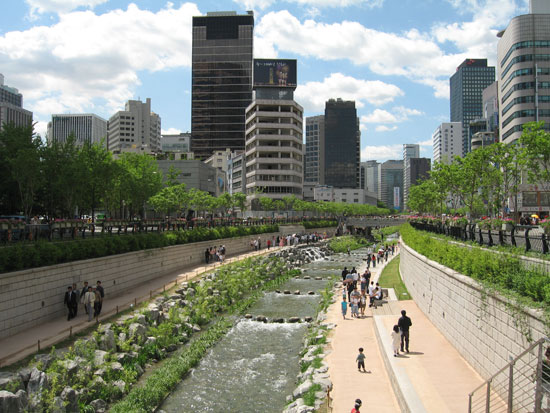
Cheonggyecheon - The Heart of Seoul's Green Rehabilitation

After learning about this ambitious project on the PBS documentary design series " e2 " I sought out some more information. The endeavor had its critics but there can be no argument: the city of Seoul is far better off for having agreed to this expensive but worthwhile renovation of an urban eyesore into a cosmopolitan, "green" jewel.

A decent overview of the Cheonggyecheon River Restoration project from Spacing Toronto will help to see all the phases from the demolition of the expressway to the finishing of the promenade that has become the heart of Seoul's social life.

Images from the Rights of Way blog show the remnants of the original elevated expressway that orginal covered the river. Ironically, the mayor who originally spearheaded the elevated highway was the very same who pushed for the rehabilitation and restoration of the Cheonggyecheon River. So, in the end, it's a good thing that some politicians, in their search for approval, end up backing projects that actually improve quality of life.

Check out this pdf. hosted by cepis.org for more images and information.

16.7.09

Only in New York...but why?

The recent opening of NYC's newest greenspace, the Highline Urban Park, which sits atop an abandoned, elevated rail line, is an exemplary rehabilitation of derelict industrial infrastructure and, in my opinion, represents the new standard for reuse in an urban setting. The fact that the space occupies square footage above the conventional, street-level plane is yet another reason this project is so remarkable.

The mission and its concept are reported thoroughly at the leading sustainable design site inhabitat.com, so that's the place to see the Highline Urban Park project from all the nicest angles.

For those who want it and want it now, check out the video below to give a glimpse of what cities with a more modest profile (and even small towns) should be striving for in the coming years and decades.


Just because NYC is a mecca for creativity and innovation (or maybe it's the art of hype that makes New Yorkers the real pros), it absolutely does not mean that other places, tiny and not so, shouldn't be looking to do them one better. With or without a well-known architectural firm attached to the project, this example of inventive and considerate renovation could happen anywhere, not only in New York!

Our entire nation is littered with sites (literally) such as the Highline that, amidst weeds and broken bottles, are all but crying out to be transformed into gorgeous, open green space where people can feel human again whilst the vegetation thrives.

What real, sustainable, environmentally conscious urban planning requires is an ambitious, motivated, vocal citizenry to demand thoughtful progress, not in terms of economics or profit, but simply in terms of quality of life.

30.6.09

To Shed Light...

In my opinion, a good idea deserves to be spread around.

A group of three designers, jointly know as the Civil Twilight Collective , has recently been recognized on NPR.org as the winner of Metropolis Magazine’s Next Generation Design Competition for an innovative adaptation to conventional streetlighting. The lunar-resonant streetlight intelligently adjusts brightness in correspondence with the phases of the moon and in doing so would stand to save significant amounts of energy, energy that currently dissipates into the night illuminating very little that the moon (in its brighter phases) is not already.

The inspiration for such a creative approach to outdoor, public lighting is little more than common sense, but by the same token, if it's such an obvious idea, then why had no one thought of it previously? The point may be that by adopting an ecologically "smart" system such as lunar-resonant streetlights , no corporation, no entities besides the manufacturer and
the designers stand to gain anything from its implementation.


This is where the currently snowballing shift from antiquated, greed-driven, profit-making ventures to sustainable, earth and human-friendly, social business models amasses some serious speed. With no material "wants" to calculate on behalf of its creators, lunar-resonant streetlights (like most socially beneficial inventions) simply cover the needs of their beneficiaries which is to brighten the night while conserving energy resources and also perceptibly reducing light pollution in urban centers.


Other intriguing projects by the Civil Twilight Collective:

Origami Kayak
Mycofarmhouse