21.12.09

Humming a Different Tune

While it may be new compared to the song of Kyoto, the new Copenhagen Accord on climate change regulation may not be exactly the kind of progress we needed, but at the least it sounds like a secondary step in a positive direction.

Sunday's New York Times editorial sums it up and at once highlights just what I thought was wrong with the media's treatment of the conference and its goals despite the intense preparations made by participating factions:

The global climate negotiations in Copenhagen produced neither a grand success nor the complete meltdown that seemed almost certain as late as Friday afternoon. Despite two years of advance work, the meeting failed to convert a rare gathering of world leaders into an ambitious, legally binding action plan for reducing greenhouse gas emissions. It produced instead a softer interim accord that, at least in principle, would curb greenhouses gases, provide ways to verify countries’ emissions, save rain forests, shield vulnerable nations from the impacts of climate change, and share the costs.

Now, after the fact, it seems fine to pin a good deal of the credit on Mr. Obama and his eleventh hour efforts to save the disintegrating negotiations from failure. This new accord may be a save of sorts, but the article overstates the case that our man in Washington was the main catalyst.

President Obama deserves much of the credit. He arrived as the talks were collapsing, spent 13 hours in nonstop negotiations and played hardball with the Chinese. With time running out — and with the help of China, India, Brazil and South Africa — he forged an agreement that all but a handful of the 193 nations on hand accepted.

Nonetheless, the heavy-hitters (or more aptly named, "heavy smokers") are now further obligated to make significant changes in climate regulation in their home countries, although I won't qualify the U.S. target of 17% reduction by 2020 as any kind of glorious illustration of leading by example. At the very least, we and all the rest of the most noxious emitters are dancing to the same tune for now, and it seems that the world's leaders can agree that this climate cycle is, for the most part, man-made and should thus be addressed and ameliorated by the same guilty party.

So, even after months of negativity and doubt, there is an accord, with real emissions targets on the horizon, to which governments and corporations must adhere. This should be the christening needed to send a new, greener ship on an inter-continental voyage to sweep fossil fuels, hopefully along with last century's other environmental ills, right out the back door like so much useless grit.

14.12.09

Produce: Labor's Fruits

As I paused to let a garbage truck turn clumsily in front of me, I caught the a scent-memory of photo fixer in my nose and it slipped me back years in time, back into the darkroom on a day reminiscent of this misty, muggy day. I'd spend hours with that familiar smell wafting into my head, my mind transfixed on images and processes and exposure times and light. By the end of such a day, I'd have a stack of dried down prints to marvel at, nitpick over, and sometimes actually enjoy. But the day had sure enough satisfyingly slithered away from me like a venomless snake through leaf litter.

Now, the days slip by but I've little concrete to show for those days of long work. My eyes become a filter and what does not belong deserves mention, a discussion, a suggestion, a lesson. The students glean something from every session, but in the end what exactly that is eludes measure.

What scent will trigger these days? Will this be a fond recollection of good work and satisfaction? My wish is only this.

8.12.09

Copenhagen | Hopenhagen

The climate talks in Copenhagen: It's clearly an "all your eggs in one basket" kind of deal. However, it's better that the "eggs" ride along in any basket as opposed to being kicked around like golf balls "foot-wedged" from the rough. If we leave it up to lawmakers alone, though, we may end up scrambled anyway, but that's an entirely different discussion.

Admittedly, the Kyoto Protocol has served the world's governments as a framework within which they can build and implement environmentally conscious policies. What has been disturbing about all the lead up to the Copenhagen talks is that most new agencies and media figures have been repeating their skepticism at reaching any kind of binding climate agreement.

Even as the talks get underway, the media is poisoning the diplomatic dynamic, one that is inherently fragile and often emotionally charged, by continuing to convey only the doubts surrounding the summit. The media should report on the talks day-to-day, bringing the public a snapshot of a restricted, influential slice of the democratic process; leave conjecture to the think-tanks and just see what happens instead of jinxing the whole affair with negative projections.

As a media leader, The New York Times is doing the prescribed job at least: the organization is trying to present a multi-faceted look at Copenhagen while using Kyoto as a reference point (maybe the only one available). Check out the piece on the Kyoto Protocol's effect on carbon emissions and we begin to see from where the negative outlook for results in Copenhagen sprung forth. The interactive page-by-page diagram is particularly informative.

For the most part, the media has put a figurative "dark cloud" over Copenhagen where a literal cloud has already formed -- over there and over here and everywhere in between. My hope is that humanitarian vision and idealism will prevail over the practicalities of economic strength and profit trajectories as related to emissions legislation. Our leaders need to see that, in addition to supporting bottom-up, grassroots conservation efforts that keep local economies thriving and green, they need to put the U.S. in a political and economic position to lead by example and let that ecologically-minded position trickle down to developing world where the environmental battles can still be fought and won, as well.

We all have a responsibility to "quit smoking" fossil fuels, as we've learned to do so well since the Industrial Revolution, and begin sipping green energy to the benefit of the entire earthly system. Let's hope that those in Copenhagen can find a path through the concrete jungle of rhetoric and greed to a healthier planet for us all -- one where human rights, economic fortitude, and environmental impacts all still matter.

24.11.09

Friday Night in San Francisco

Of all the great vinyl that I listened to as a kid, this album was the epitome of that crackly, hissy but markedly vibrant set of experiences.

By now, the cover art and the font here seem trite and dated, but the music captured on this inspirational night in 1981 is by the far the highest level acoustic performance I've yet heard recorded. Each player comes through on his individual channel with John McLaughlin playing from the center.

Sure, there are probably a handful of classical guitarists out there who could top the technical skills of any of these three men; however, I'm confident that never before had three towering talents all converged for one evening at the vortex of style, technique and passion, leaving the crowd in wild ecstasy while leaving behind a record of rhythmic and melodic nonpareil. These guys were flamenco/classical rockstars at the time and it's easy to discern the source of their legend as you listen to each serendipitous mounting of theme and improvisation, each phrase that seems to threaten to take the whole ensemble irrevocably over some precipice of control and reason. The result is a tension-filled frenzy of fingers and breath and chills that leaves the listener enraptured and jealous of the audience on that inspired night in San Francisco.

Check out Walter Kolosky's article about this historic recording at AllAboutJazz.com

9.11.09

Photography: Roy DeCarava

Other Roy DeCarava links of interest:

NPR blog picture show - nice overview of images

NY Times blog - good series of photos
LA Times obituary - died at age 89

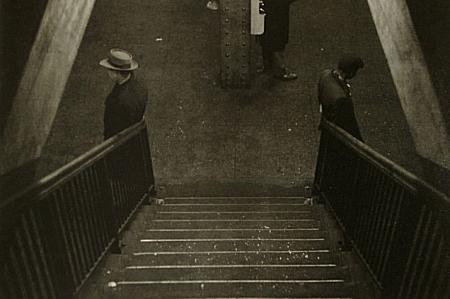
The National Public Radio story following the death of photographer Roy DeCarava does a fine job with the biography of the relatively unknown artist. Just a glance at a very few images, though, gives one the notion that he had an unrivaled power of observation and immpecable timing to capture the essence of African-American life in the mid-20th century.


photo courtesy of www.dpgr.gr
DeCarava's subject matter was what he found around his home, the people in the streets or on buses and trains, and with his remarkably keen eye, he was able to capture certain fleeting but very telling moments that most of us would never even notice. A fine example of his astute observational skill comes in the form of this famous image of a subway platform, one in which race plays a central role but is emphasized by space rather than color.


photo courtesy of web.ncf.ca

DeCarava's photographs of jazz legends are some of the finest in the genre. There were others who sidled up to the likes of Duke Ellington and Thelonius Monk, but Roy DeCarava's shots genuinely seem to evoke sound, smoke, heat and excitement, the kind found right there at the foot of the stage (Decarava's Coltrane photo courtesy of arteseanp.blogspot.com).
Whether historically accurate or not, my inclination is to put DeCarava in an elite category with another lover of the street, the patriarch of spontaneity in photography, Cartier-Bresson. And Gordon Parks, that renaissance man of visual, sonic, and written language, is also of DeCarava's era and the two have complimentary styles which are worthy of comparison.

29.10.09

Odilon Redon


The Buddha (1905) ~ Bertrand-Jean (Odilon) Redon

image courtesy of artinthepicture.com

This image is one of my favorite oil paintings from any time period. I'm not sure why I enjoy it so much, but I think it's something in the way the objects and figures seem to float on top of the lush backgrounds, appearing separate from the landscape but not completely detached.

The effect is surrealist, in a sense, but Redon's subject matter, mostly still-lifes with plenty of natural themes, lends a calming tone to the work overall. The fact that the French artist was a skilled printmaker draws me in further. There is much more to discover about this underrated master.

This vision of the Buddha with the Bodhi Tree is one that appears in a few of Redon's paintings and I appreciate the Buddhist mythology, the serenity of the classic pose, as well as the vibrant but earthy color palette.

For more exquisite paintings by Redon, visit Odilon-Redon.org. Another site, OdilonRedon.net, can provide some more detailed biographical info.

21.10.09

Wave Action

The scientific principle behind these videos captured my attention as I was exploring the Objectified blog (a recent documentary film by Gary Hustwit). The images do a far better job expressing the wave phenomenon than I ever could.

Enjoy...but before you do, turn down the volume because the frequencies used to create these patterns are somewhat obnoxious!


This next one is a cool, practical application for the same resonant effect.


14.10.09

The Blog's Odd Name...

As has become the tradition in this space, it's time for a new name. Again, I've selected one of many classic Latin phrases with an aim to find a message that is emblematic of my goals here.

This go 'round with the name 'nosce te ipsum' (roughly meaning "know thyself") has been a good cycle for the blog and I've seen readership increase little by little which, I'll egotistically admit, has been gratifying. So, my thanks go out to those who've frequented the spot and I hope that you've enjoyed the content. I'll keep it coming ... just for y'all!

For this next cycle, I've chosen the phrase 'audi alteram partem' as a thank you and a challenge to those of you who are visiting. It means "to hear the other side" and that is exactly what I am hoping will happen. Please, if you find something of interest and you have something to say, write a comment and I know it will add to the depth and diversity of the perspectives presented here.

Thanks again for your interest and for your future thoughts & sentiments.

The Objects of Our Lives

I had been waiting for this film to be released on DVD and, thankfully, it did live up to all the hype and glowing reviews. It was guaranteed that the film would have a smooth, stylish yet highly informative flow based on Gary Hustwit's previous film on the ubiquitous font Helvetica. In terms of career continuity, Hustwit has again taken the viewer on a thought-provoking journey into good design and the reasons for it, this time via an examination of the objects we encounter and use daily.


One aspect of the film, however, did leave me wishing for a more thorough treatment and that was the discussion of sustainability regarding the life cycles of these quotidian objects. More than ever, a valid concern for consumers of these objects (that is to say, all the products we allow into our experience) is what we will do with them once they've worn out.

Certain designers and critics featured in Objectified did address this issue. Bill Moggridge, of the design firm IDEO, expressed his firm's interest in the addition of value through the repeated use of an object so that as the manufactured product ages and becomes "broken in", its value to the user increases either due to increased functionality (i.e. stiff leather hiking boots) or because of sentimentality (i.e. an antique fountain pen used to compose a love letter).

Overall, the film was engaging and enlightening, even if you have only a cursory interest in design. It's a good time to try to spot the products that have crossed your path over the years and also to see whether you agree or disagree with the considerations and justifications behind their design.

Find out more at the film's official website:
Objectifed ~ a documentary film by Gary Hustwit

12.10.09

One Slick Compound

Yesterday I finally got around to applying an aquaphobic coating to my windshield (let's call it Rain "Y" for trademark purposes). The timing, as it turns out, was excellent; the rain poured down starting at about midnight last night and it is forecasted to continue steadily throughout the week.

Normally, I wouldn't be lauding a chemical product so enthusiatically, but I found that the transparent but greasy stuff worked amazingly well. This morning's drive to work, one that could have been anywhere from somewhat frustrating to downright perilous, was instead typical as ever thanks to my crystalline perspective.

The heavy rain drops beaded, gathered together, and at highway speeds made their way up the windscreen and over the top of the car with haste. In the diffused light of mid-morning, the droplets of water sparkled into my eyes as they moved swiftly across my field of vision, like little mercury marbles racing up the glass. If I focused too long on the sheeting action, sucddenly the rain seemed not to fall but to rise up in waves as though gravity had been locally and momentarily inverted.

Had I not been operating a vehicle, I would have been mesmerized by the flow of the shimmering spheres, letting them lull me into a drizzly trance. As it was, I arrived at work and found myself oddly appreciative of Minnesotan chemical engineers and myriad factory workers I'd never even met.

8.10.09

A Wardrobe in Need of Bolstering

It's a luxurious thing to think that we should be covering ourselves in new, and more importantly, unique ensembles of textiles every day. It is maybe a purely Western thing that has consequently seeped in reverse, against the stream of emigration, back to even developing countries where the notion is all the more absurd. In my case, the fundamental problem is a tad lighter: I keep wearing the same damn clothes over and over and I always have. What's worse is that I have pictures, decades worth, that indisputably prove this fact.

If you went to public school in the U.S. you may recall picture day. For some kids, it was a day to shine in fine outfits, those normally reserved for church or holidays. My mom also did her best to send me to school looking decent that day. The on-going problem presented itself not on picture day but on the day when the prints were delivered.

It was a much anticipated moment; "Did I blink? Where there boogers? Was my hair sticking up?". These and other childlike doubts ran amuck as the overpriced prints were handed out. The photos inevitably came out fine, and my mother would be satisfied for that school year. The most embarrassing issue, though, was the fact that as I slid the prints out of the envelope, I would almost always be wearing on that day the very same clothing I had been wearing when the images were made.

I guess it was not enough to worry about during the first couple of coincidental "mirror image" moments. Other kids would notice (if I allowed the coincidence to be picked up) and before true, hormone-induced self-consciousness had set in, I wasn't all that perturbed. However, as grade school turned to junior high, high school, college and the official picture-taking opportunities grew, I noticed that what was once an infrequent happenstance had become a distinct trend.

Literally every time I had a picture taken, the image would reflect my attire at that moment and in future. So, as it turned out, my identifying documents then had an unmatched representative realism. If I were pulled over for speeding, I'm not sure if the officer would notice, but I'd be wearing the same striped shirt as on my driver's license. It was the same instance with my passport; I'd come to a customs official in an airport, and there I was, just as I appeared in the photograph.

I suppose it's remarkable that I'd have this innate, inadvertent skill of choosing the exact ensemble to represent myself in images as I would in person. After all, I stood in person to be photographed, right? It's almost as though I'd established a personal uniform, like we all do, but maybe this trend should alert me that my uniform has become just a little too uniform.

4.10.09

Blooms

Sitting here with a vase full of lilies. Orange ones, a few cut tall. When I brought them home there were three blooms open. Several others remained tightly shut like the part of a screw driver that bites the bit from three sides.

Now, seven flowers have spread out wide, pistils loaded with rusty pollen. One has gone as far as shedding all its petals, foregoing wilt, nature giving up under a spiraling force of gravity. What once flourished in glory and fullness is now a stalk of a stamen without protection. Its brothers and sisters still lean and reach for the light. In this inside air, there's not a chance that the pollen will ever find its target. Their attitude, nonetheless, is inate, if futile.

The first blooms suffer the effortless throws of entropy. Late blooms stand firm, as if inviting the world to embrace, petals outstretched like estranged friends approaching a happy reunion. But the artificial scenario is inescapable. The end will be in decay, maybe with a pungent smell, maybe not. Natural beauty, faint hints of honey and lightness and suppleness, becomes wrinkled, a withered pile of shriveled arms and hands. Still honor and memory balance in the air, as though the thought of the bloom alone were enough to yield a smile.

1.10.09

Chiasmus for the Rest of Us

As a Libra, and in keeping with the current blog title about introspection and self-knowledge, it's time to delve into a little literary device called chiasmus. Why? Just for fun...and because it's a rhetorical technique that is still used often even though it's ancient in origin. Even connections to Christ on the cross have been made to the format of chiasmus, so it carries its weight.

Any dictionary will tell you that chiasmus comes from the Greek "χιάζω or chiázō" which means "in the shape of the letter X". According to Wikipedia.org the device is used in speech and in prose to achieve a kind of parallelism of thoughts and to establish a sense of balance (hence my zodiacal connection).

My own introduction to chiasmus came from its more recent, but still historical usage, in African American literature of the 19th and early 20th centuries. I've never quite been able to devise any decent 'chiasmi' of my own, so I'll borrow from the masters to illustrate its power and eloquence when employed correctly and efficiently.

Here we go with a some examples I enjoyed from the wikipost:

"Mankind must put an end to war or war will put an end to mankind." John F. Kennedy

"You have seen how a man was made a slave; you shall see how a slave was made a man." Frederick Douglass

"I’d rather have a bottle in front of me than a frontal lobotomy." Tom Waits

"Well, it's not the men in your life that counts, it's the life in your men." Mae West

"In peace sons bury their fathers, but in war fathers bury their sons." Croesus

This last is partuicularly appropriate for our times. Chiasmus can be succinct or befuddling. Sometimes the phrase's meaning jumps off the page and other times it requires some turning over in the mind. In more contemporary uses, like the Tom Waits quote, quirkiness and humor are what make the chiasmus form ring so truthfully.

Our President is a fan -- I've heard him use chiasmus more than once in speeches on the campaign trail -- but then again so are folks like Regis Philbin and your next door neighbor, probably when he's trying to sound wise from over the fence.

So, I declare, chiasmus for them and chiasmus for the rest of us!


30.9.09

Selected Prints

For anyone interested in printmaking, from lithographs and mezzotints to intaglio and drypoints, here is a sample of some incredible work all found at the Davidson Galleries Contemporary Print & Drawing Center. I was floored by the sheer volume and quality of work in this immense collection out of Seattle, WA. Enjoy this sampling, but definitely visit the site itself and explore for yourself.

Lotta Pyykkönen ~ There was no bio available at Davidson Galleries, but I'm guessing this artist is Finnish. Immediately, I notice a parallel to the austere Scandinavian landscapes of Gunnar Norrman previously featured on this blog.


Peter Milton ~ Back in school, a printmaking instructor alerted me to Peter Milton's work and, based on the size and pricing of his work, he may be one of the most prolific and profitable artists currently working the medium. His intaglio almost certainly involves photographic techniques judging from the level of layering in the highly detailed compositions. The following is the bio offered by Davidson Galleries:
Peter Milton is a major force in the printmaking world. Using etching and engraving techniques, Milton often spends a year or more to create his large and complex images. At Yale University under Josef Albers, Milton developed a concern less for the surface appearance of objects, but rather for the explication of their underlying, substantive qualities. Milton conveys meaning through a contextual environment of people, places, and moments in time.

Milton’s imagery frequently draws on elements from the late 19th and early 20th century English and French literary world. Rendering such imagery in a rich tonal scale of black and whites, Milton manages not only capture the mood of another era but also mid-century cinema. He cites among his major influences Ingmar Bergman and Fellini. With time and reflection, a narrative in Milton’s densely symbolic and historically referential images unfolds. Milton has received numerous awards for his prints, has a published book titled Peter Milton: Complete Prints 1960-1996, and is in every major museum collection.

Ben Moreau ~ Again, Davidson provided no biographical info on Moreau. His work, with its comic book/superhero humor, speaks for itself though.


Robert Marx ~ This artist's work very much reminded me of Ralph Steadman's loopy, sketchy style that he used in illustrations for his collaborations with the late Hunter S. Thompson. See the bio provided by Davidson Galleries below:
Robert Marx is part of a small group of important American figurative artists who comment on what it means to be human in an inhuman age. A kindred spirit with such great but often overlooked social protest artists like Leonard Baskin and Leon Golub, Marx's work speaks only to those who wish to be challenged by an artist's idea --those who seek an intense and enduring dialogue with works of art. One of America's most important exponents of the north European expressionist tradition that goes back to Bosch, Grünewald, and Bruegel, Marx's work explores the futility of trying to bring universal order or give conclusive meaning to the human condition.


Shigeki Tomura ~ Again, there are echoes of Gunnar Norrman in terms of the vastness of the landscapes but with a more classical sensibility. Glean more insight from the Davidson Galleries bio below:

The fine, intimate scale drypoints and etchings by Japanese print artist Shigeki Tomura offer spaces of quiet contemplation, where the viewer has an opportunity to pause and reflect.These serene rural landscapes depict a natural world untrammeled by human development; we find only oblique acknowledgement of a human prescence - a pathway or a thatched roof. Tomura’s imagery conveys a stillness in time, but in this quietude, there is a lightness and an implied sense of soft movement - the rustling of wind in the trees, the whisper of thawing snow, or the first drops of rain on leaves. The artist reminds us to recognize and appreciate these poetic moments in the normal context of our lives. Tomura was born in 1951 in Aomori Prefecture, Japan.He studied drawing and printmaking at the IWATE University from 1970 - 1976.Tomura has exhbited in many international print competitions and has earned many rewards for printmaking, including the prestigious Medal of Honor at the Small Graphic Forms Exhibition in Lodz, Poland.This is the first exhibition of his work at the Davidson Galleries Contemporary Prints and Drawing Center since 2000.


Mikio Watanabe ~ See the bio below provided by Davidson Galleries:
Mezzotint artist Mikio Watanabe was born in 1954 in Japan and currently lives in France. He is most known for his elegant, evocative black and white nudes. In these images the artist alternates between full figures and the sensuous ambiguity of closer cropped body parts. The female figure emerges out of the rich, velvety black shadows. Watanabe skillfully manipulates the subtle gradations of gray that are available in a mezzotint with careful burnishing and scraping of the plate. More recently Watanabe has added flora and fauna subjects, using multiple plates for the color. These new works have the same quality of grace and delicacy found in his nudes, but are playful in spirit.
This is Watanabe’s first solo exhibition at Davidson Galleries. His works are part of the permanent collections of the Bibliotheque National in Paris, the Central Academy of Art in Kuala Lumpur and the New Orleans Museum of Art.

Michael Barnes ~ I don't think these figures (more like creatures) are supposed to be humorous, but for me, there's a playful element to them. The cornbelt must hold some mysterious inspiration for Professor Barnes. See bio below:
Michael Barnes, Illinois, studied printmaking at the University of Iowa and is now Associate Professor, Head of Printmaking at Northern Illinois University. His lithographs are from his most recent series featuring strange hybrid creatures he calls The New Breed. This series addresses the human desire to control and possess.